








SFC expands solid-waste platform with 1,000 TPD CBG plan

Find your next multibaggerBe a Pro Investor
Research stocks and track your picks on the go. Download the app.
Key highlights
- SFC's Mumbai MSW-based CBG joint venture is expandable to 1,000 TPD.
- SFC received 2025 CBG EPC awards for 125 TPD in Assam and 300 TPD in Odisha.
- SFC states a biogas yield of 150 Nm³ per tonne versus an 80 to 100 Nm³ industry-average range.
- SFC cites an Indian CBG market estimate of Rs 1,45,750 crore by FY31E, up from Rs 9,350 crore in FY26.
powered by IRIS
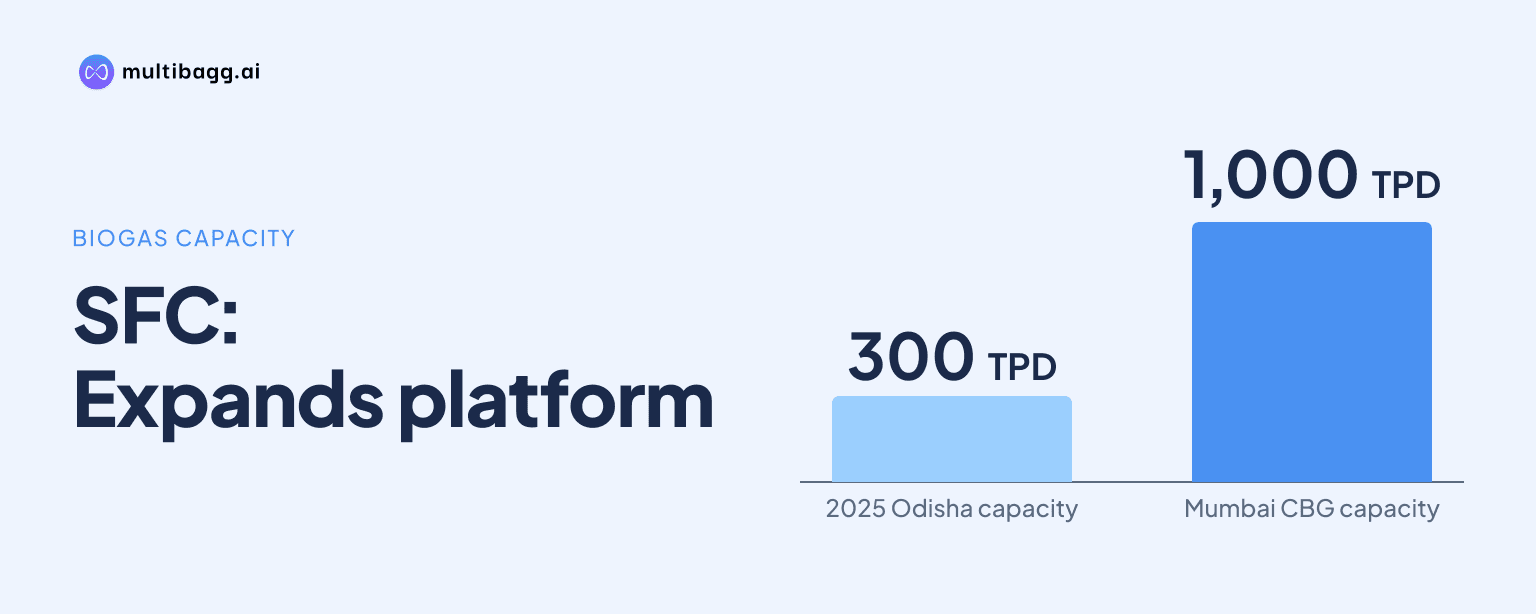
SFC Environmental Technologies Ltd. is expanding its solid-waste treatment platform through a municipal solid-waste compressed-biogas joint venture in Mumbai expandable to 1,000 tonnes per day, alongside 125 tonnes-per-day Assam and 300 tonnes-per-day Odisha engineering, procurement and construction awards in 2025. The presentation also identifies North Goa and South Goa plants without capacity or operating-term details.
Know SFC Environmental Technologies inside out
Results, valuation, peers and who's buying, in one view.
What solid-waste projects does SFC disclose?
SFC discloses North Goa Plant and South Goa Plant as part of its solid-waste treatment portfolio, but the presentation does not state their throughput, commissioning dates, ownership structure or concession tenure. This prevents a like-for-like comparison of the Goa facilities with the engineering, procurement and construction, or EPC, awards from 2014, 2020 and 2025 that carry stated tonnes-per-day capacity.
SFC also says it is a joint-venture partner for a municipal solid waste, or MSW, based compressed biogas, or CBG, plant in Mumbai expandable to 1,000 tonnes per day, or TPD. Its disclosed project pipeline also includes joint ventures with an Indian city gas distribution, or CGD, company and an oil-and-gas company for CBG and waste-to-energy, or WtE, plants, plus a memorandum of understanding with an Indian oil-and-gas conglomerate for an MSW plant.
The Mumbai venture is the largest individual project capacity figure in the presentation at 1,000 TPD, although SFC does not disclose its current operating capacity, capital investment, ownership share, commissioning date or offtake arrangement. The document also does not say whether the stated expansion capacity is a single plant’s feedstock-processing capacity or a project-wide capacity.
How has SFC's disclosed CBG EPC capacity changed?
SFC's disclosed public-sector oil marketing company, or OMC, EPC awards moved from 300 TPD in 2014 to 125 TPD in 2020 and 425 TPD in 2025. The 2014 projects were awarded as 250 TPD plus 50 TPD and are described by SFC as among India’s longest-operating plants, while the 2025 awards identify Assam and Odisha as their locations.
The 2025 awards comprise a 125 TPD plant in Assam and a 300 TPD plant in Odisha, making their combined scale 125 TPD greater than the 2014 awards and 300 TPD greater than the 2020 awards. SFC does not disclose completion dates for the 2025 projects or clarify whether each TPD measure refers to MSW input, CBG output or separate processing modules.
The stated award sequence therefore shows project sizes rather than a reported operating-capacity total. The presentation identifies the 2014 plants as operating for a longer period, but does not state whether the 2020 or 2025 EPC awards have been commissioned, remain under execution or have generated revenue.
Which oil-company relationships has SFC announced?
SFC says Oil India Ltd., Oil and Natural Gas Corporation, or ONGC, and Indraprastha Gas Ltd. each gave in-principle approval for a joint venture with an SFC subsidiary. The presentation separately notes that SFC formed a joint-venture entity with a subsidiary of Oil India Ltd. on October 13, 2026, a disclosed step beyond an in-principle approval.
The document lists Hindustan Petroleum Corporation Ltd., or HPCL, as planning to offer a delivered price to procure CBG. Indian Oil Corporation Ltd. and Essar Oil are described as planning to procure CBG from entrepreneurs, while Mahanagar Gas Ltd. is listed as planning to set up CBG plants.
These disclosures distinguish SFC’s announced collaborative links from confirmed commercial economics. The presentation provides no contract value, equity contribution, CBG offtake volume, commissioning deadline or expected revenue for the Oil India, ONGC, Indraprastha Gas, HPCL, Indian Oil, Essar Oil or Mahanagar Gas relationships.
Got a follow-up? Ask IRIS
How does SFC turn mixed waste into saleable outputs?
SFC uses OREX, or Organic Extraction Technology, to separate mixed waste into wet organic and dry inorganic streams before biomethanation and waste recovery. SFC says the automated multi-stage system results in waste containing more than 98% biodegradable material, a process designed to reduce digester challenges and enhance biogas-production efficiency for Indian MSW.
SFC states that its biomethanation solution yields 150 normal cubic metres, or Nm³, of biogas per tonne, compared with an industry-average range of 80 to 100 Nm³ per tonne cited in the presentation. That comparison indicates a stated incremental yield of 50 to 70 Nm³ per tonne versus the cited range, although SFC does not disclose operating data from a specific plant.
The wet-waste stream can generate biogas or CBG, organic compost, electricity and recirculation water, according to SFC. The dry-waste stream can produce refuse-derived fuel, or RDF, recyclables, polyethylene terephthalate flakes and electricity, creating revenue streams from project execution, energy sales, recyclable materials, compost, operation and maintenance services, and tipping fees.
SFC says its high-calorific RDF can be used as fuel and that a higher recyclable proportion and better compost marketability can affect price realisation. However, it does not provide segment revenue, operating margin, realised biogas prices, recyclable-material prices, compost prices or tipping-fee rates for its solid-waste operations.
What market and policy backdrop does SFC identify?
SFC cites an estimated Indian CBG market increase from Rs 9,350 crore in FY26 to Rs 1,45,750 crore in FY31E, representing a stated compound annual growth rate of 73%. This is an external market estimate presented by SFC, rather than company guidance, and the document does not estimate the market share available to SFC’s current plants or proposed joint ventures.
The presentation links this outlook to the CBG blending obligation, under which OMCs are to blend 1% CBG by FY26 and 5% by FY29. It also cites mandated CBG blending in CGD pipelines from FY26, financial incentives and subsidies under the Gobardhan Scheme, and a Rs 1,700 crore National Bio Energy Programme budget to promote biogas and pellet production.
India generated 59.2 million tonnes per annum, or MTPA, of waste in the cited data, of which 48.1 MTPA was treated, leaving treatment at 82%. SFC cites projected waste generation of 165 MTPA by 2030 and FY31E MSW revenue potential of Rs 32,920 crore from CBG, recyclables, electricity and compost, assuming 195,500 TPD of MSW generation.
Conclusion
SFC’s disclosed solid-waste expansion combines OREX-based waste separation, public-sector OMC EPC awards and collaboration-led CBG and WtE projects. The 1,000 TPD expandable Mumbai CBG joint venture is the largest stated individual capacity, while the 2025 Assam and Odisha awards total 425 TPD and follow 300 TPD of awards in 2014 and 125 TPD in 2020.
The next disclosed developments to watch are progress on the 125 TPD Assam and 300 TPD Odisha awards, and whether the Mumbai venture advances towards its 1,000 TPD expansion potential. SFC has not disclosed capacity, operating status or concession terms for the North Goa and South Goa plants, leaving those matters unresolved in the presentation.

