










Shadowfax Technologies Limited says speed earns 15%-20% premium
Key highlights
- Shadowfax said same-day delivery earns 15% to 20% higher realization on the same network.
- Shadowfax's D2C business more than doubled year on year and its market share rose above 14% in Q2 FY27.
- Shadowfax reported Q2 FY27 revenue of Rs 1,538 crore, up 57% year on year, and adjusted EBITDA of Rs 77 crore.
- Shadowfax 360 exceeded 6,700 sellers within 200 days of launch, with two-thirds joining without sales effort.
powered by IRIS
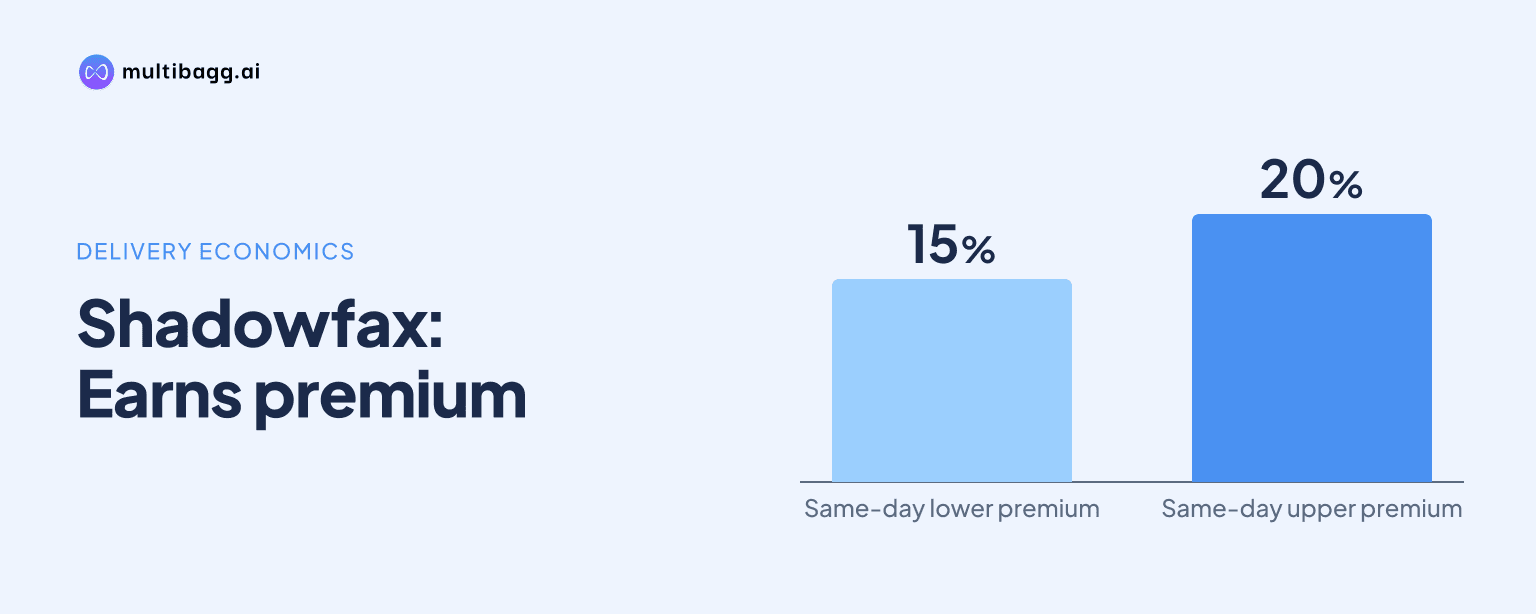
Shadowfax Technologies Limited said in Q2 FY27 that same-day delivery generated 15% to 20% higher realization on the same network, while its direct-to-consumer, or D2C, business more than doubled year on year. The company also said D2C market share rose 2 percentage points quarter on quarter to above 14%.
Know Shadowfax Technologies inside out
Results, valuation, peers and who's buying, in one view.
Why does Shadowfax charge more for same-day delivery?
Shadowfax says same-day delivery earns a 15% to 20% higher realization because sellers competing on delivery dates value speed differently from large marketplaces focused on logistics cost. Management said the premium is earned on the same network, rather than through a separate delivery network or stated service-area surcharge.
The company provides the service through Prime, its same-day and next-day delivery offering for e-commerce customers. Shadowfax said it is the only third-party logistics network at national scale offering same-day and next-day delivery across more than 120 cities. Prime revenue grew 36% quarter on quarter in Q2 FY27 within the Express Parcel segment.
Management linked the pricing to sellers' ability to offer a delivery promise comparable with marketplace-fulfilled orders. A fast delivery date historically depended on inventory held in a marketplace's own warehouse, while sellers shipping from their own shelves could not generally provide the same service level, according to Shadowfax.
How is Shadowfax extending fast delivery to small sellers?
Shadowfax said it began in Q2 FY27 to collect goods from a small seller's own location and deliver them the same day or next day through marketplaces. The company said a seller in Delhi can now show the same delivery date as a marketplace-fulfilled order without first placing stock in a marketplace warehouse.
The arrangement removes the need, as described by management, for smaller sellers to pre-position inventory, pay for storage or give up control of their stock to offer faster delivery. Shadowfax did not disclose how many sellers had adopted this pickup-and-delivery capability during Q2 FY27.
Shadowfax 360, the company's self-service platform for smaller sellers, had more than 6,700 sellers placing orders within 200 days of launch. Management said two-thirds of these sellers joined without sales effort. About 30% of incoming leads on Shadowfax 360 were seeking Hyperlocal delivery, showing demand for rapid delivery beyond conventional parcel shipping.
How fast is Shadowfax growing in D2C and small sellers?
Shadowfax said its D2C business more than doubled year on year in Q2 FY27, while its D2C market share increased by 2 percentage points from Q1 FY27 to above 14%. The company also said it served twice as many brands as it did one year earlier.
Management said wallet share across its largest D2C customers had doubled from a year earlier. Customers outside Shadowfax's top 10 were its fastest-growing group and paid higher realization, according to management. That customer mix supports the company's view that faster delivery can raise revenue quality without changing the underlying network.
The company estimated that India has more than 15 lakh online sellers, compared with over 6,700 sellers using Shadowfax 360 in its first 200 days. Shadowfax said this gap underpins its effort to build delivery infrastructure for D2C brands, small and medium enterprises, or SMEs, and other smaller merchants rather than depend only on large marketplaces.
Got a follow-up? Ask IRIS
What do Q2 FY27 results show about Shadowfax's pricing strategy?
Shadowfax reported revenue of Rs 1,538 crore in Q2 FY27, up 57% year on year and 13% from Q1 FY27, even though the sales season occurred in October and therefore did not contribute to the quarter. It delivered 27.1 crore orders, up 70% year on year, and reported adjusted EBITDA of Rs 77 crore at a 5% margin.
Adjusted EBITDA means earnings before interest, tax, depreciation and amortisation. Profit after tax was Rs 67 crore in Q2 FY27. Management said this was the company's first quarter with a 5% adjusted EBITDA margin and its first quarterly top line above Rs 1,500 crore.
Express Parcel produced Rs 1,096 crore of revenue from 21.7 crore shipments during Q2 FY27. While Express Parcel revenue increased 55% year on year, shipment volume grew 72% year on year. Shadowfax identified Prime as the fastest-scaling part of Express Parcel, with revenue up 36% sequentially.
Hyperlocal revenue grew 88% year on year and 26% quarter on quarter to Rs 341 crore, while realization per order rose 13% sequentially. Other logistics services contributed Rs 100 crore, up 13% quarter on quarter, as CriticaLog and Dark Stores expanded. Shadowfax said it acquired CriticaLog to serve time-critical requirements for more than 550 customers.
What capacity is Shadowfax adding for faster delivery?
Shadowfax expanded operating space to 69 lakh square feet in Q2 FY27 from 53 lakh square feet in Q1 FY27 ahead of the festive sales period. Its middle-mile footprint grew to more than 34 lakh square feet from 24 lakh square feet over the same comparison.
Management said roughly 5% of the Q2 FY27 footprint comprised temporary pop-up facilities for the peak season and would be wound down afterwards. Two mega sorters and volume profilers were under completion and scheduled to go live in Q4 FY27, with the stated purpose of raising automation and weight-reconciliation capacity.
The company increased its delivery-partner network by 31%, to 3.8 lakh partners in Q2 FY27 from 2.9 lakh in Q1 FY27. Management said the crowdsourced model allowed the company to add partners without a significant cost burden, although it did not quantify the cost effect.
Shadowfax also deployed an in-house artificial intelligence, or AI, optimisation engine before the sales season. Management said the system replans freight movements daily using live demand and available capacity while keeping promised delivery times intact. The company expects lower cost per shipment, fuller vehicles and faster movement over time, but gave no savings target or timing for a reported-cost impact.
Conclusion
Shadowfax's Q2 FY27 results link its delivery-speed strategy to both growth and pricing. The company reported a 15% to 20% same-day realization premium, D2C growth of more than 100% year on year, and a 2-percentage-point sequential increase in D2C market share to above 14%. Prime revenue rising 36% quarter on quarter adds support to management's view that speed is becoming a larger part of the sales mix.
The next disclosed test is Q3 FY27, which includes the sales season that fell outside Q2 FY27. Management said it would assess Q3 performance before considering another guidance revision, while maintaining long-term cumulative growth guidance of 27% to 30%. Investors can also watch for the Q4 FY27 commissioning of two mega sorters and volume profilers, and the planned build-out of micro-fulfilment centres over the next 6 to 12 months.