










Shalimar Paints Limited Opens QIP at ₹80.87 Floor Price
Key highlights
- Shalimar Paints opened its QIP on November 13, 2026, with a floor price of ₹80.87 per equity share.
- The QIP shares carry a face value of ₹2, and the company may offer a discount of up to 5%.
- Shalimar Paints has shareholder approval to raise up to ₹1,000 crore through a QIP.
- Shalimar Paints reported FY26 revenue of ₹576 crore and a net loss of ₹65 crore.
powered by IRIS
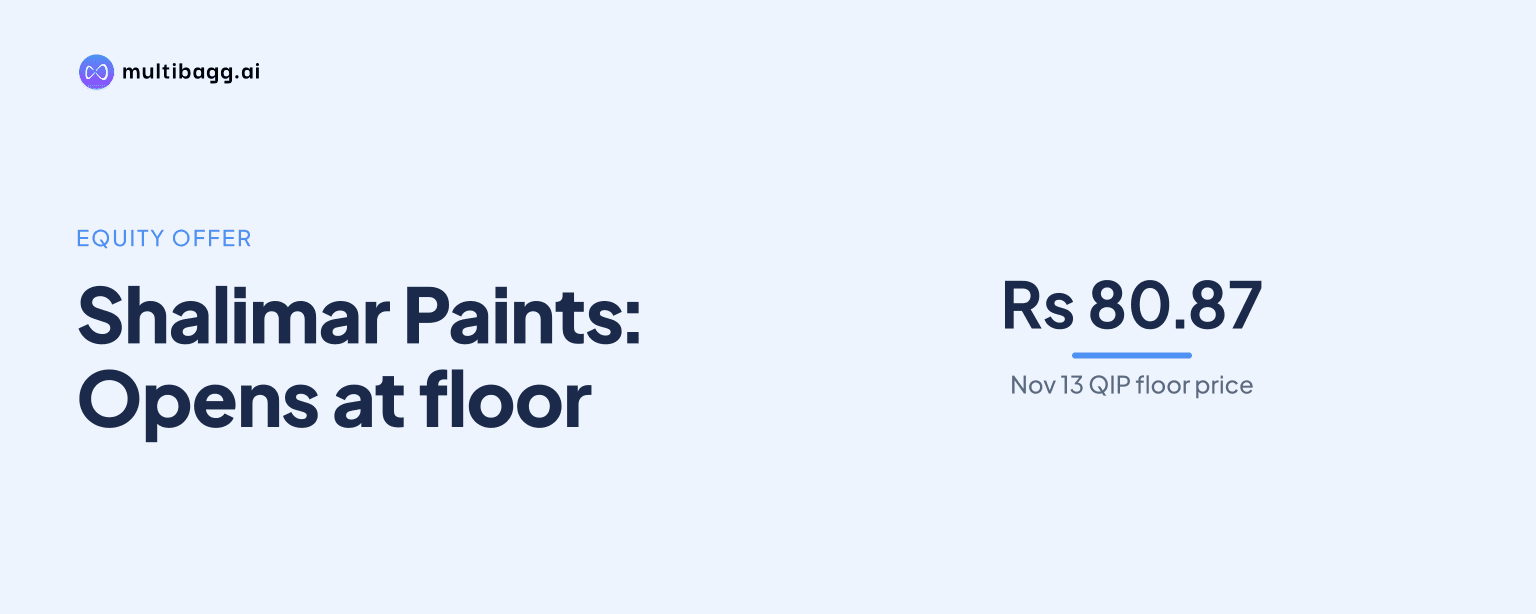
Shalimar Paints Limited opened a qualified institutions placement on November 13, 2026, with a floor price of ₹80.87 per equity share and an approved fundraising ceiling of up to ₹1,000 crore. The move formally starts the institutional equity-raising process for the paint manufacturer, although the final issue price and issue size have not been disclosed.
Know Shalimar Paints inside out
Results, valuation, peers and who's buying, in one view.
What did Shalimar Paints approve for the QIP?
Shalimar Paints approved the opening of its Qualified Institutions Placement, or QIP, through a meeting of its QIP Committee on November 13, 2026. The committee also adopted the preliminary placement document and application form for qualified institutional buyers.
The shares proposed to be issued under the QIP have a face value of ₹2 each. November 13 was designated as the relevant date for determining the floor price under the Securities and Exchange Board of India, or SEBI, Issue of Capital and Disclosure Requirements Regulations, 2018.
The preliminary placement document was to be filed with BSE Limited and the National Stock Exchange of India Limited on the date of the committee meeting. The company also closed its trading window for designated persons and their immediate relatives until 48 hours after the issue price is determined.
What is the ₹80.87 QIP floor price?
The QIP floor price is ₹80.87 per equity share, calculated under SEBI's ICDR Regulations. It represents the regulatory minimum pricing reference for the institutional offering rather than the final price at which shares will necessarily be allotted.
Shalimar Paints may offer qualified institutional buyers a discount of up to 5% to the floor price, at its discretion. At the full permitted discount, the price would be about ₹76.83 per share. The company has not announced whether it will use this discount, the number of shares to be issued, or the final placement price.
These pending terms are significant for shareholders because they will determine the amount of fresh equity raised and the resulting dilution in the existing equity base. The November 13 filing confirms the start of the process but does not confirm the size of the completed capital raise.
How was the fundraising plan authorised?
The QIP opening follows approvals secured earlier in 2026. Shalimar Paints' board approved fundraising through a QIP of up to ₹1,000 crore at its August 12 meeting. Shareholders subsequently passed a special resolution at an extraordinary general meeting held on September 11, 2026.
The August board meeting also approved adding cumulative non-participating compulsory convertible preference shares, or CCPS, amounting to ₹400 crore to the authorised capital clause of the company's memorandum of association. These CCPS were proposed as 200 crore preference shares with a face value of ₹2 each and a coupon rate of 0.001%.
On September 11, the company approved four capital-raising resolutions. They included the QIP, preferential equity issues for cash and non-cash consideration, and the proposed issue of up to 81,12,02,664 CCPS. The QIP that opened on November 13 is therefore part of a wider set of financing authorisations, though the filing did not state that all such instruments would be issued immediately.
Got a follow-up? Ask IRIS
Why does the QIP matter for Shalimar Paints' finances?
The QIP matters because it provides a route to bring in fresh institutional equity, subject to investor demand and final pricing. Equity funding can strengthen the balance sheet without adding borrowing obligations, but the actual financial effect cannot be measured until Shalimar Paints announces the number of shares allotted and the funds raised.
The company reported revenue of ₹576 crore for FY26 ended March 2026 and a net loss of ₹65 crore for the year, according to the information provided. Its borrowings stood at ₹165 crore as of March 2026, while net worth was reported at ₹251 crore, comprising ₹17 crore of equity and ₹234 crore of reserves.
A completed equity issue could alter these reported balance-sheet figures, depending on the amount raised and the use of proceeds. However, Shalimar Paints has not disclosed a specific QIP issue size, debt-repayment allocation, capital expenditure plan, or working-capital deployment plan in the November 13 announcement. Those details will be needed to assess the transaction's effect on leverage, interest costs and operations.
What should investors watch after the QIP opening?
Investors should watch for the final QIP price, the number of equity shares allotted and the gross proceeds raised. These disclosures will show whether the company used a discount to the ₹80.87 floor price and how much dilution existing shareholders will face.
The market will also need clarity on the use of proceeds. The company has an approved QIP limit of up to ₹1,000 crore, but approval of a maximum amount does not establish the amount that will be raised in this specific placement. The final announcement should distinguish between the broader shareholder-authorised limit and the actual completed issue.
The timing of further disclosures is also relevant because Shalimar Paints has restricted trading by designated persons until 48 hours after the issue price is determined. This restriction is linked to the pricing process and does not itself indicate the outcome or size of the placement.
Conclusion
Shalimar Paints has formally launched an institutional equity placement with a ₹80.87 per-share floor price, following board approval for a QIP of up to ₹1,000 crore and shareholder approval in September. The filing establishes the pricing framework and regulatory process, but it does not disclose the final price, number of shares or funds to be raised.
The next disclosures to watch are the final placement price, any discount offered, allotment size and the stated use of proceeds. These terms will determine the immediate impact on Shalimar Paints' equity base, balance sheet and existing shareholder dilution.