










Sheela Foam H1 FY27 Revenue Rises 22% to ₹2,077 Crore
Key highlights
- Sheela Foam's H1 FY27 consolidated revenue rose 22% to ₹2,077 crore from ₹1,696 crore.
- Consolidated operating EBITDA increased 23% to ₹200 crore in H1 FY27.
- H1 FY27 standalone revenue grew 18% to ₹1,542 crore, while standalone EBITDA rose 5% to ₹129 crore.
- Gross margin contracted 428 basis points in H1 FY27, while Q2 consolidated EBITDA fell 5% to ₹83 crore.
powered by IRIS
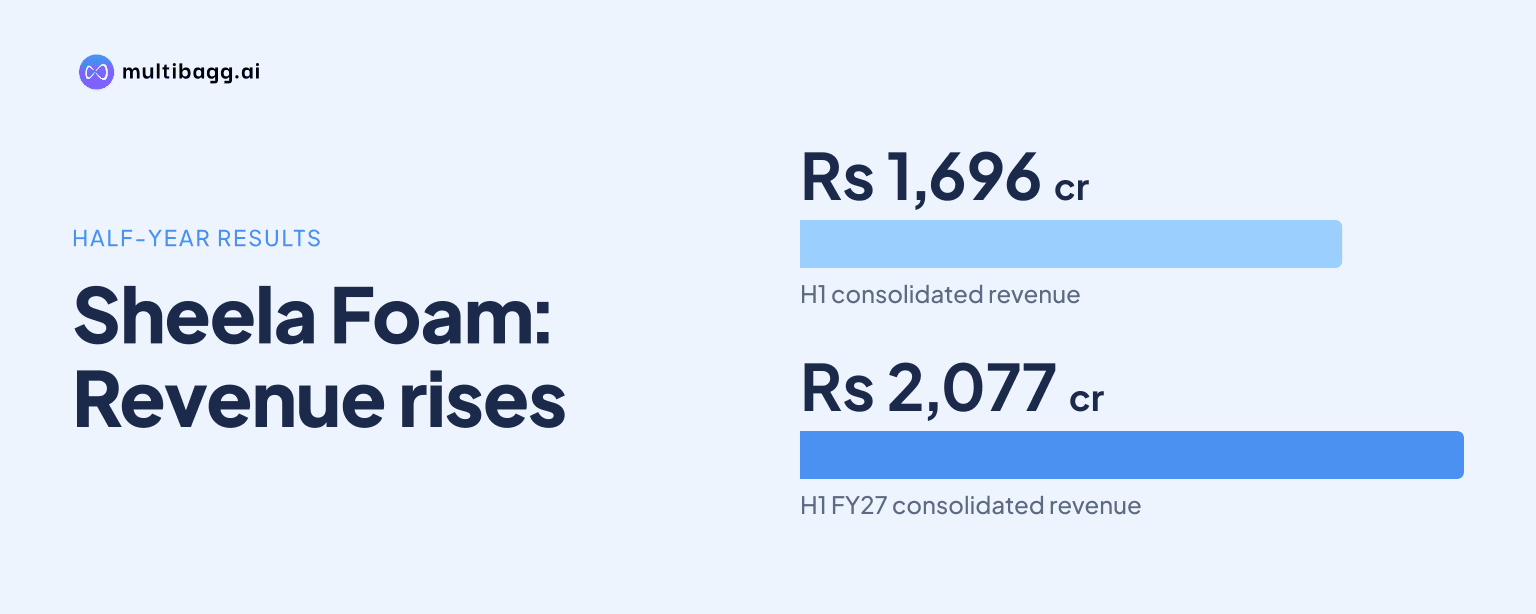
Sheela Foam Limited reported consolidated revenue of ₹2,077 crore in H1 FY27, a 22% year-on-year increase, while operating EBITDA rose 23% to ₹200 crore despite a 428-basis-point contraction in gross margin. The performance shows continued value growth across the mattress and foam businesses, with Furlenco adding to consolidated growth.
Know Sheela Foam inside out
Results, valuation, peers and who's buying, in one view.
What did Sheela Foam report for H1 FY27?
Sheela Foam reported consolidated revenue from operations of ₹2,077 crore for the half year ended September 30, 2026, compared with ₹1,696 crore in H1 FY26. The 22% increase was accompanied by a 23% rise in consolidated operating EBITDA to ₹200 crore.
The company’s standalone business, comprising SFL and KEL, recorded revenue of ₹1,542 crore, up 18% from ₹1,301 crore a year earlier. Standalone EBITDA increased 5% to ₹129 crore from ₹123 crore. The difference between consolidated and standalone growth reflects contributions from the group’s other businesses, including Furlenco.
The H1 numbers followed a strong first quarter, when the group said it had crossed ₹1,000 crore of consolidated revenue and ₹100 crore of EBITDA in a fiscal first quarter for the first time. In Q1 FY27, the standalone Indian business recorded 20% revenue growth and 13% EBITDA growth.
How did Sheela Foam perform in Q2 FY27?
Sheela Foam’s consolidated revenue increased 19% year-on-year to ₹1,045 crore in Q2 FY27, while reported EBITDA declined 5% to ₹83 crore. The reported consolidated EBITDA margin stood at 8.0% for the quarter.
On a standalone basis, quarterly revenue rose 17% to ₹781 crore. Standalone EBITDA declined 3% to ₹61 crore, and the EBITDA margin was 7.8%. These quarterly margin and EBITDA movements were weaker than the half-year growth figures, indicating that the second quarter carried greater profitability pressure.
The company’s board approved the unaudited standalone and consolidated results for the quarter and half year ended September 30, 2026, at its meeting held on November 2, 2026. Sheela Foam had earlier informed exchanges that it would hold an investor call on November 3 to discuss the Q2 and H1 FY27 performance.
Why did gross-margin pressure matter in H1 FY27?
Gross margin contracted by 428 basis points in H1 FY27, making profitability the key qualification to the company’s revenue and operating EBITDA growth. Gross margin measures the surplus left after direct product costs, before other operating expenses, and a contraction can limit the benefit of higher sales.
Sheela Foam had previously referred to volatile raw-material prices amid the Middle East situation during its Q1 FY27 earnings call. It said at that time that it had delivered EBITDA growth and higher absolute EBITDA despite raw-material volatility. The H1 release confirms that cost pressure remained relevant even as the company expanded revenue.
The reported figures also show a difference between operating EBITDA for the half year and reported EBITDA for the second quarter. The available disclosure does not provide a detailed reconciliation for this difference. Investors will therefore look to management’s results discussion and the company’s detailed presentation for further context on margins, expenses and business-level performance.
Got a follow-up? Ask IRIS
What drove growth in the mattress, foam and Furlenco businesses?
Sheela Foam said mattress and foam value grew in H1 FY27, although foam volumes were soft. This means the group increased the value of foam sales despite volume weakness, while the source does not provide a separate H1 value-growth percentage for either segment.
The company’s Q1 FY27 commentary provides context for the first-half trend. In that quarter, mattresses grew 15% in value and 6% in volume, while the foam business grew 26% in value and 4% in volume. The H1 update indicates that foam volume conditions softened subsequently, even as overall foam value growth continued.
Furlenco was described as a strong growth contributor following its turnaround. Its contribution is particularly important because Sheela Foam’s consolidated revenue grew faster than standalone revenue in H1 FY27, at 22% versus 18%. However, the disclosed information does not specify Furlenco’s H1 revenue, EBITDA or profitability, so its exact financial contribution cannot be quantified from the available results.
How should investors read the H1 FY27 results?
Investors can read H1 FY27 as a period of strong sales expansion with uneven profitability trends across the half year and second quarter. Consolidated revenue and operating EBITDA both grew by more than 20% in H1, but Q2 reported EBITDA declined and gross margin narrowed substantially.
The standalone business remained the larger disclosed operating base, contributing ₹1,542 crore of H1 revenue. Its EBITDA growth of 5% was materially lower than its 18% revenue growth, underscoring the effect of cost and margin pressure. At the consolidated level, Furlenco’s turnaround and growth contribution helped support stronger growth in revenue and operating EBITDA.
For the broader mattress and foam industry, the figures highlight the importance of pricing, product mix and raw-material costs. Sheela Foam’s H1 results show that value growth can continue during softer volume conditions, but margin performance remains important for translating sales growth into earnings growth.
Conclusion
Sheela Foam delivered 22% consolidated revenue growth to ₹2,077 crore and 23% operating EBITDA growth to ₹200 crore in H1 FY27. The result was supported by mattress and foam value growth and a stronger contribution from Furlenco, while a 428-basis-point gross-margin contraction and weaker Q2 EBITDA showed the continuing effect of cost pressure.
The next disclosed event is Sheela Foam’s November 3, 2026 investor call on its Q2 and H1 FY27 results. Investors will watch for management’s comments on raw-material costs, the reasons for the Q2 margin movement, foam volumes, and the scale of Furlenco’s contribution to consolidated growth.