










Jay Bharat Maruti Q2 Profit Rises 72.6% to Rs 31.12 Crore
Key highlights
- Jay Bharat Maruti reported Q2 FY27 standalone net profit of Rs 31.12 crore, up 72.6% year on year.
- Standalone revenue from operations rose 41.3% year on year to Rs 823.42 crore in Q2 FY27.
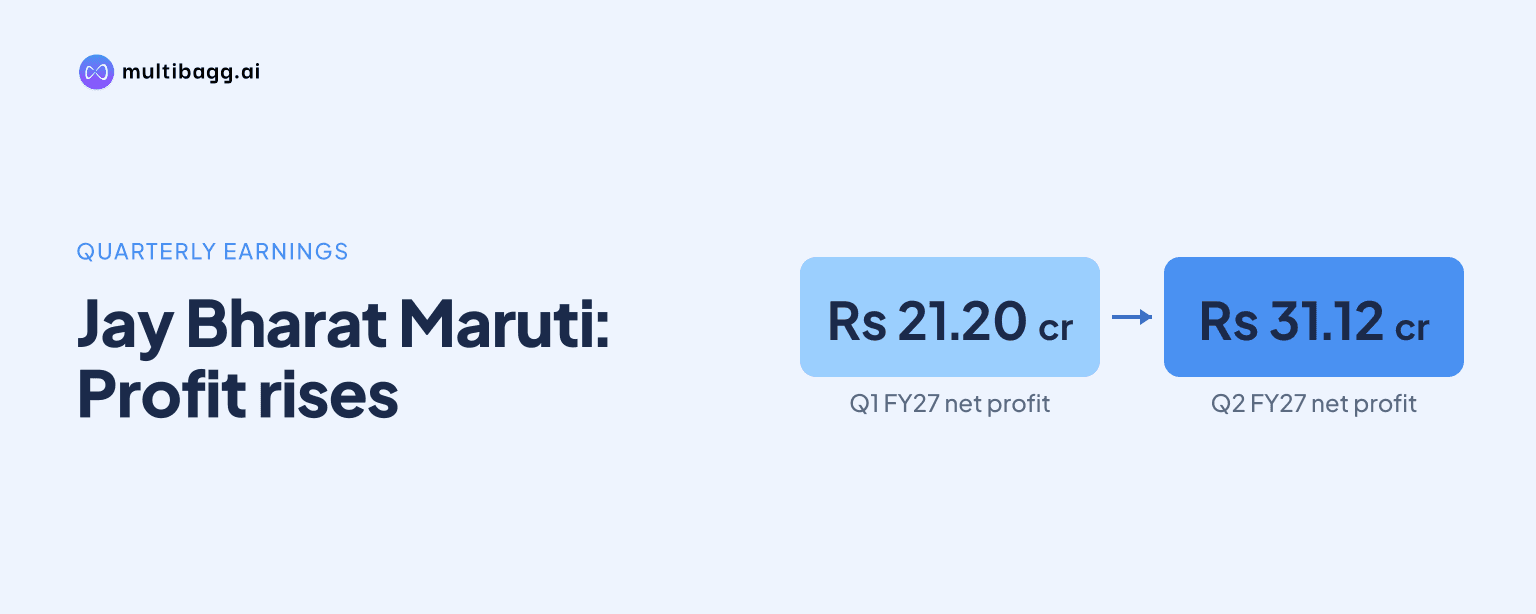
- Standalone profit increased 46.8% sequentially from Rs 21.20 crore in Q1 FY27.
- Consolidated Q2 FY27 net profit rose 73.7% year on year to Rs 32.01 crore.
powered by IRIS
Jay Bharat Maruti Limited reported standalone net profit of Rs 31.12 crore for Q2 FY27, a 72.6% year-on-year increase from Rs 18.03 crore, supported by a 41.3% rise in revenue from operations to Rs 823.42 crore. The September-quarter performance matters because it shows stronger operating scale despite higher raw-material costs.
Know Jay Bharat Maruti inside out
Results, valuation, peers and who's buying, in one view.
What did Jay Bharat Maruti report for Q2 FY27?
Jay Bharat Maruti reported a sharp increase in both revenue and profit for the quarter ended September 30, 2026. The Tier-1 automotive component manufacturer, which is part of the JBM Group, said standalone revenue from operations rose to Rs 823.42 crore in Q2 FY27 from Rs 582.65 crore in Q2 FY26.
Standalone net profit increased to Rs 31.12 crore from Rs 18.03 crore a year earlier. This represents a 72.6% year-on-year rise in profit, ahead of the pace of revenue growth. The figures indicate that higher production volumes across the company's automotive component operations contributed to earnings growth during the quarter.
The reported numbers also show improvement from the immediately preceding quarter. Revenue from operations grew 31.4% from Rs 626.79 crore in Q1 FY27, while standalone net profit rose 46.8% from Rs 21.20 crore. The sequential improvement is notable because it places the September-quarter revenue materially above the June-quarter level.
On a consolidated basis, Jay Bharat Maruti reported net profit of Rs 32.01 crore, compared with Rs 18.43 crore in Q2 FY26. Consolidated profit was therefore up 73.7% year on year, while consolidated revenue from operations was reported at Rs 823.42 crore.
What drove Jay Bharat Maruti's revenue and profit growth?
Jay Bharat Maruti attributed the profit improvement to strong revenue growth across its automotive component manufacturing operations. Higher demand and volumes in its core business supported the 41.3% annual increase in standalone revenue.
The company also faced higher raw-material expenses during the quarter. However, the increase in revenue was sufficient to offset that cost pressure and support the expansion in reported net profit. The supplied information does not provide operating-profit, margin, product-level, or customer-level data, so the precise contribution from cost control or product mix cannot be determined from the reported figures.
Jay Bharat Maruti operates as a Tier-1 auto component supplier, manufacturing components and assemblies for automotive original equipment manufacturers. Its earnings are consequently linked to vehicle production volumes, customer order schedules, material prices and manufacturing utilisation.
The Q2 result is being assessed against a lower year-ago base, when standalone revenue was Rs 582.65 crore and standalone profit was Rs 18.03 crore. The reported September-quarter revenue was also higher than the Rs 626.79 crore recorded in Q1 FY27, showing that the profit increase was accompanied by a substantial rise in quarterly sales.
How do the Q2 FY27 figures compare with earlier periods?
Jay Bharat Maruti's Q2 FY27 figures show growth both year on year and sequentially across revenue and profit. Standalone revenue added Rs 240.77 crore from the year-ago quarter and Rs 196.63 crore from Q1 FY27, based on the reported numbers.
Standalone net profit increased by Rs 13.09 crore from Q2 FY26 and by Rs 9.92 crore from Q1 FY27. Consolidated profit rose by Rs 13.58 crore from Rs 18.43 crore in Q2 FY26. These comparisons are based on the financial figures stated in the source material.
The reported standalone and consolidated revenue figure for Q2 FY27 was Rs 823.42 crore. The available information does not set out a separate consolidated revenue comparison for Q1 FY27 or disclose reasons for any difference between standalone and consolidated profit.
Got a follow-up? Ask IRIS
What corporate changes and compliance actions were announced?
Jay Bharat Maruti re-designated Mayank Varma as Chief Executive Officer with responsibility for both the tooling and auto components divisions. The change places oversight of the two divisions under one chief executive role, according to the supplied announcement.
The company also scheduled a Board of Directors meeting for November 2, 2026, to consider and approve unaudited standalone and consolidated financial results for Q2 and the first half of FY2026-27. The quarter under review ended on September 30, 2026.
Its trading window was closed from October 1, 2026, and was scheduled to remain closed until November 4, 2026. Such closures are part of insider-trading compliance procedures around the consideration and release of financial results.
The source material contains references to a results alert alongside the board-meeting intimation. Investors should distinguish between the financial figures reported in the supplied alert and the formal exchange filing or approved results documentation when reviewing the complete Q2 and half-year disclosures.
What does the Q2 performance mean for investors and the auto-component sector?
Jay Bharat Maruti's reported Q2 performance shows that higher automotive component volumes translated into a faster increase in profit than revenue during the quarter. Revenue growth of 41.3% and standalone profit growth of 72.6% provide the central financial indicators for investors assessing the September-quarter performance.
For the wider auto-component industry, the result underlines the importance of production volumes and material-cost management. Component suppliers can benefit when vehicle makers increase output, but their profitability can remain sensitive to raw-material costs, customer programmes and the pace at which manufacturing capacity is utilised.
The company's revenue base is closely connected with automotive original equipment manufacturer activity. As a result, investors may examine subsequent disclosures for changes in volumes, raw-material costs, operating margins, customer demand and any capital expenditure related to tooling or component manufacturing operations.
The source material also referred to renewable-energy initiatives intended to reduce energy costs and to an expectation of stable finance costs despite new-plant expansion. It does not provide Q2 FY27 financial evidence confirming the outcome of either initiative, so they remain areas for review in future company disclosures.
Conclusion
Jay Bharat Maruti reported strong Q2 FY27 growth, with standalone revenue reaching Rs 823.42 crore and standalone net profit rising to Rs 31.12 crore. The higher revenue base offset reported raw-material cost pressure, while consolidated profit rose 73.7% year on year to Rs 32.01 crore.
The next focus is the company's approved Q2 and H1 FY2026-27 results documentation following the November 2, 2026 board meeting. Investors can watch for detailed margin data, cost trends, production-volume commentary and updates on the tooling and auto components divisions under the revised CEO structure.