










Triveni Engineering reports ₹94 crore Q2 FY27 profit
Key highlights
- Triveni reported Q2 FY27 PAT of ₹94 crore, compared with a ₹11 crore loss in Q2 FY26.
- Q2 FY27 net revenue from operations rose 8.4% year-on-year to ₹1,731 crore.
- Q2 FY27 EBITDA increased 352.4% to ₹165 crore and margin improved to 9.5% from 2.3%.
- Short-term borrowings declined to ₹193.25 crore on September 30, 2026, from ₹1,817.87 crore on March 31, 2026.
powered by IRIS
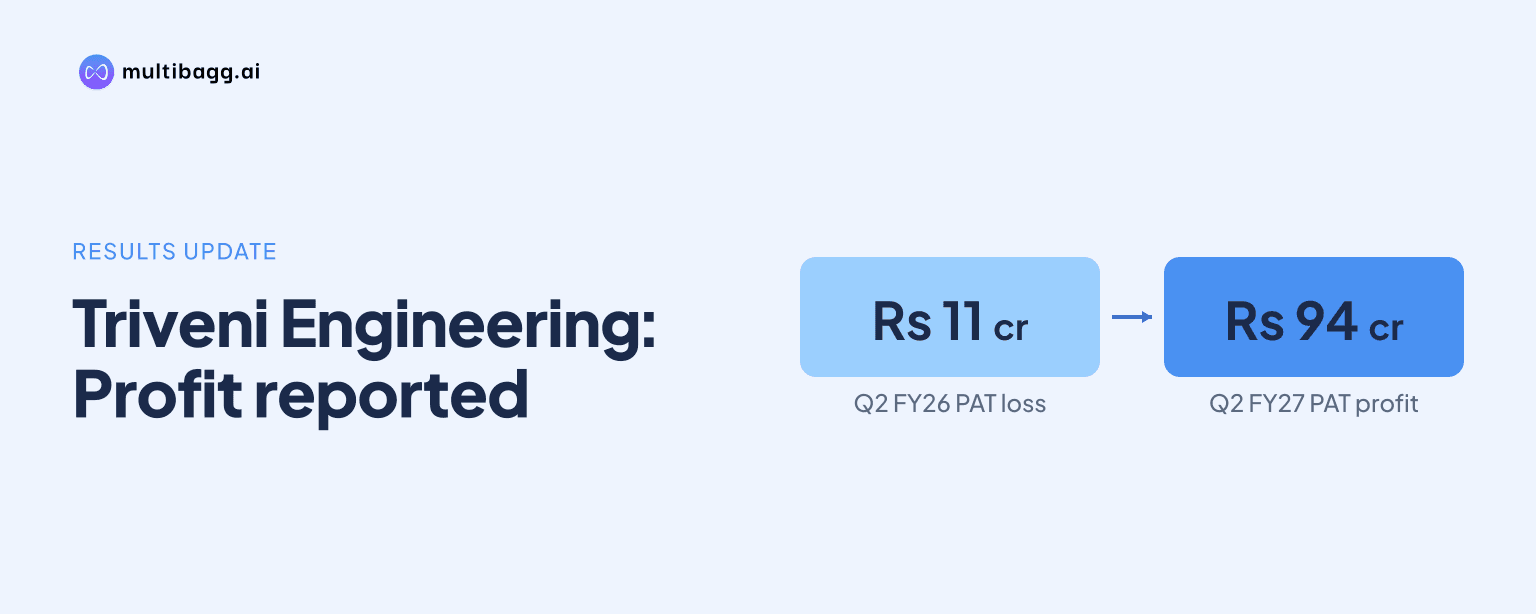
Triveni Engineering & Industries Limited reported a consolidated profit after tax of ₹94 crore in Q2 FY27, compared with a ₹11 crore loss a year earlier, as net revenue from operations rose 8.4% to ₹1,731 crore. The result reflects improved sugar and alcohol realisations and a sharp recovery in operating profitability.
Know Triveni Engineering and Industries inside out
Results, valuation, peers and who's buying, in one view.
What did Triveni report for Q2 FY27?
Triveni reported gross revenue from operations of ₹2,049 crore for the quarter ended September 30, 2026, up 7.5% from ₹1,905 crore in Q2 FY26. Revenue net of excise duty increased 8.4% to ₹1,731 crore from ₹1,597 crore. The company reported EBITDA of ₹165 crore, a 352.4% year-on-year increase, while the EBITDA margin rose to 9.5% from 2.3%.
Profit before tax for the quarter stood at ₹126 crore, against a loss of ₹16 crore in the corresponding quarter of FY26. Profit after tax was ₹94 crore, compared with a ₹11 crore loss a year earlier. Earnings per share improved to ₹4.25 from negative ₹0.52. The Board of Directors approved the unaudited standalone and consolidated results on November 2, 2026.
The statutory exchange filing reported consolidated total income of ₹2,069.49 crore for the quarter. It recorded profit from continuing operations after tax of ₹93.65 crore and total comprehensive income of ₹93.45 crore. The ₹94 crore PAT in the investor presentation is the rounded reported figure.
How did Triveni perform in the first half of FY27?
Triveni reported gross revenue from operations of ₹3,999 crore for H1 FY27, a 5.0% increase from the prior-year period. Net revenue from operations rose 5.3% to ₹3,311 crore. EBITDA increased 136.7% to ₹229 crore, and the EBITDA margin improved to 6.9% from 3.1%.
The company reported H1 profit before tax of ₹131 crore, compared with a loss of ₹25 crore in H1 FY26. PAT reached ₹97 crore against a loss of ₹18 crore in the previous year, while earnings per share were ₹4.42 compared with negative ₹0.82. These figures show that the improvement in the September quarter followed a weaker first quarter and lifted the half-year result into profit.
The exchange filing listed consolidated total income of ₹4,030.07 crore for the six months ended September 30, 2026. It reported profit from continuing operations before tax and exceptional items of ₹126.14 crore. The company submitted the results with limited-review reports from statutory auditor SS Kothari Mehta & Co. LLP.
Got a follow-up? Ask IRIS
What drove Triveni's improvement in profitability?
Triveni attributed the stronger performance to higher sugar realisations and sales volumes across its sugar and alcohol businesses. Improved realisation for distillers dried grains with solubles, or DDGS, from the grain distillery also supported profitability. These factors helped lift quarterly EBITDA despite only single-digit revenue growth.
The Sugar & Allied Businesses remained the principal contributor to segment profit. For the three months ended September 30, 2026, this segment reported profit of ₹141.31 crore. The Engineering Business' Water segment reported profit of ₹1.12 crore during the quarter, indicating that the sugar-linked operations accounted for most of the reported segment profitability.
For H1 FY27, Sugar & Allied Businesses reported segment profit of ₹185.64 crore, while the Water segment reported ₹2.82 crore. The company said water results were affected by slower EPC execution. The Water segment recorded revenue of ₹47.29 crore in Q2 FY27 and ₹89.80 crore in H1 FY27.
How did working capital and borrowings change during H1 FY27?
Triveni's reported inventory fell to ₹780.48 crore as of September 30, 2026, from ₹2,985.99 crore on March 31, 2026. The reduction was associated with an operating cash inflow of ₹2,152.72 crore during the first half, according to the disclosed financial information. Seasonal inventory movement can be material for a sugar business because stocks build and unwind around the production and sales cycle.
Short-term borrowings declined to ₹193.25 crore at September-end from ₹1,817.87 crore at the end of March 2026. The reported change followed a release in seasonal working capital and came after the Composite Scheme of Arrangement became effective on May 19, 2026. The company had also paid its FY26 final dividend of ₹1.25 per share in September 2026.
For investors, the working-capital movement is relevant alongside the profit recovery because borrowings and inventory can affect cash flow differently from reported earnings. The disclosed figures show lower inventories and lower short-term debt at the September reporting date, while the operating performance was led by sugar and alcohol operations.
What should investors watch after Triveni's Q2 FY27 results?
Triveni scheduled a conference call for analysts and investors at 3:30 pm IST on November 3, 2026, following the Board's approval of its Q2 and H1 FY27 results. The call provides the next scheduled forum for management to discuss the reported operating performance and business updates.
The company had previously released its Q1 FY27 investor brief and presentation on July 29, 2026. The Q2 presentation states that higher sugar realisations, sugar and alcohol sales volumes, and better DDGS realisations supported results. It also identifies slower EPC execution as a factor affecting the Water business.
Conclusion
Triveni returned to quarterly profitability in Q2 FY27, reporting PAT of ₹94 crore against a loss in the year-earlier quarter. Revenue growth, a substantial rise in EBITDA and improved margins were supported by sugar and alcohol operations, while the Water segment remained comparatively small and faced slower EPC execution.
Investors will watch the November 3 conference call for management's discussion of the reported drivers, including sugar and alcohol realisations, DDGS economics and Water-business execution. The disclosed changes in inventories and short-term borrowings will also remain relevant when assessing the company's working-capital position in the second half of FY27.