










Shree Ram Proteins Limited faces going-concern uncertainty
Key highlights
- Union Bank auctioned Shree Ram Proteins’ plant, machinery, land and factory building for Rs 20.58 crore in 2026.
- The reviewer cited Rs 21.53 crore of outstanding dues against the Rs 20.58 crore auction realisation.
- Shree Ram Proteins reported Rs 0.94 lakh of cash and cash equivalents at September 30, 2026.
- Shree Ram Proteins wrote off Rs 24.26 crore of supplier advances and Rs 11.18 crore of inventory in the half year.
powered by IRIS
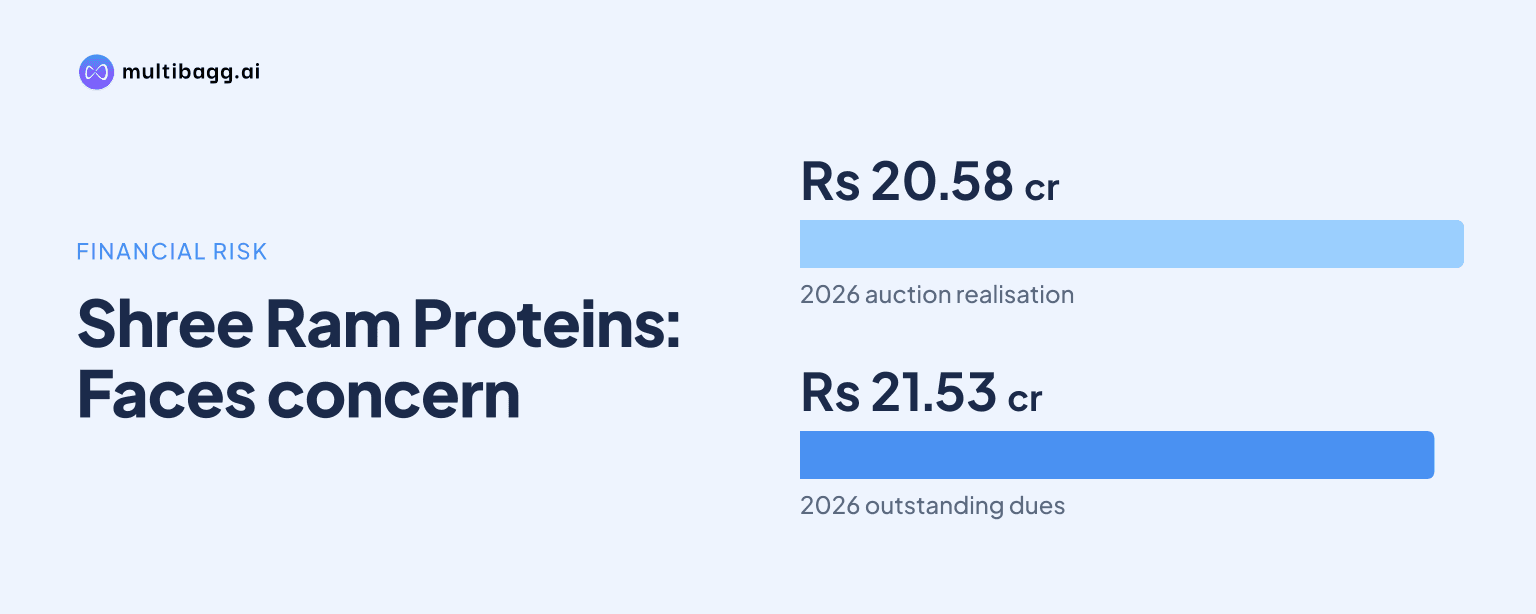
Shree Ram Proteins Limited faced material uncertainty over its ability to continue as a going concern at September 30, 2026, after Union Bank of India auctioned Rs 20.58 crore of primary secured assets against Rs 21.53 crore of outstanding dues. The independent reviewer said management had not documented an adequate going-concern assessment.
Know Shree Ram Proteins inside out
Results, valuation, peers and who's buying, in one view.
Why did the reviewer flag Shree Ram Proteins’ going-concern position?
The reviewer flagged Shree Ram Proteins because the company had defaulted on loan repayments, bank-loan covenants and statutory dues while continuing to prepare its September 30, 2026 interim accounts on a going-concern basis. The company said its working-capital shortage arose from an increase in its working-capital cycle.
The independent review report, dated November 7, 2026, said management had neither performed nor documented an adequate going-concern assessment under Indian Accounting Standard 1, Presentation of Financial Statements, and Indian Accounting Standard 34, Interim Financial Reporting. It also said the interim information did not sufficiently disclose the conditions causing significant doubt, management’s plans to mitigate them, or possible effects on the financial statements.
The reviewer issued a qualified conclusion for the quarter ended September 30, 2026. It said it could not conclude whether the interim information would require further adjustments or disclosures had Shree Ram Proteins completed and presented an appropriate going-concern assessment.
The report said Shree Ram Proteins might cease to be a going concern and remain in default of financial covenants if it could not improve its financial position in the immediate future. This was a review conducted under Standard on Review Engagements 2410, rather than a full audit, and the reviewer said such work is substantially narrower in scope than an audit.
What assets did Union Bank of India auction from Shree Ram Proteins?
Union Bank of India auctioned Shree Ram Proteins’ plant and machinery for Rs 3.82 crore on May 18, 2026, and its land and factory building for Rs 16.76 crore on September 21, 2026. The Rs 20.58 crore combined realisation was appropriated directly against the company’s cash-credit account following debt-servicing defaults.
The company described the assets as its primary secured assets. Union Bank exercised enforcement rights under the Securitisation and Reconstruction of Financial Assets and Enforcement of Security Interest Act, 2002, or SARFAESI Act, during the half year ended September 30, 2026.
The auction realisation was Rs 0.95 crore below the Rs 21.53 crore of outstanding dues cited in the review report. Shree Ram Proteins recorded a Rs 16.45 crore net profit on sale of assets in other income, but the filing says the proceeds did not remain available to the company because the lender appropriated them against non-performing borrowing accounts.
The cash-flow statement records Rs 20.58 crore of proceeds from the disposal of property, plant and equipment in the half year ended September 30, 2026. Net cash flow from financing activities was an outflow of Rs 19.41 crore, including a Rs 14.78 crore net reduction in short-term borrowings and Rs 1.87 crore of interest and finance expenses.
Got a follow-up? Ask IRIS
Which balances could the reviewer not verify at Shree Ram Proteins?
The reviewer could not verify debtor, creditor and advance balances because Shree Ram Proteins had not conducted balance confirmations or reconciliations for the period under review. The absence of these procedures limited the evidence available for the September 30, 2026 interim accounts.
Shree Ram Proteins also did not inspect inventories during the review period, so the reviewer could not review the inventory position at the balance-sheet date. The company reported an inventory write-off of Rs 11.18 crore in the current half year, compared with Rs 6.14 crore in the half year ended September 30, 2025.
The increase in the inventory write-off was Rs 5.04 crore from the corresponding prior-year period. Management said the current half-year loss was on account of the Rs 11.18 crore inventory write-off, while the reviewer separately cited the lack of inventory inspection as a limitation.
The filing also says Shree Ram Proteins did not physically inspect property, plant and equipment or carry out impairment assessments for property, plant and equipment, inventories, advances, cash and bank balances, and debtors. The reviewer therefore said it could not provide an opinion on whether those balances reflected their underlying economics.
Management additionally decided during the first half of the year to write off Rs 24.26 crore of supplier advances receivable since financial year 2022-23, saying they were not recoverable in cash or kind. The half-year cash-flow statement showed bad debt of Rs 24.29 crore, a separately presented item in the operating-cash-flow reconciliation.
What do Shree Ram Proteins’ reported cash flows show?
Shree Ram Proteins reported cash and cash equivalents of Rs 0.94 lakh at September 30, 2026, down from Rs 1.35 lakh at September 30, 2025. The closing balance comprised Rs 0.86 lakh in cash on hand and Rs 0.08 lakh with scheduled banks.
Cash generated from operations was negative Rs 1.17 crore in the half year ended September 30, 2026, compared with positive Rs 1.32 crore in the corresponding period a year earlier. The movement followed an operating loss before working-capital changes of Rs 11.83 crore, compared with a loss of Rs 0.37 crore in the previous-year half.
The Rs 20.58 crore investing inflow was tied to the lender-enforced disposal of property, plant and equipment, rather than a disclosed investment programme. The company operates in one segment, Solvent Products, and said segment reporting was therefore not applicable under Indian Accounting Standard 108, Operating Segments.
Conclusion
Shree Ram Proteins’ September 30, 2026 filing combines defaults on loans and statutory dues, a Rs 20.58 crore lender-enforced sale of primary secured assets, and uncompleted procedures over inventories, fixed assets and multiple balance-sheet balances. The reviewer’s qualified conclusion focuses on the absence of an adequate documented going-concern assessment and adequate related disclosures.
The disclosed next governance matter is shareholder approval of H. Jamnadas & Co. as statutory auditor for a first five-year term, from the conclusion of the 18th annual general meeting to the conclusion of the 23rd annual general meeting. Investors will also watch for any disclosure of measures to address the working-capital shortage, covenant defaults and unpaid statutory dues identified in the November 7, 2026 filing.