










Shyamkamal Investments Board to Consider ₹124 Crore Rights Issue
Key highlights
- Shyamkamal Investments will consider a partly paid rights issue of up to ₹124 crore on November 20, 2026.
- The proposed payment structure requires 25% on application and 75% through three subsequent calls.
- The board may adjust up to ₹18.75 crore of unsecured inter-corporate loans against eligible rights subscriptions.
- Shyamkamal Investments closed at ₹14.02 on November 20, 2026, up 0.94% from ₹13.89.
powered by IRIS
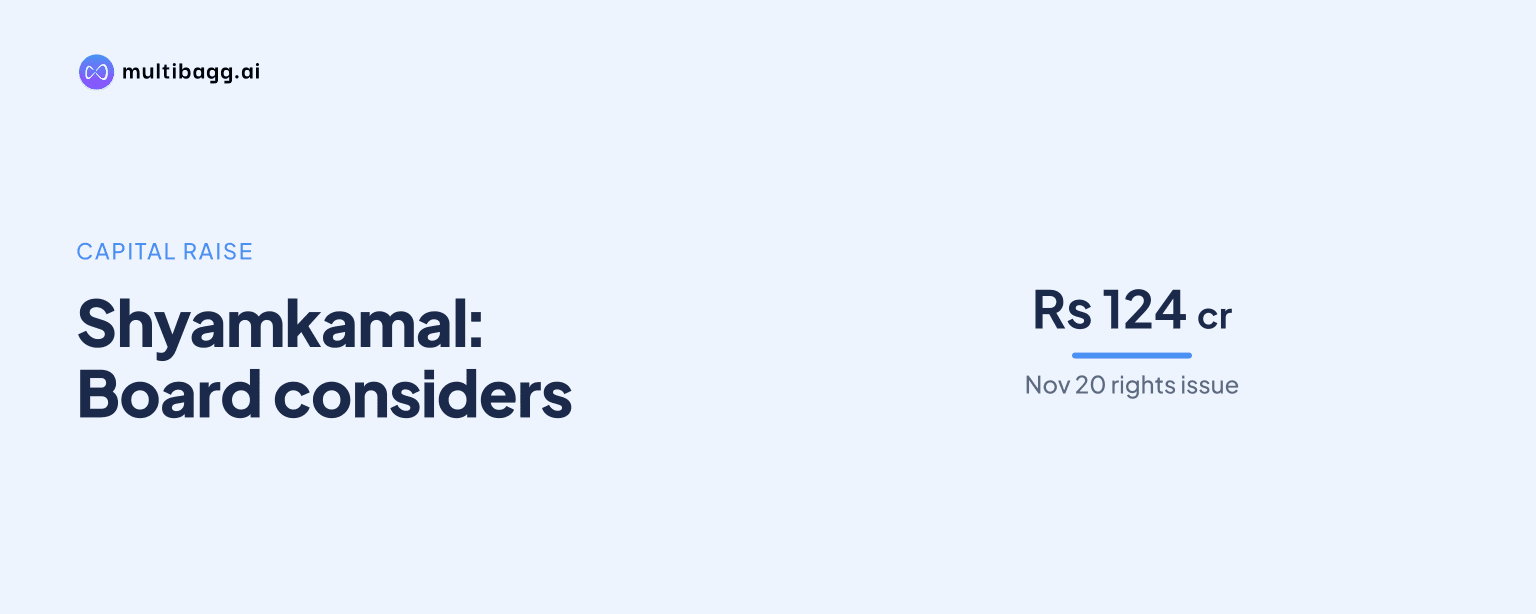
Shyamkamal Investments Limited is scheduled to consider a partly paid-up equity rights issue of up to ₹124 crore at its board meeting on November 20, 2026, with 25% of the issue amount proposed to be collected on application. The filing does not confirm approval, pricing, share count, or the record date for the proposed fund raise.
Know Shyamkamal Investments inside out
Results, valuation, peers and who's buying, in one view.
What will Shyamkamal Investments consider at its November 20 board meeting?
Shyamkamal Investments will consider a proposal to raise up to ₹124 crore through a rights issue of partly paid-up equity shares. The meeting is scheduled for 4:00 pm IST on November 20, 2026, at the registered office and/or through video conferencing.
The company informed BSE Limited about the meeting on November 17 under Regulation 29 of the SEBI (Listing Obligations and Disclosure Requirements) Regulations, 2015. The proposed issue would be offered to eligible equity shareholders under Section 62(1)(a) of the Companies Act, 2013 and the SEBI (Issue of Capital and Disclosure Requirements) Regulations, 2018.
This is a board-meeting intimation rather than a final approval announcement. As of the notice, the proposed maximum issue size is ₹124 crore, but the company has not disclosed the issue price, the number of shares to be issued, or the final terms of the offer.
How would the proposed partly paid rights issue work?
Shyamkamal Investments proposes to collect 25% of the subscription amount as application money and the remaining 75% through three subsequent calls. This structure means shareholders who subscribe would not be required to pay the full issue amount at the time of application, subject to the board approving the proposal and final terms.
The board agenda also includes fixing the rights entitlement ratio, which determines how many rights shares an eligible shareholder may receive against their existing holding. It is also expected to consider the record date, issue opening and closing dates, payment-call schedule, and the timeline for renunciation of rights entitlements.
A partly paid share issue requires shareholders to track future payment calls after the initial application amount. The filing does not specify the timing or size of each of the three proposed calls. It also does not state the issue price or whether the proposed fund raise will be completed in full.
What is the proposed ₹18.75 crore loan adjustment?
Shyamkamal Investments will also consider adjusting up to ₹18.75 crore of unsecured inter-corporate loans against subscription amounts payable for rights shares by qualifying lenders. The proposal concerns loans owed by the company to those lenders.
If approved, the adjustment would allow the relevant lenders to set off eligible amounts due from the company against money payable by them for allotted rights shares. The board notice does not identify the lenders, disclose the terms of the loans, or confirm how much of the ₹18.75 crore amount may eventually be adjusted.
The agenda further covers approval of a draft letter of offer for filing with BSE, which is the designated stock exchange. The board is also scheduled to consider forming a Rights Issue Committee and appointing the registrar, bankers to the issue, and other intermediaries.
Got a follow-up? Ask IRIS
What information is still pending from Shyamkamal Investments?
Shyamkamal Investments has not yet disclosed several terms that shareholders need to assess the proposal, including the issue price, number of shares, entitlement ratio, record date, issue timetable, and resulting equity capital. These matters are listed for consideration at the board meeting.
The company has also not announced whether the board has approved the fund raise because the meeting was scheduled for November 20. Investors should distinguish the current intimation from a final board outcome, letter of offer, or a completed rights issue.
The trading window for designated persons and their immediate relatives was closed from November 16, 2026. According to the notice, it will reopen 48 hours after the board outcome is made public.
How did Shyamkamal Investments shares trade before the meeting?
Shyamkamal Investments shares were quoted at ₹14.02 at 3:28 pm IST on BSE on November 20, 2026, up ₹0.13 or 0.94% from the previous close of ₹13.89. The company is classified in the non-banking financial company sector and has a micro market capitalisation.
The disclosed share-price move occurred before the scheduled 4:00 pm IST board meeting. It therefore does not reflect a disclosed board decision on the rights issue. The company’s prior listed calendar includes quarterly-results meetings on November 1, August 12, May 19 and February 10, 2026, along with its annual general meeting on September 25, 2026.
For existing shareholders, the key pending disclosures are the record date and entitlement ratio, which establish eligibility and the number of rights available. The issue price and call timetable will also determine the amount payable at application and in later instalments.
Conclusion
The board notice sets out a proposed capital-raising framework of up to ₹124 crore through partly paid-up rights shares, rather than a completed fund raise. It also provides for 25% application money, three later calls for the balance, and a possible adjustment of up to ₹18.75 crore of unsecured inter-corporate loans against qualifying subscriptions.
The next item to watch is the board’s outcome from the November 20, 2026 meeting. That disclosure may clarify whether the proposal is approved and provide the issue price, entitlement ratio, record date, opening and closing dates, payment-call terms, and the draft offer process.