










Siemens revenue rises 17% while operating margin falls to 9.5%
Key highlights
- Siemens’ continuing-operations revenue rose 17% to Rs 5,734 crore in the quarter ended 30 September 2026.
- Profit from operations declined to Rs 545 crore from Rs 561 crore, reducing the margin to 9.5% from 11.4%.
- Smart Infrastructure revenue increased to Rs 3,281 crore from Rs 2,725 crore in the September quarter.
- New orders rose 37.8% to Rs 6,228 crore and order backlog reached Rs 47,034 crore.
powered by IRIS
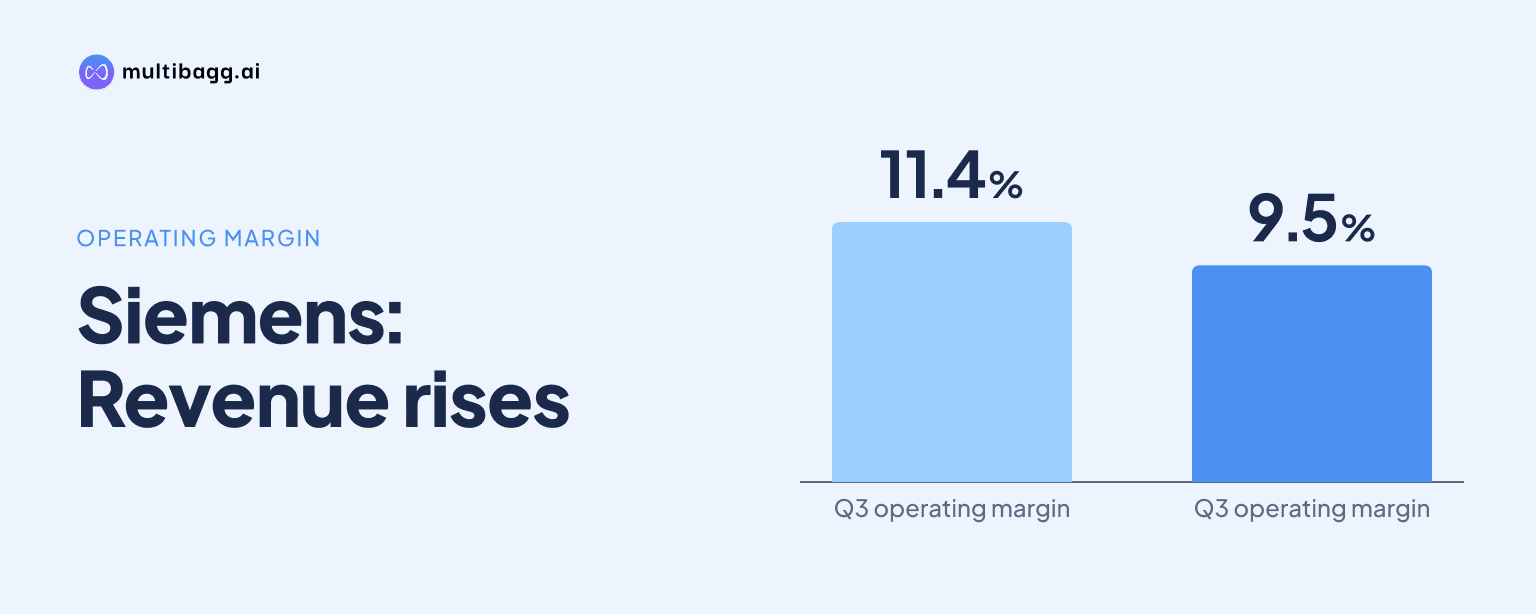
Siemens Limited reported continuing-operations revenue of Rs 5,734 crore for the quarter ended 30 September 2026, up 17% from Rs 4,900 crore a year earlier, but profit from operations declined to Rs 545 crore from Rs 561 crore and the margin fell to 9.5% from 11.4%. Management attributed the profitability pressure mainly to higher material costs arising from commodity-price and foreign-exchange volatility.
Know Siemens inside out
Results, valuation, peers and who's buying, in one view.
Why did Siemens’ operating margin fall despite 17% revenue growth?
Siemens’ operating margin fell because expenses increased by more than the growth in revenue and other income during the September 2026 quarter. Total expenses from continuing operations increased by Rs 846 crore to Rs 5,210 crore, compared with an Rs 834 crore increase in revenue from operations and an Rs 31 crore rise in other income.
Material consumption was the largest disclosed movement, rising by Rs 758 crore year on year to Rs 2,744 crore. Other direct costs increased by Rs 93 crore to Rs 432 crore and employee-benefit expense rose by Rs 69 crore to Rs 500 crore, while purchases of stock-in-trade declined by Rs 185 crore to Rs 769 crore.
Siemens recorded profit from operations of Rs 545 crore, down Rs 16 crore from the September 2025 quarter, despite the revenue increase. Sunil Mathur, Managing Director and Chief Executive Officer, said commodity-price and foreign-exchange volatility had mainly affected profitability through higher material costs; the filing does not separately quantify either factor.
Which Siemens segments drove revenue growth in the quarter?
Smart Infrastructure was Siemens’ largest segment and contributed the most to the revenue increase, with September-quarter revenue rising to Rs 3,281 crore from Rs 2,725 crore. Mobility revenue increased to Rs 1,291 crore from Rs 1,135 crore, while Digital Industries revenue rose to Rs 1,150 crore from Rs 1,066 crore.
Smart Infrastructure added Rs 557 crore of revenue year on year, against the Rs 834 crore increase in continuing-operations revenue. Mobility added Rs 156 crore, Digital Industries added Rs 85 crore and Others added Rs 19 crore, while inter-segment revenue declined by Rs 17 crore to Rs 64 crore.
Segment profitability did not move uniformly in the September 2026 quarter. Smart Infrastructure’s segment result increased by Rs 30 crore to Rs 385 crore, but Mobility’s declined by Rs 30 crore to Rs 96 crore and Digital Industries’ fell by Rs 17 crore to Rs 58 crore. The combined segment result was therefore Rs 545 crore, compared with Rs 561 crore a year earlier.
How did Siemens’ continuing profit after tax rise to Rs 504 crore?
Siemens’ continuing profit after tax rose to Rs 504 crore in the quarter ended 30 September 2026 from Rs 481 crore a year earlier, even though profit from operations declined. Profit before tax from continuing operations rose by Rs 18 crore to Rs 676 crore, while total tax expense decreased by Rs 5 crore to Rs 171 crore.
Other income increased by Rs 31 crore to Rs 152 crore during the quarter, while finance costs increased by Rs 8 crore to Rs 13 crore. These movements, rather than an increase in operating profit, explain why profit before tax and continuing profit after tax rose in the September 2026 quarter.
Reported profit from discontinued operations was nil in the September 2026 quarter, compared with Rs 4 crore a year earlier. Siemens had recognised a provisional pre-tax gain of Rs 2,099 crore in the June 2026 quarter after selling its Low Voltage Motors business to Innomotics India Private Limited on 1 June 2026.
Got a follow-up? Ask IRIS
What do Siemens’ first-half revenue and cash flows show?
Siemens generated Rs 10,448 crore of continuing-operations revenue in the six months ended 30 September 2026, up from Rs 9,008 crore in the corresponding six months ended 30 September 2025. However, profit from operations declined to Rs 901 crore from Rs 1,013 crore, while profit before tax from continuing operations fell to Rs 1,138 crore from Rs 1,226 crore.
First-half material consumption rose by Rs 1,037 crore to Rs 4,819 crore, employee-benefit expense increased by Rs 148 crore to Rs 982 crore, and other direct costs rose by Rs 100 crore to Rs 725 crore. Continuing profit after tax was Rs 848 crore, down Rs 56 crore from Rs 903 crore in the derived prior six-month comparison.
Net cash generated from operating activities was Rs 1,311 crore for the six months ended 30 September 2026. The source also reports Rs 375 crore for the twelve months ended 30 September 2025, but those periods are not directly comparable because the earlier figure covers 12 months and the 2026 figure covers six months.
Cash and cash equivalents stood at Rs 1,021 crore at 30 September 2026, down from Rs 1,694 crore at 31 March 2026. Bank balances other than cash and cash equivalents increased to Rs 7,477 crore from Rs 3,918 crore, while the cash-flow statement records net placement of Rs 3,559 crore in bank deposits with original maturities above three months.
What is Siemens’ order position and which corporate actions remain pending?
Siemens reported new orders of Rs 6,228 crore for the September 2026 quarter, up 37.8% from Rs 4,519 crore a year earlier, and an order backlog of Rs 47,034 crore, up 12.0%. Management said continued infrastructure capital expenditure and increased private-sector capital expenditure supported orders and revenue.
Siemens’ board approved the proposed amalgamation of wholly owned subsidiary Siemens Rail Automation Private Limited with Siemens on 26 May 2026. The scheme remains subject to approvals from regulatory authorities, including the National Company Law Tribunal, and the filing does not give a completion date.
C&S Electric Limited, a Siemens subsidiary, received National Company Law Tribunal approval for a capital reduction on 24 September 2026, followed by a Registrar of Companies registration certificate on 26 October 2026. Siemens recognised a Rs 35 crore financial liability for consideration payable to specified C&S shareholders, with corresponding adjustments to non-controlling interest and other equity.
Conclusion
Siemens combined 17% continuing-revenue growth in the September 2026 quarter with a Rs 16 crore decline in profit from operations. Smart Infrastructure delivered the largest revenue increase and a higher segment result, but lower results in Mobility and Digital Industries, alongside higher material and other costs, reduced the operating margin by 1.9 percentage points to 9.5%.
The next developments to watch are whether the Rs 47,034 crore order backlog converts into revenue while commodity-price and foreign-exchange volatility persists, as management identified those factors as cost pressures. The timing of the Siemens Rail Automation Private Limited amalgamation is also unresolved because the source says regulatory approvals, including from the National Company Law Tribunal, are still required.