










Simbhaoli Sugars Extends Resolution Plan Deadline to November 21
Key highlights
- Simbhaoli Sugars extended its resolution-plan submission deadline from November 5, 2026, to November 21, 2026.
- Simbhaoli Sugars reported a Q3 FY26 net loss of ₹4.53 crore on revenue of ₹213.54 crore.
- The Simbhaoli and Brijnathpur units lost 28 and 11 cane centres, respectively, for the 2025-26 season.
- Interest on delayed cane-payment claims before the insolvency professional aggregated to ₹121.63 crore as of July 11, 2024.
powered by IRIS
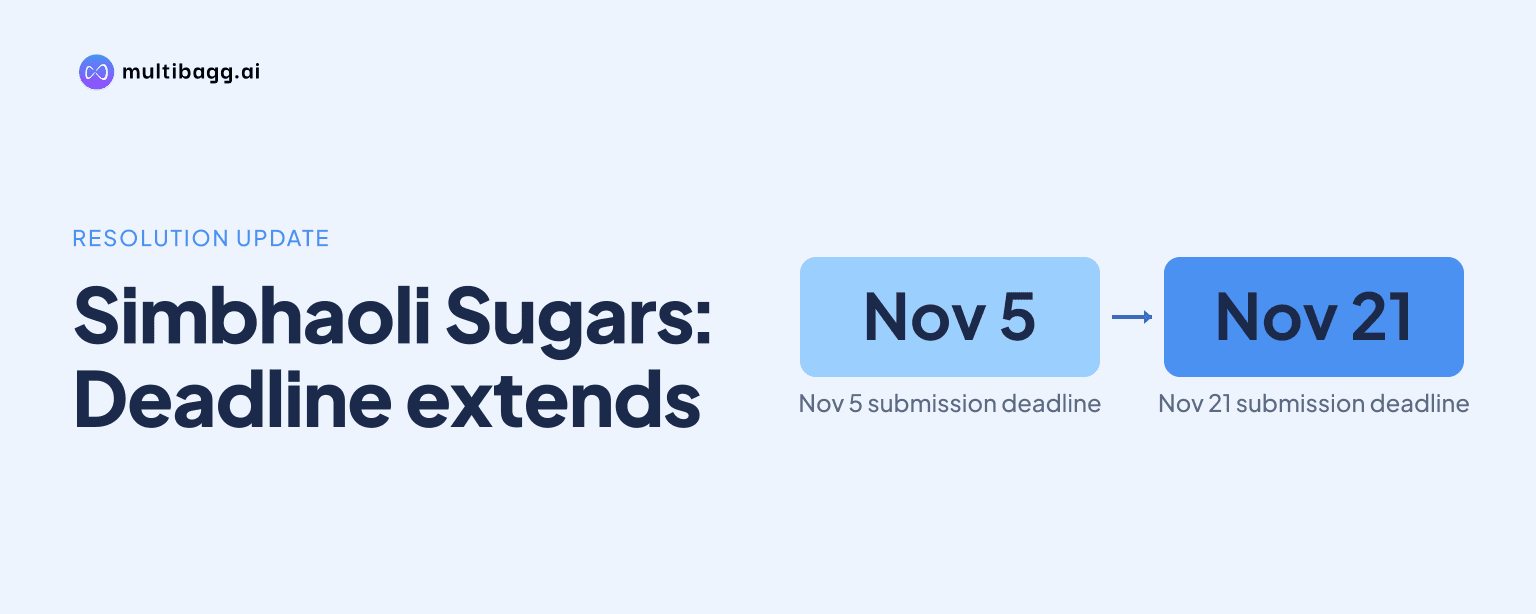
Simbhaoli Sugars Limited extended the deadline for submitting resolution plans from November 5, 2026, to November 21, 2026, after its fifth Committee of Creditors meeting, as the company continues its Corporate Insolvency Resolution Process amid losses, cane shortages and operational disruptions.
Know Simbhaoli Sugars inside out
Results, valuation, peers and who's buying, in one view.
Why did Simbhaoli Sugars extend its resolution plan deadline?
Simbhaoli Sugars extended the resolution plan submission deadline by 16 days, moving it from November 5 to November 21, 2026. The decision was discussed at the fifth meeting of the Committee of Creditors, held on November 4, 2026, according to the company's disclosure to BSE Limited and the National Stock Exchange of India Limited.
The disclosure did not specify the reason for the extension or identify prospective resolution applicants. It confirmed that the creditors' committee considered general operational matters, the revised timeline for resolution plans, and developments relating to cane allocation appeals before the Allahabad High Court.
The deadline extension is material because Simbhaoli Sugars has been under the Corporate Insolvency Resolution Process, or CIRP, since July 2024. The process is taking place while the company manages weak operating conditions, including reduced access to sugarcane, liquidity constraints and compliance-related uncertainty.
What did the November 4 creditors committee meeting cover?
The November 4 meeting covered the revised resolution-plan deadline, routine operational matters and an update on cane allocation appeals. Cane availability is a central operational issue for Simbhaoli Sugars because sugar production depends on supply from cane purchase centres allocated by the Uttar Pradesh cane authorities.
The company's disclosures indicate that the allocation of cane centres has been affected across its units. For the 2025-26 crushing season, 28 cane centres were diverted from the Simbhaoli unit and 11 from the Brijnathpur unit. The Chilwaria unit received zero sugarcane allotment under the order dated October 25, 2025.
Simbhaoli Sugars stated that the Allahabad High Court, through an order dated August 21, 2026, stayed the directions connected with the cane allocation matter. The source does not provide further details on the scope or duration of the stay. Management had earlier said it was studying the impact of allocation orders and could challenge them before the court if necessary.
How have cane shortages and the turbine breakdown affected operations?
Cane shortages and equipment disruption have added pressure on Simbhaoli Sugars' three-unit network of Simbhaoli, Brijnathpur and Chilwaria. During the 2025-26 season, Chilwaria did not operate, while the Simbhaoli and Brijnathpur units closed more than a month earlier than usual, according to the reported local industry account.
The reported decline in cane availability over the previous three years was nearly 82.22 lakh quintals. Delayed payments to farmers were cited as the main reason for lower supply, alongside reduced cane area, shifting procurement centres and better prices offered by local crushers. Farmers are generally expected to receive payment within 14 days of cane supply, but the report said payments had been delayed by several months.
Brijnathpur also faced a power-unit turbine breakdown. On January 12, 2026, the Uttar Pradesh Cane Commissioner ordered the temporary reallocation of five cane purchase centres from the Brijnathpur unit to Bindals Papers Mills Limited, Changipur, Bijnor, for the balance of the 2025-26 crushing season.
Got a follow-up? Ask IRIS
What do Simbhaoli Sugars' financial results and audit observations show?
Simbhaoli Sugars reported a net loss of ₹4.53 crore for Q3 FY26, while revenue declined to ₹213.54 crore from ₹264.36 crore in the corresponding previous-year period. Separately, its Q2 FY26 disclosure reported a net loss of ₹21.95 crore and revenue of ₹225.46 crore, representing stated revenue growth of 12.74%.
The financial disclosures pointed to significant constraints on raw-material availability and the reduced cane area allocation for the current crushing season. The company continues to produce sugar, molasses, rectified spirit, Indian-made foreign liquor and other by-products, but stated that lower cane availability could affect operational performance and viability.
The auditor noted material uncertainty related to Simbhaoli Sugars' ability to continue as a going concern. The stated reasons included continuing losses, current liabilities exceeding current assets, and defaults on dues to lenders, cane farmers and other parties. The auditor was unable to form an opinion on the financial statements because of uncertainty and insufficient appropriate audit evidence.
Interest on delayed cane payments claimed by cane societies before the insolvency professional as of July 11, 2024 aggregated to ₹121.63 crore. The disclosure also said that the insolvency professional had discharged most outstanding cane dues in line with a July 24, 2024 NCLAT order, except dues relating to the Chilwaria unit for earlier years.
Why do cane allocation disputes matter to Simbhaoli Sugars?
Cane allocation disputes matter because the annual reservation exercise determines the raw-material catchment available to a sugar mill. Under Rule 22 of the relevant Uttar Pradesh rules, authorities consider factors including a factory's cane-price, cess and commission payments, its development work in the allocated area, and the views of cane growers and their cooperative societies.
The legal material cited in the source states that mills with substantial unpaid cane dues should not receive additional cane purchase centres and may face reductions or transfers of existing areas. It also notes that allocation decisions must consider the cumulative effect of relevant factors rather than relying on one factor alone.
For Simbhaoli Sugars, the issue directly affects mill utilisation, crushing duration and the supply available for sugar and by-product production. The company has already reported diversions of cane centres and the absence of allotment for Chilwaria. No stock-price reaction to the November 4 creditors committee meeting was provided in the source.
Conclusion
The extension of the resolution-plan deadline to November 21 gives the CIRP process additional time while Simbhaoli Sugars remains under operational and financial pressure. Reported losses, reduced cane allocations, the Brijnathpur turbine disruption and concerns raised by the auditor show that the resolution process is unfolding against a difficult operating backdrop.
Investors and stakeholders will watch whether resolution plans are submitted by the revised deadline, the next steps taken by the creditors' committee, and developments in the Allahabad High Court proceedings concerning cane allocation. The outcome of these matters will be relevant to the company's access to cane and its ability to operate its sugar units.