










Simplex Castings has 36.55 lakh warrants outstanding after conversion
Key highlights
- Simplex Castings allotted 37,59,577 convertible warrants at Rs 105 each through a preferential issue.
- Simplex Castings had 36,54,577 warrants outstanding after 1,05,000 warrants converted into equity shares.
- Each outstanding warrant can convert into one equity share within 18 months of allotment.
- Holders must pay at least Rs 26.25 upfront per warrant and the remaining 75% on conversion.
powered by IRIS
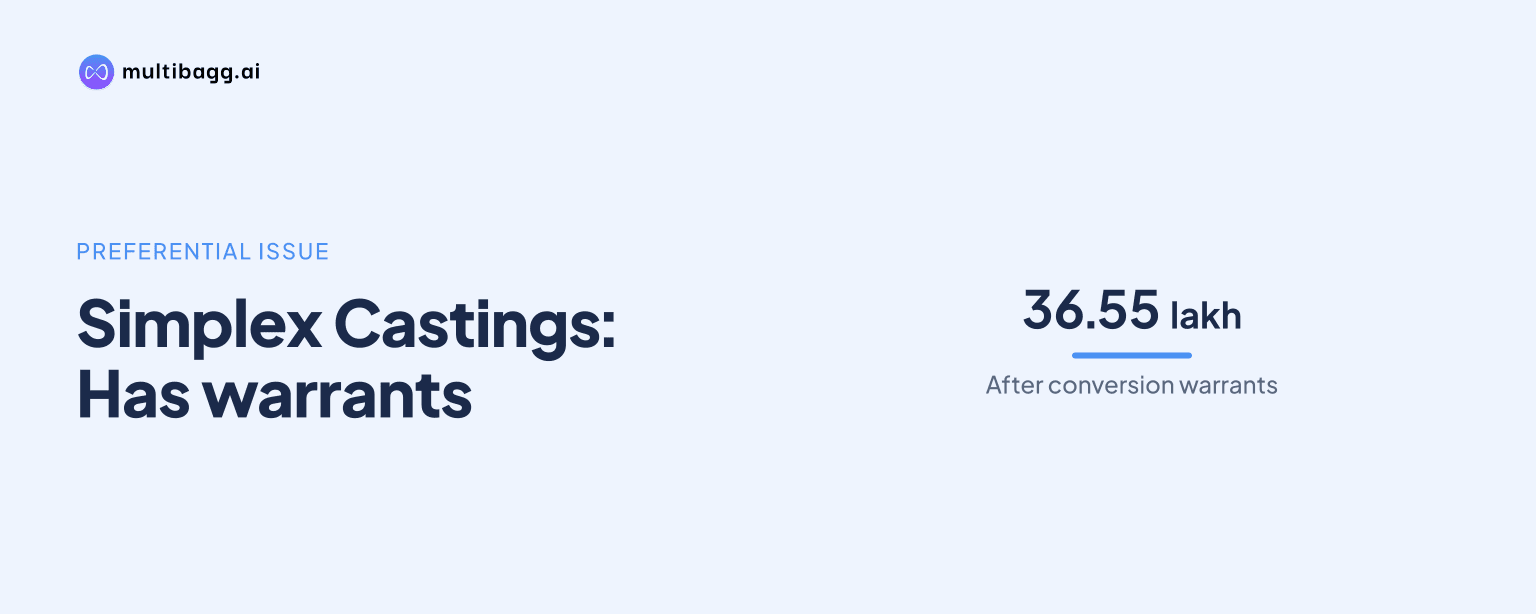
Simplex Castings Ltd. has 36,54,577 convertible warrants outstanding following a preferential allotment of 37,59,577 warrants at Rs 105 each, after 1,05,000 warrants were converted into equity shares; each remaining warrant can convert within 18 months if its holder pays the 75% balance.
Know Simplex Castings inside out
Results, valuation, peers and who's buying, in one view.
How many Simplex Castings warrants remain outstanding?
Simplex Castings has 36,54,577 warrants outstanding after 1,05,000 of the 37,59,577 warrants allotted were converted into equity shares. The warrants were issued through a preferential allotment under the Securities and Exchange Board of India, or SEBI, Issue of Capital and Disclosure Requirements Regulations, 2018, the Companies Act, 2013 and related rules.
The 1,05,000 converted warrants represented the portion for which two investors paid 100% of the consideration. Simplex Castings issued 1,05,000 fully paid equity shares at Rs 105 each on that conversion, with each share carrying a face value of Rs 2 and a premium of Rs 103.
The filing identifies Comfort Securities Limited and Pranav Koshal Maheshwari as the two investors whose 1,05,000 warrants converted into shares. The disclosure records Rs 1.1025 crore of consideration for those shares, while the remaining 36,54,577 warrants retain their conversion feature rather than representing issued equity.
Simplex Castings disclosed 35 investors for the warrant allotment. The supplied pages do not state the company’s total post-allotment equity share capital, so the 36,54,577 potential shares cannot be expressed as a percentage of its outstanding equity from this filing alone.
What are the payment and conversion terms for Simplex Castings warrants?
Simplex Castings requires warrant holders to pay at least 25% of the Rs 105 issue price upfront, or Rs 26.25 per warrant, and the remaining 75% when they exercise conversion. Each warrant is convertible into one fully paid equity share with a Rs 2 face value.
The warrants have a maximum exercise period of 18 months from their allotment date. The conversion decision rests with the proposed allottees, so the 36,54,577 outstanding warrants are potential shares rather than shares already issued by Simplex Castings.
The exercise price disclosed for the warrants is Rs 105 each, including a Rs 103 premium. The filing does not provide a floating conversion formula or an alternative future exercise price, meaning the stated mechanism is one warrant for one equity share at the disclosed Rs 105 issue price.
Equity shares issued on exercise will rank pari passu with existing Simplex Castings equity shares, meaning they will rank equally. The company also says the number of shares allotted on exercise is subject to appropriate adjustments allowed by applicable laws and regulations.
Got a follow-up? Ask IRIS
How does the warrant pool compare with Simplex Castings' direct share allotment?
Simplex Castings' 36,54,577 outstanding warrants exceed the 24,92,578 fully paid equity shares it separately allotted through a preferential issue. The difference is 11,61,999 securities, although the two instruments have different funding status and issuance mechanics.
The direct equity allotment involved 24,92,578 shares at Rs 105 each, including Rs 103 premium per share, and aggregated to Rs 26.172069 crore. Those shares were fully paid upon allotment, whereas holders of the outstanding warrants must still elect conversion and pay the remaining 75% of the issue price.
Both the direct equity issue and the warrant issue involved 35 investors, according to the respective disclosures. However, the filing does not establish that every investor received both types of securities, as the investor-level warrant allocations are set out separately in Annexure II.
The comparison shows that the possible future issue from outstanding warrants is larger by number than the completed direct equity allotment. It does not establish that all 36,54,577 warrants will convert, because conversion remains optional until the expiry of the 18-month exercise period.
What happens if Simplex Castings warrant holders do not convert?
Simplex Castings says unexercised warrants will lapse if holders do not exercise them within 18 months from allotment, and the amount paid on those warrants will be forfeited. This outcome applies to warrants still outstanding, not to the 1,05,000 warrants already converted into shares.
For the 36,54,577 outstanding warrants, the filing sets out two possible outcomes. Holders that exercise must pay the remaining 75% of the Rs 105 price and receive an equivalent number of fully paid shares; holders that do not exercise by the deadline lose the warrants and forfeit the upfront amount paid.
The company reported no cancellation or termination of the warrant issuance proposal. Its Regulation 30 disclosure cites the SEBI Master Circular dated January 30, 2026, while the warrant terms set the 18-month deadline from allotment rather than specifying a separate calendar conversion date in the supplied pages.
The initial payment requirement also differs from the two warrants already converted. Those two investors paid 100% consideration for 1,05,000 warrants, while the remaining warrant holders were subject to the minimum upfront payment of at least Rs 26.25 per warrant and the subsequent 75% payment on exercise.
Conclusion
Simplex Castings has completed a direct allotment of 24,92,578 equity shares and converted 1,05,000 warrants into shares, but it still has 36,54,577 warrants that could become equity. The outstanding warrant pool is larger than the direct share allotment, while its eventual conversion depends on each holder's decision and payment of the remaining 75% consideration.
The next disclosed milestone is the maximum 18-month exercise period from warrant allotment. Investors can watch for further conversion disclosures, the number of shares issued against warrants, and any warrants that lapse with the upfront payment forfeited if holders do not exercise by that deadline.