










Skyways Q2 profit rises 129.6% as revenue grows 90.3% YoY
Key highlights
- Skyways reported Q2 FY27 consolidated revenue from operations of Rs 1,311.45 crore, up 90.3% year on year.
- Q2 FY27 consolidated profit was Rs 33.18 crore, up 129.6% year on year.
- Skyways' Indian air-export market share rose to 6.3% from 6.2% during the quarter.
- The board declared a Rs 0.40 per-share second interim dividend, with November 20, 2026 as the record date.
powered by IRIS
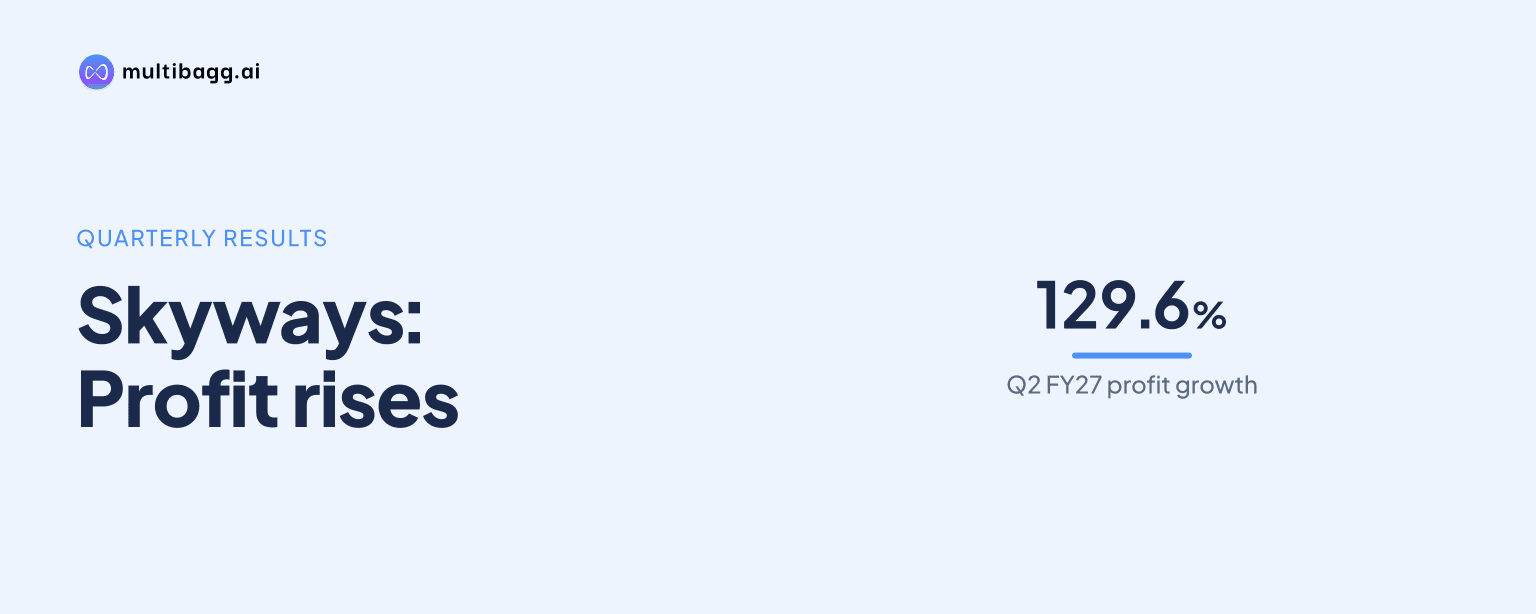
Skyways Air Services Limited reported unaudited consolidated profit of Rs 33.18 crore in Q2 FY27, up 129.6% year on year, as revenue from operations rose 90.3% to Rs 1,311.45 crore for the quarter ended September 30, 2026. The company also reported its Indian air-export market share increased by 0.1 percentage point to 6.3%.
Know Skyways Air Services inside out
Results, valuation, peers and who's buying, in one view.
How did Skyways' Q2 FY27 financial performance change?
Skyways increased consolidated revenue from operations by 90.3% year on year in Q2 FY27, while profit grew faster, by 129.6%. Revenue reached Rs 1,311.45 crore for the quarter ended September 30, 2026, compared with Rs 689.19 crore in Q2 FY26. Total income rose 88.8% to Rs 1,316.62 crore from Rs 697.21 crore, while total comprehensive income increased 127.4% to Rs 35.37 crore.
The first-half comparison showed a similar pattern, with Skyways' profit growing more rapidly than revenue. H1 FY27 revenue from operations was Rs 2,527.99 crore, up 90.3% from Rs 1,328.20 crore in H1 FY26, while profit for the period increased 135.5% to Rs 59.97 crore from Rs 25.46 crore. Total income for the six months rose 89.6% to Rs 2,541.79 crore.
Which margins and earnings measures improved at Skyways?
Skyways' Q2 FY27 earnings before interest, taxes, depreciation and amortisation, or EBITDA, margin rose to 4.46% from 4.33% in Q2 FY26, and its profit margin increased to 2.53% from 2.10%. EBITDA rose 96.0% to Rs 58.47 crore in the quarter from Rs 29.83 crore a year earlier. The EBITDA-margin change was 13 basis points, where one basis point equals one-hundredth of a percentage point, while the profit-margin change was 43 basis points.
For H1 FY27, EBITDA increased 90.0% to Rs 108.60 crore from Rs 57.15 crore, but the EBITDA margin remained at 4.30% in both half-year periods. Profit margin nevertheless rose to 2.37% from 1.92%, alongside a 135.5% increase in profit to Rs 59.97 crore. Basic earnings per share were Rs 1.91 in Q2 FY27 against Rs 0.71 in Q2 FY26, and Rs 3.60 in H1 FY27 against Rs 1.35 in H1 FY26.
Skyways also disclosed standalone results that were smaller than the consolidated totals for Q2 FY27. Standalone revenue from operations was Rs 704.10 crore, compared with consolidated revenue of Rs 1,311.45 crore, while standalone profit was Rs 22.59 crore against consolidated profit of Rs 33.18 crore. Standalone basic earnings per share were Rs 1.81, compared with Rs 0.73 in Q2 FY26.
Got a follow-up? Ask IRIS
What does Skyways report about air-cargo market position?
Skyways said its Indian air-export market share increased to 6.3% in the quarter from 6.2%, while WorldACD ranked it No. 42 globally for air cargo. The reported global position was two places higher than No. 44 in the preceding quarter. Skyways also said WorldACD continues to identify it as India's No. 1 air-export logistics solutions provider.
The company handled 51,115 tonnes of air cargo through offices in India and 11 other countries during H1 FY27. Its disclosure describes operations in 12 countries and partnerships with 56 airlines, alongside more than 9,500 customers in 65 industries. It also stated that its express network, operated through its own and partner network, covers more than 12,000 pin codes in India.
Management linked higher business volumes, market-share expansion and productivity to deeper use of digital capabilities and technology-led processes across business verticals. The company said wider technology adoption is intended to improve operational efficiency and scalability, and contributed to the Q2 FY27 EBITDA-margin improvement to 4.46%. This is management's stated operating explanation rather than a quantified segment-by-segment revenue attribution.
What agreements and shareholder actions did Skyways disclose?
Skyways renewed its Global Annual Agreement with Qatar Airways Group Q.C.S.C. as agent, with the agreement signed on November 6, 2026 and stated to be effective from January 1, 2026 for one year. The company said the agreement aims to increase the mutual air-cargo volumes handled. It did not disclose a cargo-volume commitment, rate, revenue target or financial contribution from the renewed agreement.
The board also declared a second interim dividend for FY 2026-27 of Rs 0.40 per equity share, equal to 4% of the Rs 10 face value. The record date is Friday, November 20, 2026, and Skyways said the dividend will be paid within 30 days of declaration. This shareholder action followed the Q2 FY27 consolidated profit of Rs 33.18 crore.
Chairman, Managing Director and Chief Executive Officer Yashpal Sharma said India's logistics sector was benefiting from rising exports, new airports and infrastructure-led reforms. He said Skyways is combining air, ocean, express, cross-border customs brokerage and trucking services with technology solutions to provide speed, visibility and inventory control. The statement sets out management's view of industry conditions and its service strategy, rather than a financial forecast.
Conclusion
Skyways' Q2 FY27 figures show revenue from operations rising 90.3% to Rs 1,311.45 crore and profit rising 129.6% to Rs 33.18 crore, with profit growth exceeding revenue growth. The quarter also brought a 43-basis-point year-on-year increase in profit margin to 2.53%, while the company reported a move in Indian air-export share from 6.2% to 6.3% and a global ranking improvement from No. 44 to No. 42.
The next disclosed milestones are the November 20, 2026 record date for the Rs 0.40 second interim dividend and payment within 30 days of its declaration. Operationally, the one-year Qatar Airways agreement, stated to be effective from January 1, 2026, is intended to increase mutual air-cargo volumes, so subsequent disclosures could indicate whether that aim is reflected in handled tonnage, market share or financial performance.