








Smruthi Organics Limited Stake Rises to 56.34% by Inheritance
Max Plan at ₹4,999/yr₹8,999

Find your next multibaggerBe a Pro Investor
Research stocks and track your picks on the go. Download the app.
Key highlights
- Eaga Purushotham Malaiah inherited 17,29,350 Smruthi Organics shares on 23 November 2026.
- The inheritance raised Malaiah’s individual holding from 41.23% to 56.34%.
- The transferred shares represented 15.11% of Smruthi Organics’ voting capital.
- The filing reported nil consideration and no encumbrance, warrants or convertible instruments for the acquisition.
powered by IRIS
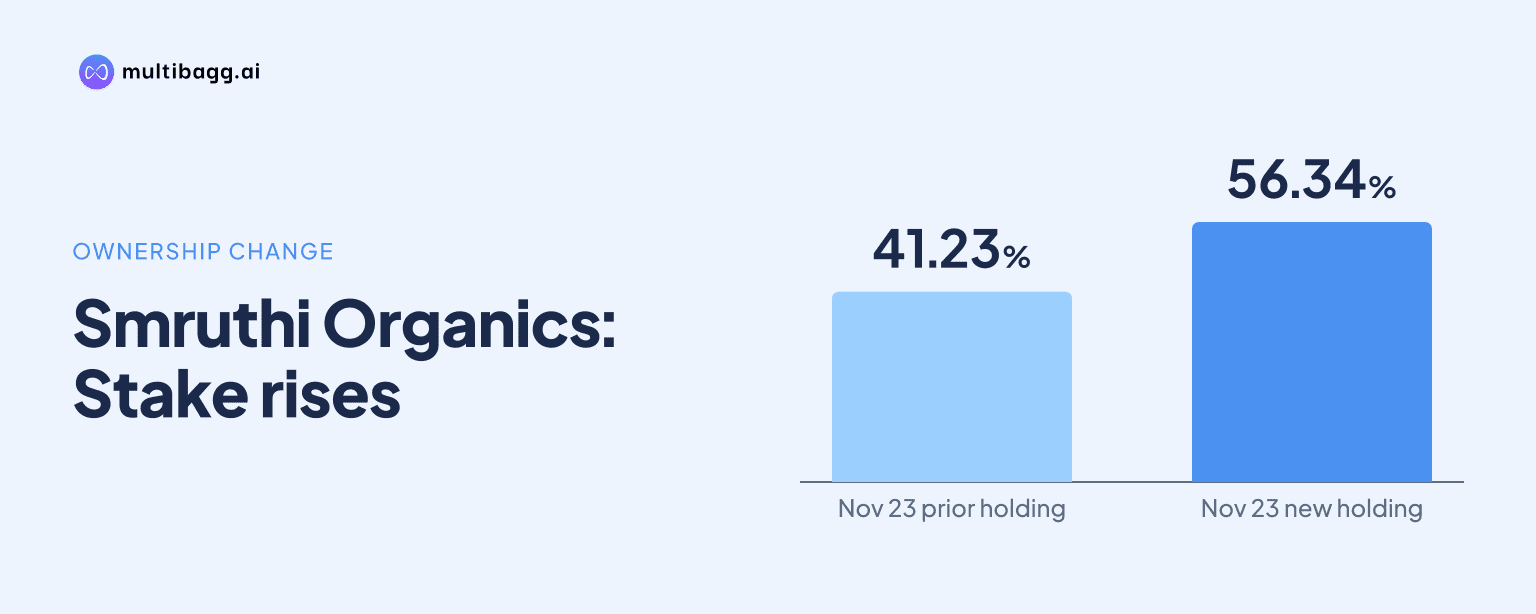
Smruthi Organics Limited reported that promoter and Managing Director Eaga Purushotham Malaiah’s individual holding rose to 56.34% on 23 November 2026 after he inherited 17,29,350 equity shares, representing 15.11% of voting capital. The transmission followed the death of Vaishnavi Purushotham Eaga and did not involve a fresh issue of shares.
Know Smruthi Organics inside out
Results, valuation, peers and who's buying, in one view.
What did Smruthi Organics Limited disclose about the inheritance?
Smruthi Organics Limited disclosed that Eaga Purushotham Malaiah received 17,29,350 equity shares through inheritance. His individual shareholding increased from 47,18,936 shares, or 41.23%, to 64,48,286 shares, or 56.34%, following the transmission completed on 23 November 2026.
The filing identifies the late Vaishnavi Purushotham Eaga, a promoter-group member, as the person from whom the shares were transmitted. It records inheritance as the mode of acquisition and states that the transaction occurred after her demise. The company made the disclosure on 25 November 2026.
This is a transfer of an existing shareholding within the promoter group rather than a market purchase, preferential allotment, or issue of new equity. As a result, the filing does not indicate an increase in Smruthi Organics’ outstanding equity share capital.
How large was the promoter holding change?
Eaga Purushotham Malaiah’s holding rose by 15.11 percentage points to 56.34%, matching the 17,29,350 shares transmitted by inheritance. The percentage is calculated against the company’s reported equity capital base of 1,14,46,290 shares.
The individual stake before the transmission stood at 41.23%. After the transaction, Malaiah held more than half of the company’s voting capital in his individual capacity. The filing, however, concerns his individual holding and should not be read as a full statement of the combined promoter-group holding.
The disclosure also reports nil encumbrance, warrants and convertible instruments in relation to the acquisition. It does not disclose a transaction price because the shares were received by inheritance and without consideration.
Which regulatory disclosure applies to the transfer?
The company reported the transaction under Regulation 29(2) of the Securities and Exchange Board of India’s Substantial Acquisition of Shares and Takeovers Regulations, 2011. This provision requires disclosure when an acquisition or disposal results in specified changes in shareholding or voting rights.
The filing describes inheritance as the mode of acquisition. Inheritance-based transmission is distinct from a voluntary off-market purchase because ownership passes due to succession rather than through a negotiated sale. The available disclosure also describes the transaction as exempt from an open-offer requirement under the applicable takeover regulations.
A separate promoter-trading disclosure recorded inheritance as the mode of acquisition and named the parties involved. These disclosures provide a formal record of the ownership change but do not state that cash consideration was paid by Malaiah for the shares.
Got a follow-up? Ask IRIS
Why does the inheritance transfer matter for investors?
The inheritance transfer matters because it increases Malaiah’s individual voting stake in Smruthi Organics to 56.34%. A holding above 50% gives the promoter a majority of voting capital on an individual basis, subject to the rights attached to the equity shares and applicable corporate law requirements.
For public shareholders, the immediate development is a change in the distribution of existing promoter-group shares, not an equity dilution event. The company’s filing does not report new shares, a capital raise, a change in business operations, or a financial impact arising from the transmission.
The transaction also formally documents succession-related ownership following the death of Vaishnavi Purushotham Eaga. The disclosure provides clarity on the recipient, number of shares, date of transmission and post-transaction individual holding, which are relevant facts for investors tracking promoter ownership.
What should investors monitor after the disclosure?
Investors should monitor subsequent shareholding disclosures for any updated combined position of Malaiah and persons acting in concert. The 25 November filing identifies relevant promoter and promoter-group parties, while reporting Malaiah’s individual stake at 56.34%.
Investors can also track future exchange filings for changes in pledge status, further promoter transfers, board-related disclosures or revisions to the shareholding pattern. The present filing reports no encumbrance connected with the disclosed acquisition and no warrants or convertible instruments.
The transfer itself does not establish a change in Smruthi Organics’ financial performance or operating outlook. It is principally an ownership disclosure, so its market relevance rests on the concentration and transparency of promoter shareholding rather than a reported operating development.
Conclusion
Smruthi Organics reported a succession-related transfer of 17,29,350 shares to Eaga Purushotham Malaiah, lifting his individual stake from 41.23% to 56.34%. The filing records an inheritance without consideration, leaves the equity capital unchanged, and reports no encumbrance, warrants or convertible instruments for the acquisition.
The next point to watch is a subsequent disclosure detailing the combined holding of Malaiah and the persons acting in concert identified in the filing. Investors may also watch for the company’s next shareholding-pattern update or any further promoter-group transaction reported to the exchanges.

