










Spice Money loan disbursals rise 33% sequentially in Q2 FY27
Key highlights
- Spice Money's Grahak loan disbursals rose 33% sequentially to Rs 223.5 crore in Q2 FY27.
- Unsecured Grahak loan disbursals increased to Rs 32.8 crore in Q2 FY27 from Rs 1.7 crore in Q1 FY27.
- Spice Money's lifetime CASA accounts reached 18.89 lakh in Q2 FY27, up from 17.77 lakh in Q1 FY27.
- Total float income declined to Rs 47 lakh in Q2 FY27 from Rs 51 lakh in Q1 FY27.
powered by IRIS
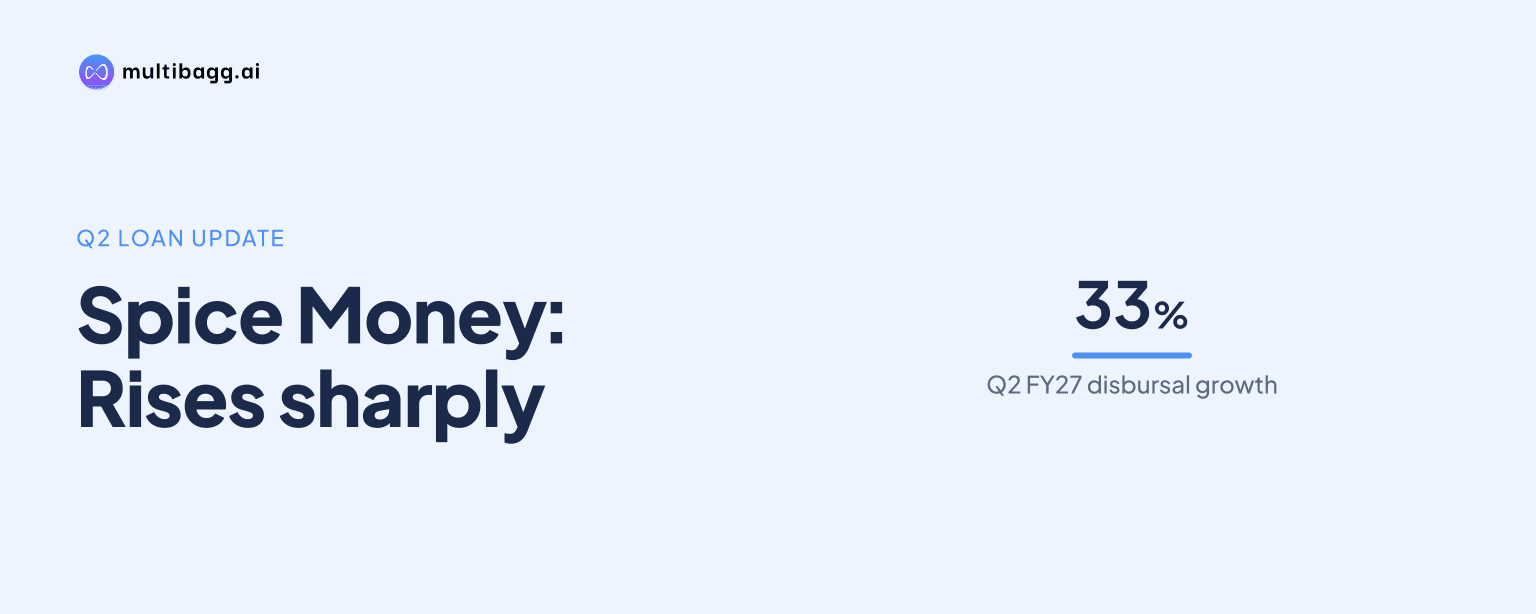
Spice Money distributed Rs 223.5 crore of Grahak loans in Q2 FY27, 33% more than Rs 167.7 crore in Q1 FY27, as unsecured lending increased to Rs 32.8 crore from Rs 1.7 crore. The Q2 FY27 personal-loan-category launch coincided with gains in secured distribution, while total float income fell to Rs 47 lakh.
Know DigiSpice Technologies inside out
Results, valuation, peers and who's buying, in one view.
How much did Spice Money's Grahak loan distribution grow?
Spice Money's total Grahak loan disbursals rose by Rs 55.8 crore sequentially to Rs 223.5 crore in Q2 FY27, from Rs 167.7 crore in Q1 FY27. The presentation reports 33% quarter-on-quarter growth and 40% year-on-year growth, compared with Rs 159.3 crore of disbursals in Q2 FY26.
The Q2 FY27 total exceeded the Rs 198.1 crore distributed during all of FY25, but remained below the Rs 539.6 crore distributed in FY26. FY26 disbursals were 2.7 times the FY25 figure, with secured gold, other secured and unsecured loans all contributing to that annual increase.
Which loan products drove Spice Money's quarterly increase?
Unsecured loans made the largest contribution to Spice Money's quarter-on-quarter rise, increasing by Rs 31.1 crore to Rs 32.8 crore in Q2 FY27 from Rs 1.7 crore in Q1 FY27. The category accounted for about 15% of Q2 FY27 Grahak disbursals, compared with about 1% in the preceding quarter.
Other secured loan disbursals grew by Rs 19.8 crore sequentially to Rs 83.5 crore, while secured gold loans increased by Rs 4.9 crore to Rs 107.2 crore. Gold loans remained the largest category by value in Q2 FY27, although other secured and unsecured products grew faster than gold loans from Q1 FY27.
Spice Money said it launched its personal-loan category in Q2 FY27. The presentation does not separate personal loans within the Rs 32.8 crore unsecured total or disclose borrower mix, approval rates, loan tenors, pricing or credit performance for the category.
What is Spice Money's plan for credit distribution?
Spice Money reported six lenders on board for credit distribution and said it plans to scale five core referral loan products: two-wheeler loans, gold loans, and micro loans for home, loan against property and business purposes. Management also said it is targeting supply-side strengthening through lender partnerships, including for fixed-deposit-backed credit cards.
Spice Money reported 2,261 fixed-deposit-backed credit cards in Q2 FY27, compared with 1,622 in Q1 FY27 and 1,101 in Q2 FY26. The Q2 FY27 count also exceeded the 2,049 cards reported in Q4 FY26, after declining to 901 in Q3 FY26.
Savings and investment products are the next categories on Spice Money's product roadmap. The presentation gives no launch date, disbursal target, revenue target or planned number of additional lenders for these products.
Got a follow-up? Ask IRIS
How did Spice Money's CASA accounts and float income change?
Spice Money's lifetime current-account and savings-account, or CASA, total reached 18.89 lakh in Q2 FY27, rising from 17.77 lakh in Q1 FY27 and 13.23 lakh in Q2 FY26. Savings accounts numbered 18.05 lakh in Q2 FY27, while current accounts totalled 83,000.
Total float income declined to Rs 47 lakh in Q2 FY27 from Rs 51 lakh in Q1 FY27, although it was above Rs 42 lakh in Q2 FY26. Spice Money said more than 60,000 Adhikaris had opened more than 18.9 lakh CASA accounts, generating about Rs 16 lakh of monthly recurring float income.
Spice Money reported daily account openings of about 1,200 and average bank balances of about Rs 1,000 to Rs 1,500 per account. Its stated banking growth levers are referral banking, new account variants and building float, while the presentation does not disclose the reason for the sequential decline in total float income.
How does Spice Money's network support financial-product distribution?
Spice Money plans to deepen credit, CASA, Unified Payments Interface Cash Point and Spice Money UPI adoption across its established SMA network in the East and Central belt. At September 2026, the company reported 17.25 lakh total agents, including 14.4 lakh agents in Tier 4, 5 and 6 small towns with populations below 20,000.
The East region had 6.26 lakh agents, or 36.3% of the total, while the North had 5.78 lakh, or 33.5%. West Central accounted for 3.62 lakh agents and the South for 1.59 lakh, and Spice Money said it would continue agent onboarding in the South, West and North-East to build density.
The agent base rose from 16.61 lakh in FY26 to 17.25 lakh in Q2 FY27. Spice Money cited a 12.7% compound annual growth rate for the base from FY22 to FY27, with its network extending across 2.71 lakh small towns, 6,471 blocks and dense coverage in 12 states.
Conclusion
Spice Money's Q2 FY27 financial-product distribution results show that the Rs 55.8 crore sequential increase in Grahak loan disbursals was led by a Rs 31.1 crore increase in unsecured lending, alongside higher other secured and gold-loan volumes. The CASA base also expanded by 1.12 lakh accounts sequentially, even as total float income declined by Rs 4 lakh.
The next disclosed markers are the scaling of five referral loan products, the development of savings and investment products, and any expansion beyond the six credit-distribution lenders. Spice Money has not provided a timetable or financial target for the savings and investment roadmap, while the Q2 FY27 personal-loan launch leaves future unsecured disbursal trends to be tracked.