










Styrenix Performance Materials Q2 income rises 26.5% year on year
Key highlights
- Styrenix Performance Materials reported Q2 FY27 standalone income of Rs 781 crore, up 26.5% year on year.
- Standalone Q2 FY27 EBITDA was Rs 84.5 crore, with an EBITDA margin of 10.8%.
- Consolidated Q2 FY27 income was Rs 997 crore and sales volume was 55.1 KT.
- Management expects its new expansion to add volumes in FY28 and beyond.
powered by IRIS
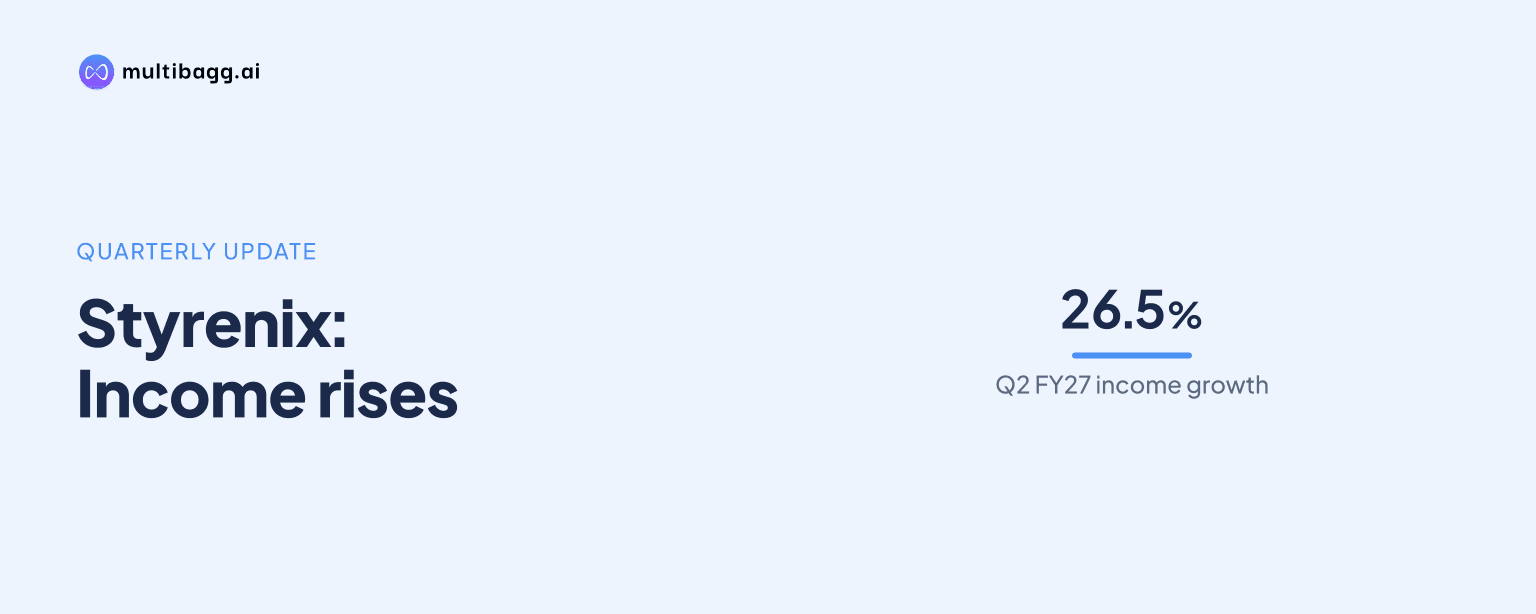
Styrenix Performance Materials Ltd reported standalone total income of Rs 781 crore for Q2 FY27, a 26.5% year-on-year increase, while consolidated income was Rs 997 crore and consolidated sales volume reached 55.1 KT. The quarterly update matters because it shows higher reported income across the India and Thailand operations amid the company’s ongoing capacity expansion plans.
Know Styrenix Performance Materials inside out
Results, valuation, peers and who's buying, in one view.
What did Styrenix Performance Materials report for Q2 FY27?
Styrenix Performance Materials Ltd reported standalone total income of Rs 781 crore in Q2 FY27, compared with a year-on-year growth rate of 26.5% disclosed during its October 29 earnings call. Standalone EBITDA was Rs 84.5 crore, up 3.3% year on year, and the EBITDA margin stood at 10.8%.
On a consolidated basis, which includes operations in India and Thailand, Styrenix Performance Materials reported total income of Rs 997 crore. Consolidated EBITDA was Rs 75.6 crore, representing a margin of 7.6%, while profit after tax was Rs 23 crore. Consolidated sales volume was 55.1 kilotonnes, or KT, for the quarter.
How did the quarter compare with Q1 FY27?
Styrenix Performance Materials reported consolidated sales volume of 55.1 KT in Q2 FY27, compared with 50.8 KT in Q1 FY27. The figures cover both India and Thailand and show a quarter-on-quarter increase of 4.3 KT in consolidated volume.
The Q1 FY27 disclosure had reported consolidated total income of Rs 1,014.2 crore, EBITDA of Rs 223.6 crore, and profit after tax of Rs 138.3 crore. The Q2 consolidated numbers were lower than these Q1 figures, with EBITDA margin at 7.6% in Q2 against 22% in Q1. The company did not provide a detailed explanation for the sequential change in the supplied call extract.
What did management say about capacity and demand?
Managing Director Rahul Agarwal said the India business, excluding Q1 FY27, has been operating relatively full. He declined to provide forward volume guidance, but said management was confident that the new expansion would achieve high utilisation within a short period and add volumes in FY28 and thereafter.
Styrenix Performance Materials also referred to the technology acquired in Thailand and the new capacity being developed in India. Management said these capabilities would allow the company to serve additional demand, including refrigeration-liner ABS requirements. It estimated the Indian ABS market at 350,000 to 400,000 tonnes, with imports accounting for roughly half of that market.
Got a follow-up? Ask IRIS
Why are imports relevant to Styrenix Performance Materials?
Management indicated that refrigeration-liner ABS imports into India are typically about 30,000 to 40,000 tonnes. This volume forms part of the broader opportunity management discussed as it builds capability through the Thailand technology and planned Indian capacity.
The company’s stated strategy has been to expand its India business despite short-term volatility and demand fluctuations. In the Q4 FY26 call, management said it remained committed to doubling ABS and SAN output in India over the following two to three years. The Q2 FY27 discussion maintained the focus on adding capacity and reaching utilisation quickly once the expansion is operational.
How does the update affect investors and industry participants?
For investors, the quarter provides two different operating indicators. Standalone income increased 26.5% year on year to Rs 781 crore, while standalone EBITDA rose 3.3% to Rs 84.5 crore and the margin was 10.8%. On the consolidated side, Q2 sales volume increased from the Q1 level, but income, EBITDA and profit after tax were lower than the preceding quarter.
For customers and the wider ABS and SAN industry, the reported expansion plans are relevant because the company expects new India capacity and Thailand-derived technology to broaden its ability to address domestic demand. Management has not issued a volume forecast, so the timing and scale of additional FY28 volumes remain dependent on execution and the utilisation ramp-up it described.
Conclusion
Styrenix Performance Materials delivered a 26.5% year-on-year rise in standalone Q2 FY27 income to Rs 781 crore, alongside consolidated income of Rs 997 crore and sales volume of 55.1 KT. The results also showed a lower consolidated EBITDA margin than in Q1 FY27, making profitability and volume trends important elements of the quarterly update.
The next point to watch is the company’s planned India expansion and its stated expectation of reaching high utilisation shortly after commissioning. Management expects the project to add volumes from FY28 onward, but has not provided forward volume guidance or a specific commissioning timetable in the supplied call details.