










Sugs Lloyd Limited borrowings more than double by September
Key highlights
- Sugs Lloyd’s total borrowings rose to Rs 163.07 crore at 30 September 2026 from Rs 68.94 crore at 31 March 2026.
- Operating cash flow was negative Rs 12.31 crore in H1 FY27, while finance costs increased 51% year on year to Rs 5.89 crore.
- H1 FY27 revenue rose 73% year on year to Rs 213.31 crore, while EBITDA increased 64% to Rs 31 crore and profit after tax rose 69% to Rs 20.01 crore.
- Sugs Lloyd reported an outstanding order book of Rs 1,068 crore at 30 September 2026, including Rs 929 crore in Power T&D and Rs 139 crore in Solar.
powered by IRIS
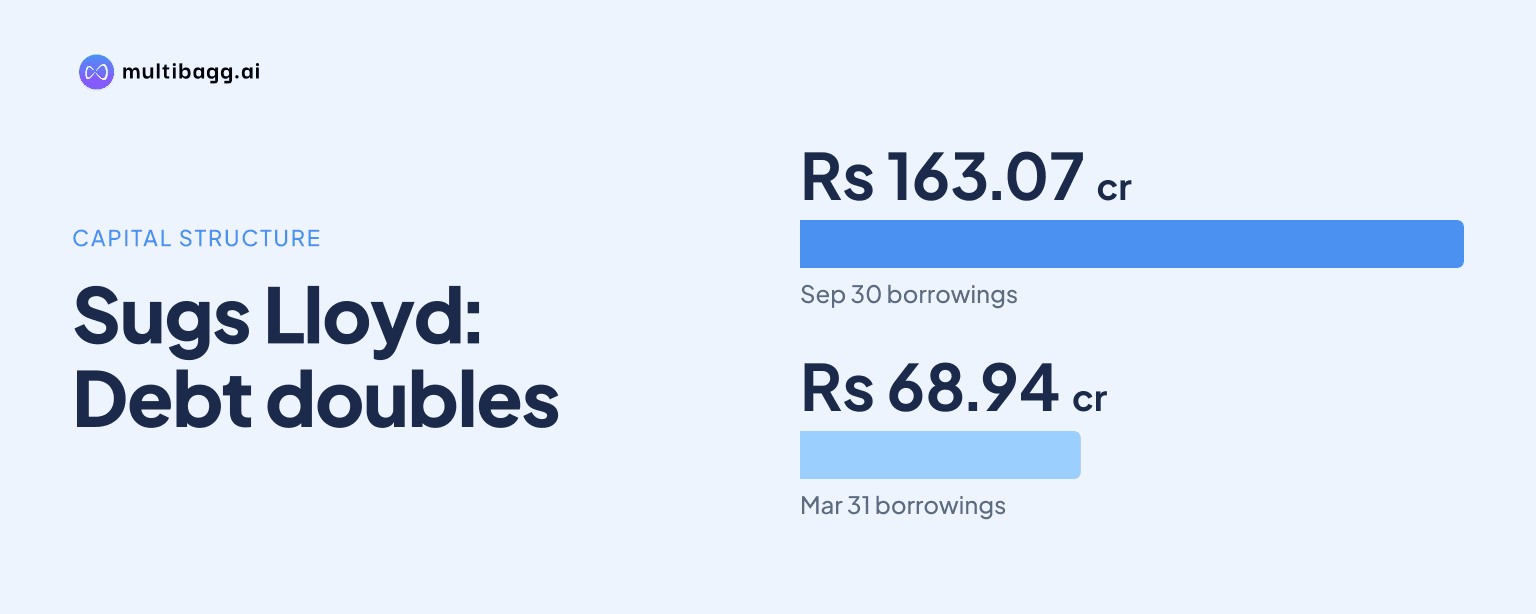
Sugs Lloyd’s total borrowings rose to Rs 163.07 crore at 30 September 2026 from Rs 68.94 crore at 31 March 2026. The increase accompanied working-capital funding for the Patna project, negative operating cash flow of Rs 12.31 crore in the first half of financial year 2026-27 (H1 FY27), and Rs 37.05 crore of solar assets under development.
Know Sugs Lloyd inside out
Results, valuation, peers and who's buying, in one view.
What changed in Sugs Lloyd’s balance sheet?
Sugs Lloyd’s borrowings increased by Rs 94.13 crore between 31 March 2026 and 30 September 2026, more than doubling over the six-month period. Net worth rose by Rs 20.01 crore to Rs 157.22 crore, but borrowings exceeded net worth by Rs 5.85 crore at the September reporting date.
The increase changed the company’s reported leverage measure. Debt to equity rose to 1.04 times at 30 September 2026 from 0.50 times at 31 March 2026, while trade receivables rose by Rs 11 crore and trade payables rose by Rs 14 crore.
Sugs Lloyd said working capital increased with the scale-up of the Patna project and was funded largely through working-capital facilities. The announcement does not provide a borrowing-by-borrowing allocation, so it does not specify how much of the Rs 163.07 crore balance was attributable to the Patna project versus other funding needs.
How did working capital affect Sugs Lloyd’s cash flow?
Sugs Lloyd reported cash flow from operations of negative Rs 12.31 crore in H1 FY27. The company compared that result with negative Rs 37.39 crore for the full financial year 2025-26 (FY26), rather than disclosing a corresponding H1 FY26 operating-cash-flow figure.
Trade receivables reached Rs 150 crore at 30 September 2026, up from Rs 139 crore at 31 March 2026. Inventories increased to Rs 12 crore from Rs 11 crore, showing that operating assets grew during the same period as the Patna project ramp-up.
Trade payables increased to Rs 75 crore at 30 September 2026 from Rs 61 crore at 31 March 2026. This Rs 14 crore increase in supplier obligations occurred alongside the Rs 94.13 crore rise in borrowings, although the release does not quantify the separate cash-flow effects of receivables, inventory and payables.
Finance costs rose 51% year on year to Rs 5.89 crore in H1 FY27, which Sugs Lloyd attributed to higher working-capital borrowings. Revenue from operations rose 73% to Rs 213.31 crore in the same half, placing the higher funding costs alongside a larger scale of billing and project execution.
Got a follow-up? Ask IRIS
How did project execution and revenue change in H1 FY27?
Sugs Lloyd’s revenue from operations increased to Rs 213.31 crore in H1 FY27 from Rs 123.03 crore in H1 FY26. The H1 FY27 figure was already 71% of the Rs 300.73 crore reported for full-year FY26, according to the company.
Second-quarter revenue reached Rs 134.91 crore, up 112% from Rs 63.62 crore in the same quarter a year earlier and 72% above Rs 78.40 crore in the first quarter of FY27. Sugs Lloyd said the second-quarter amount included both that quarter’s billing and June billing that had moved from the first quarter into the second quarter.
Power transmission and distribution (Power T&D) and Smart Grid contributed 80% of H1 FY27 revenue, compared with 46% of revenue in FY26. Solar engineering, procurement and construction (Solar EPC) contributed the remaining 20% of H1 FY27 revenue, highlighting a changed revenue mix toward the Power T&D and Smart Grid vertical.
Earnings before interest, tax, depreciation and amortisation (EBITDA) rose 64% to Rs 31 crore in H1 FY27, while profit after tax increased 69% to Rs 20.01 crore. EBITDA margin declined to 14.54% from 15.34%, and profit-after-tax margin declined to 9.38% from 9.61%.
What does Sugs Lloyd’s solar investment and order book show?
Sugs Lloyd recorded Rs 37.05 crore of capital work-in-progress at 30 September 2026, with no amount reported at 31 March 2026. The company said the balance primarily relates to assets under development for the NBPDCL rooftop solar project under a capital expenditure-plus-RESCO model.
The company’s outstanding order book was Rs 1,068 crore at 30 September 2026, comprising Rs 929 crore in Power T&D and Rs 139 crore in Solar. During the second quarter of FY27, it won seven orders worth Rs 395.28 crore excluding goods and services tax, equal to 2.9 times quarterly revenue of Rs 134.91 crore.
Management said Sugs Lloyd would focus on execution discipline, collections and conversion of its qualified bid pipeline for the remainder of FY27. It also said supplies of compact fault passage indicators are expected to begin in the third quarter of FY27, while development of vacuum circuit breakers and ring main units continues.
Conclusion
Sugs Lloyd’s September 2026 balance sheet reflects a faster execution cycle financed largely through working-capital borrowings. Debt rose to Rs 163.07 crore as receivables reached Rs 150 crore, operating cash flow was negative Rs 12.31 crore, and Rs 37.05 crore of capital work-in-progress was accumulated for the NBPDCL rooftop solar project.
The next disclosed markers are collections, execution and conversion of the Rs 1,068 crore order book. Management has set revenue guidance of Rs 1,000 crore for FY27-28, while planned compact fault passage indicator supplies in the third quarter of FY27 and ongoing product development remain additional operational milestones.