










Sundaram Finance Q2 PAT rises 21% as S Viji steps down
Key highlights
- Sundaram Finance's standalone Q2 FY27 PAT rose 21% to ₹475 crore from ₹394 crore.
- Q2 FY27 disbursements increased 28% to ₹10,355 crore, while H1 FY27 disbursements grew 25% to ₹19,302 crore.
- Assets under management rose 19% year-on-year to ₹65,992 crore as of September 30, 2026.
- S Viji stepped down after 21 years as chairman, and R Venkatraman was appointed chairman.
powered by IRIS
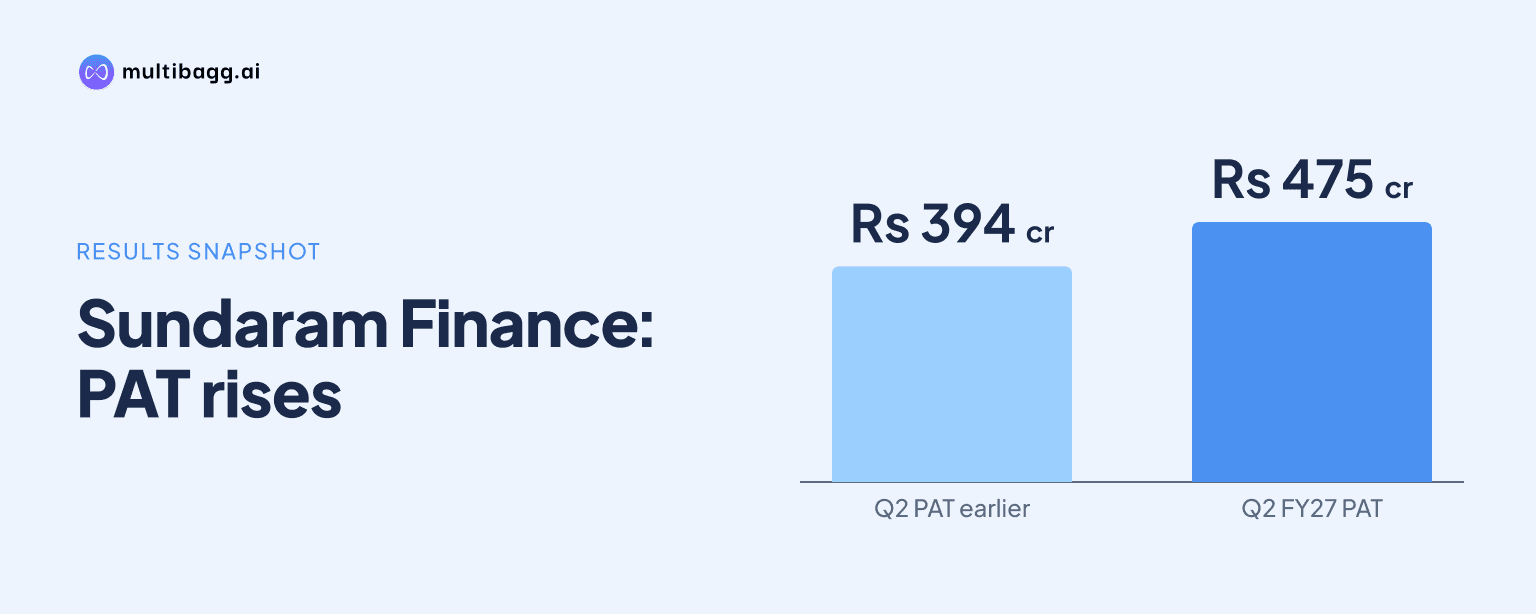
Sundaram Finance Limited reported standalone profit after tax of ₹475 crore for Q2 FY27, up 21% from ₹394 crore a year earlier, while S Viji stepped down as chairman after 21 years and the board appointed R Venkatraman as his successor. The result was supported by higher disbursements and net interest income.
Know Sundaram Finance inside out
Results, valuation, peers and who's buying, in one view.
What did Sundaram Finance report for Q2 FY27?
Sundaram Finance reported a 21% year-on-year rise in standalone profit after tax to ₹475 crore for the quarter ended September 30, 2026. The corresponding standalone profit after tax was ₹394 crore in Q2 FY26. Profit from operations before tax increased to ₹598 crore from ₹501 crore.
The company also reported consolidated net profit of ₹517 crore for the quarter, compared with ₹488 crore in the corresponding quarter of the previous year, representing growth of 5.9%. The difference between the standalone and consolidated figures reflects the inclusion of group businesses in the consolidated result.
Net interest income rose 21.1% to ₹1,016 crore in Q2 FY27 from ₹839 crore a year earlier. Revenue from operations was ₹1,768 crore, compared with ₹1,963 crore in Q2 FY26. Disbursements grew 28% to ₹10,355 crore from ₹8,113 crore.
Why did S Viji step down as Sundaram Finance chairman?
S Viji stepped down as chairman of Sundaram Finance after serving in the role for 21 years. The board appointed R Venkatraman as the new chairman during its meeting. The information provided does not state a reason for S Viji's decision to step down.
Harsha Viji, executive vice chairman, said domestic economic momentum remained strong during Q2 FY27 despite a more challenging global environment. He also said the group's asset management, general insurance and home finance businesses continued to report strong results.
The leadership change comes alongside a period of growth in the core lending business. Sundaram Finance said it remains focused on steady growth, asset quality and consistent profitability. The company also announced the SAAL acquisition, though the supplied information does not provide financial terms or further operating details of the transaction.
How did disbursements and assets under management perform?
Sundaram Finance's disbursements increased 25% in the first half of FY27 to ₹19,302 crore from ₹15,423 crore in H1 FY26. Its Q2 disbursements rose at a faster 28% year-on-year pace, indicating continued loan demand during the September quarter.
Assets under management stood at ₹65,992 crore as of September 30, 2026, up 19% from ₹55,419 crore a year earlier. For H1 FY27, profit after tax rose 21% to ₹997 crore, while profit from operations grew 23%.
Return on assets improved to 2.86% in H1 FY27 from 2.72% in H1 FY26. The cost-to-income ratio was 29.40%, marginally lower than 29.60% a year earlier. Capital adequacy stood at 18.5%, which the company described as comfortable.
Got a follow-up? Ask IRIS
Has Sundaram Finance's asset quality improved?
Sundaram Finance's asset quality improved in its core business during the period. Gross Stage 3 assets declined to 1.84% as of September 30, 2026, from 2.03% a year earlier, while net Stage 3 assets fell to 0.91% from 1.13%.
Provision coverage rose to 51% from 45% over the same period. These movements accompanied growth in lending volumes and AUM, making asset-quality trends an important part of the quarterly performance for investors.
Sundaram Home Finance, a group company, reported 21% growth in H1 FY27 disbursements to ₹3,827 crore. Its profit increased to ₹175 crore from ₹137 crore. However, its gross Stage 3 assets increased to 1.39% from 1.24%, while net Stage 3 assets rose to 0.73% from 0.62%.
What does the result mean for investors and the group businesses?
The quarterly result shows that lending growth, higher net interest income and improved core asset quality supported Sundaram Finance's standalone earnings. Investors also have a leadership transition to assess following the appointment of R Venkatraman as chairman.
The group businesses added to the broader operating picture. Royal Sundaram reported a 17% increase in H1 FY27 gross written premium to ₹2,750 crore from ₹2,352 crore a year earlier. The home finance business delivered profit growth, although its Stage 3 asset ratios moved higher.
Sundaram Finance shares closed 1.11% lower at ₹4,011.90 on the NSE on November 4. Rajiv Lochan, managing director, said the outlook for the second half was constructive on growth, while pointing to geopolitical tensions, monetary-policy direction and the impact of a below-normal monsoon on sentiment as factors requiring monitoring.
Conclusion
Sundaram Finance combined 21% growth in standalone Q2 profit with a 28% increase in quarterly disbursements and lower core Stage 3 asset ratios. The results also marked a significant board change, with S Viji ending his 21-year tenure as chairman and R Venkatraman taking over the role.
Investors will watch whether the constructive H2 growth outlook translates into further disbursement and AUM expansion, while monitoring asset quality, interest-rate conditions, monsoon-linked sentiment and the disclosed SAAL acquisition.