










Sunita Tools H1 FY27 Consolidated Profit Rises 103.3%
Key highlights
- Sunita Tools reported H1 FY27 consolidated revenue of ₹36.73 crore, up 131.7% year-on-year.
- Consolidated net profit rose 103.3% to ₹5.85 crore from ₹2.88 crore in H1 FY26.
- Standalone revenue from operations grew 129.4% to ₹35.00 crore, while net profit fell 14.1% to ₹2.61 crore.
- Capital work-in-progress increased to ₹30.98 crore from ₹19.93 crore as of March 31, 2026.
powered by IRIS
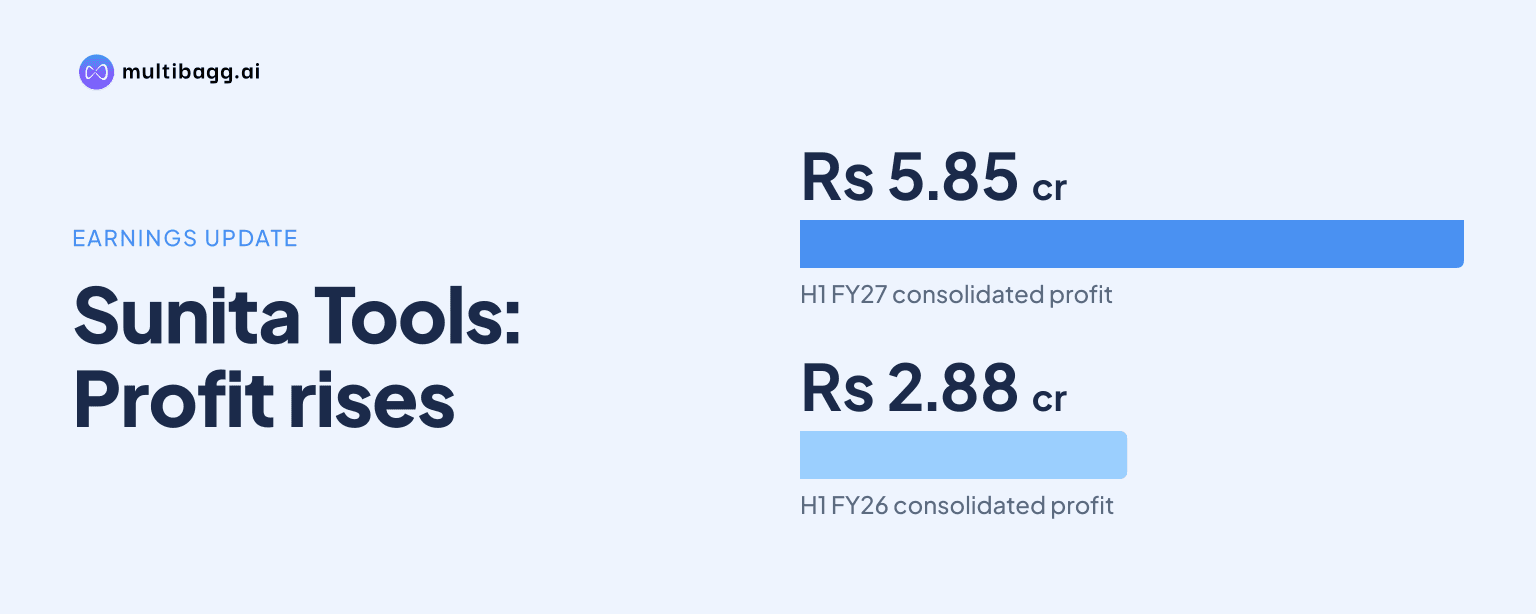
Sunita Tools Ltd reported consolidated net profit of ₹5.85 crore for the half year ended September 30, 2026, up 103.3% year-on-year, while consolidated total revenue rose 131.7% to ₹36.73 crore. The results show strong group-level growth, although the standalone business recorded lower profit despite a sharp increase in revenue.
Know Sunita Tools inside out
Results, valuation, peers and who's buying, in one view.
What did Sunita Tools report for H1 FY27?
Sunita Tools approved its unaudited standalone and consolidated financial results for H1 FY27 at a Board of Directors meeting held on November 13, 2026. The company reported consolidated revenue from operations of ₹36.60 crore, compared with ₹15.70 crore in H1 FY26. Consolidated total revenue stood at ₹36.73 crore.
Consolidated net profit rose to ₹5.85 crore from ₹2.88 crore a year earlier. The increase of 103.3% in profit was lower than the 131.7% reported rise in total revenue, but it still marked a substantial improvement in the group’s earnings during the six-month period.
On a standalone basis, total revenue increased 128.0% to ₹35.12 crore. Revenue from operations was ₹35.00 crore, against ₹15.26 crore in H1 FY26. However, standalone net profit declined 14.1% to ₹2.61 crore from ₹3.04 crore in the corresponding previous-year period.
Why did standalone profit decline despite revenue growth?
Standalone profit declined because expenses grew sharply alongside the increase in sales. Total standalone expenses rose to ₹32.12 crore in H1 FY27 from ₹11.92 crore in H1 FY26, reducing the benefit of the higher revenue base.
Purchases increased 163% year-on-year, according to the reported figures, while employee-benefit costs also rose. The resulting cost increase compressed margins at the standalone level. Profit before tax fell to ₹3.01 crore from ₹3.49 crore despite the substantial rise in revenue from operations.
The results therefore show a difference between sales growth and profitability in the standalone business. Higher activity generated more revenue, but associated input and operating costs rose at a pace that reduced pre-tax earnings compared with the prior-year half.
How did the consolidated business perform differently?
The consolidated business performed better because consolidated net profit more than doubled to ₹5.85 crore even as standalone profit fell to ₹2.61 crore. The reported consolidation includes Sunita Leoquip Aerospace Private Limited, AP Global Packing Private Limited and Sunita Defence Inc., along with step-down subsidiary New Mould Innovation.
The contrast between standalone and consolidated profit trends indicates that the wider group generated earnings beyond those reflected in the parent company’s standalone accounts. The disclosed figures do not provide separate financial contributions for each subsidiary, so their individual effect on group profit cannot be quantified from the results summary.
The company’s limited-review reports were unmodified. For the consolidated accounts, the review also referred to certain subsidiaries whose financial information was reviewed by other auditors. No exceptional items were reported for the half year.
Got a follow-up? Ask IRIS
What does the capital work-in-progress increase indicate?
The rise in capital work-in-progress indicates that Sunita Tools had ongoing projects and capacity-related investment underway as of September 30, 2026. Capital work-in-progress stood at ₹30.98 crore, compared with ₹19.93 crore as of March 31, 2026.
This change in asset composition follows the company’s earlier disclosure of additional precision machinery for aerospace and precision-engineering demand. Sunita Tools had reported commissioning two high-precision machines from Cosmos Machines India during FY27.
Capital work-in-progress is not the same as completed productive capacity, and the results do not specify the commissioning schedule or financial return from these projects. Still, the higher balance is relevant because the company’s revenue growth occurred alongside an expanding investment base.
What do the H1 FY27 results mean for investors?
The H1 FY27 results show that Sunita Tools delivered rapid revenue growth at both standalone and consolidated levels, while profitability differed meaningfully between the two sets of accounts. Investors assessing the company’s performance will need to distinguish between the parent company’s margin pressure and the stronger profit outcome reported by the consolidated group.
The fall in standalone profit before tax, despite ₹35.00 crore of revenue from operations, highlights the importance of monitoring purchases, employee costs and other expenses. The group’s ₹5.85 crore consolidated net profit provides the stronger headline figure, but the reported data does not break down subsidiary earnings or margins.
The unmodified limited-review conclusions provide assurance that the reviewed financial statements did not require qualification. The company had also previously stated that it planned to raise equity capital through permissible modes, subject to shareholder approval, though no amount or timing was specified in the provided disclosures.
Conclusion
Sunita Tools delivered H1 FY27 consolidated revenue of ₹36.73 crore and net profit of ₹5.85 crore, representing growth of 131.7% and 103.3%, respectively. The result was supported by much higher group sales, while the standalone business faced cost pressure that reduced its net profit to ₹2.61 crore.
The next areas to watch are the movement in standalone expenses, the development of capital work-in-progress of ₹30.98 crore, and any further disclosures on the proposed equity capital raise. Investors may also look for more detail on subsidiary operations, given the sizeable gap between standalone and consolidated profitability.