










Supreme Infrastructure India Limited Gets October 31 Debt Deadline
Key highlights
- The NCLT extended Supreme Infrastructure India Limited’s debt-settlement deadline to October 31, 2026, in an order dated October 28, 2026.
- The court-approved scheme covers ₹2,200.36 crore of principal debt owed to 14 financial creditors.
- The company had paid ₹687.73 crore and settled 11 of 14 lenders, with SBI, PNB and Union Bank remaining.
- A ₹120 crore fixed deposit with State Bank of India was earmarked for the remaining settlement obligations.
powered by IRIS
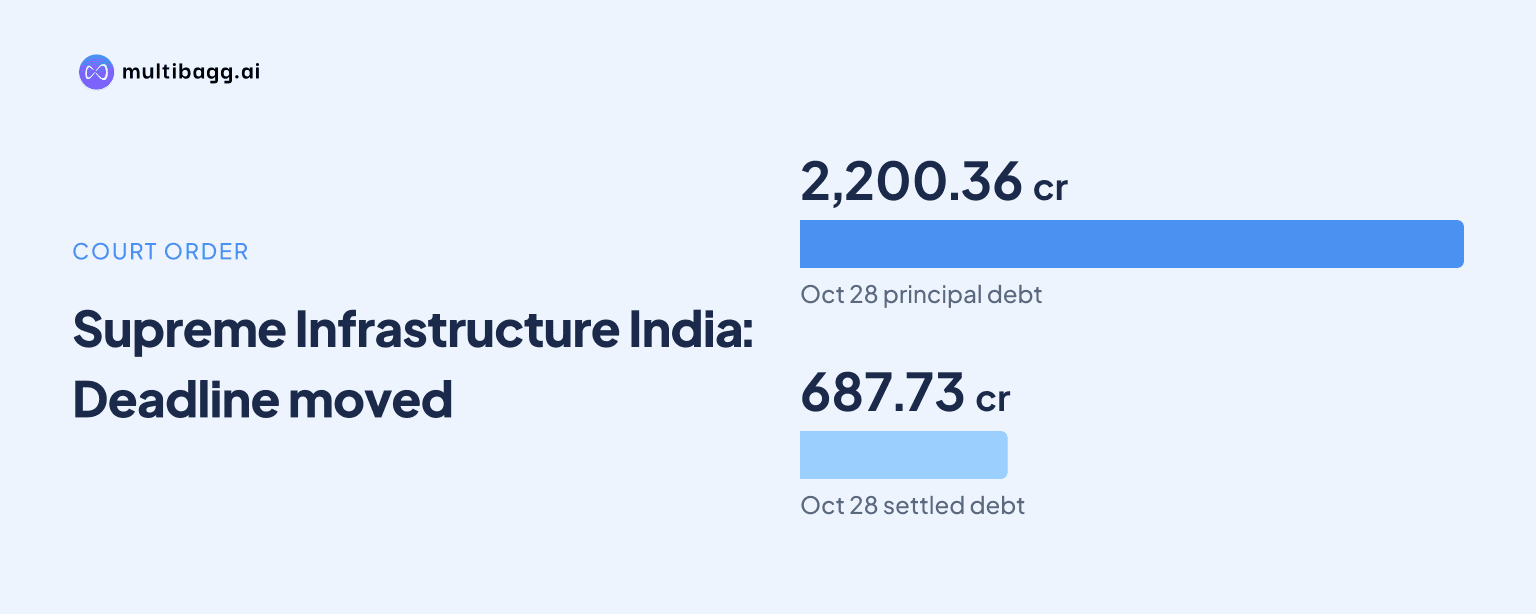
Supreme Infrastructure India Limited received a fresh deadline of October 31, 2026, from the National Company Law Tribunal to complete its court-approved debt settlement process. The scheme covers ₹2,200.36 crore of principal debt owed to 14 financial creditors, of which ₹687.73 crore had already been paid to lenders under the arrangement.
Know Supreme Infrastructure India inside out
Results, valuation, peers and who's buying, in one view.
Why did Supreme Infrastructure India Limited receive a new payment deadline?
Supreme Infrastructure India Limited received the extension after the National Company Law Tribunal, Mumbai Bench, Court-IV, considered the implementation of its Scheme of Compromise and Arrangement with lenders. In an order dated October 28, 2026, the Tribunal extended the timeline for completion of payments until October 31, 2026.
The company is resolving legacy financial liabilities through a court-sanctioned compromise under Sections 230 and 231 of the Companies Act, 2013. This route differs from a conventional insolvency resolution process, as it is based on a scheme agreed between the company and creditors and sanctioned by the Tribunal.
The settlement relates to principal debt of ₹2,200.36 crore outstanding as of June 30, 2022. The stated amount excludes accumulated interest, penal interest and related charges. Under the sanctioned scheme, these additional amounts are subject to waiver once the settlement is completed in line with its terms.
The October 28 order followed mutually agreed minutes filed on October 26, 2026, involving Supreme Infrastructure India Limited and its three remaining lenders: State Bank of India, Punjab National Bank and Union Bank of India. The minutes set out a framework for meeting the outstanding settlement obligations.
How much debt has Supreme Infrastructure India Limited settled?
Supreme Infrastructure India Limited had paid ₹687.73 crore to lenders under the sanctioned scheme, according to the earlier advisory release. Eleven of the 14 financial creditors had received their settlements, issued final No Dues Certificates and completed charge-release formalities.
That leaves three financial creditors covered by the remaining implementation process. State Bank of India, Punjab National Bank and Union Bank of India are the lenders involved in the final settlement framework placed before the Tribunal.
The company had earlier created a fixed deposit of ₹120 crore with State Bank of India, its lead bank, to meet the balance settlement obligations. The deposit was reported as being earmarked exclusively for payments to the remaining lenders after completion of banking and escrow procedures.
The Tribunal took the fixed deposit on record during a hearing on July 20, 2026, and had initially granted time until August 17 for procedural formalities. The later October order indicates that the remaining steps required further time for implementation.
What is the role of the escrow arrangement in the settlement?
The escrow arrangement is intended to facilitate the release of funds for settlement of the remaining lender dues. The NCLT directed the lead bank to operationalise the escrow mechanism within two working days of its October 28 order.
SBICAP Trustee Company Limited is involved in the escrow mechanism for the remaining obligations. The process is significant because the company had stated that the ₹120 crore fixed deposit was available for the residual settlement payments, while final banking and trustee-related formalities remained to be completed.
The NCLT order and the escrow direction do not, by themselves, confirm that the final settlement was completed by the extended deadline. They establish the procedural path and timeline for completing payments under the sanctioned scheme.
For lenders, the completion of payment and associated documentation is relevant to the release of charges and the issue of final no-dues confirmations. Supreme Infrastructure India Limited had already completed those steps for 11 creditors, showing that the scheme had moved beyond its initial approval phase.
Got a follow-up? Ask IRIS
How does the debt settlement relate to Supreme Infrastructure India Limited's financial position?
The debt settlement is central to Supreme Infrastructure India Limited's effort to address liabilities accumulated during years of defaults and lower operating activity. The NCLT approved the Scheme of Compromise and Arrangement on March 28, 2025, providing the legal framework for the company to settle lender claims.
An earlier summary of the plan stated that the company would pay ₹464 crore to financial creditors through asset monetisation of ₹183.29 crore, equity raising of ₹147.23 crore and monetisation of pledged assets of ₹133.48 crore. The subsequent ₹120 crore fixed deposit was presented as funding for the balance obligations to the remaining lenders.
The supplied FY26 financial summary reported revenue from operations of ₹65.34 crore, compared with ₹66.19 crore in the previous year. It also reported net profit of ₹5,796.43 crore and profit before tax of the same amount, attributing the large reported profit primarily to exceptional gains from debt settlement and restructuring rather than recurring operations.
This distinction is important for investors assessing the company's financial statements. A gain from debt restructuring can materially affect reported profit, while revenue from operations reflects the scale of continuing business activity. The company has indicated that it is pursuing renewed EPC execution and business opportunities in infrastructure and construction.
What does the NCLT process mean for creditors and investors?
The NCLT process gives Supreme Infrastructure India Limited a court-supervised structure for settling lender obligations and obtaining waivers contemplated by the scheme. For the 11 lenders already paid, settlements were followed by no-dues certificates and release of charges, according to the company information provided.
For the three remaining lenders, the key matter is implementation of the escrow-linked payment process under the October 28 order. The order is a milestone in execution, but it should not be interpreted as confirmation that every settlement obligation has been discharged.
For investors, the development must be viewed alongside the company's operating performance and the one-time nature of restructuring-related gains. The settlement plan may address legacy liabilities if implemented as sanctioned, while the company's operational recovery remains linked to project execution, liquidity, competition and input-cost conditions identified in the supplied FY26 summary.
The company is scheduled to hold its 43rd annual general meeting on November 12, 2026, through video conferencing or other audio-visual means. The agenda includes adoption of audited financial statements, reappointment of directors and the proposed appointment of Dr. Prabhakant as a non-executive independent director.
Conclusion
The October 28 NCLT order moved Supreme Infrastructure India Limited closer to the final implementation stage of its lender compromise. The company had settled 11 of 14 financial creditors, paid ₹687.73 crore and created a ₹120 crore fixed deposit for the balance obligations, while the remaining process centred on escrow and banking formalities.
The next point to watch is confirmation of payment completion and related lender documentation for State Bank of India, Punjab National Bank and Union Bank of India. Investors will also have the November 12, 2026 annual general meeting and the company's disclosures on operating recovery, financial statements and settlement implementation to assess.