










Suzlon Energy Limited Q2 Revenue Rises 26% to ₹4,869 Crore
Key highlights
- Suzlon reported Q2 FY27 revenue of ₹4,869 crore, up 27% quarter on quarter and 26% year on year.
- Q2 FY27 EBITDA was ₹720 crore and PAT was ₹394 crore, with PAT up 29% sequentially.
- Suzlon delivered 710 MW in Q2 FY27, up 40% quarter on quarter, and installed 454 MW.
- EBITDA margin declined to 14.8% from 18.8% a year earlier, while the order book stood at 6 GW.
powered by IRIS
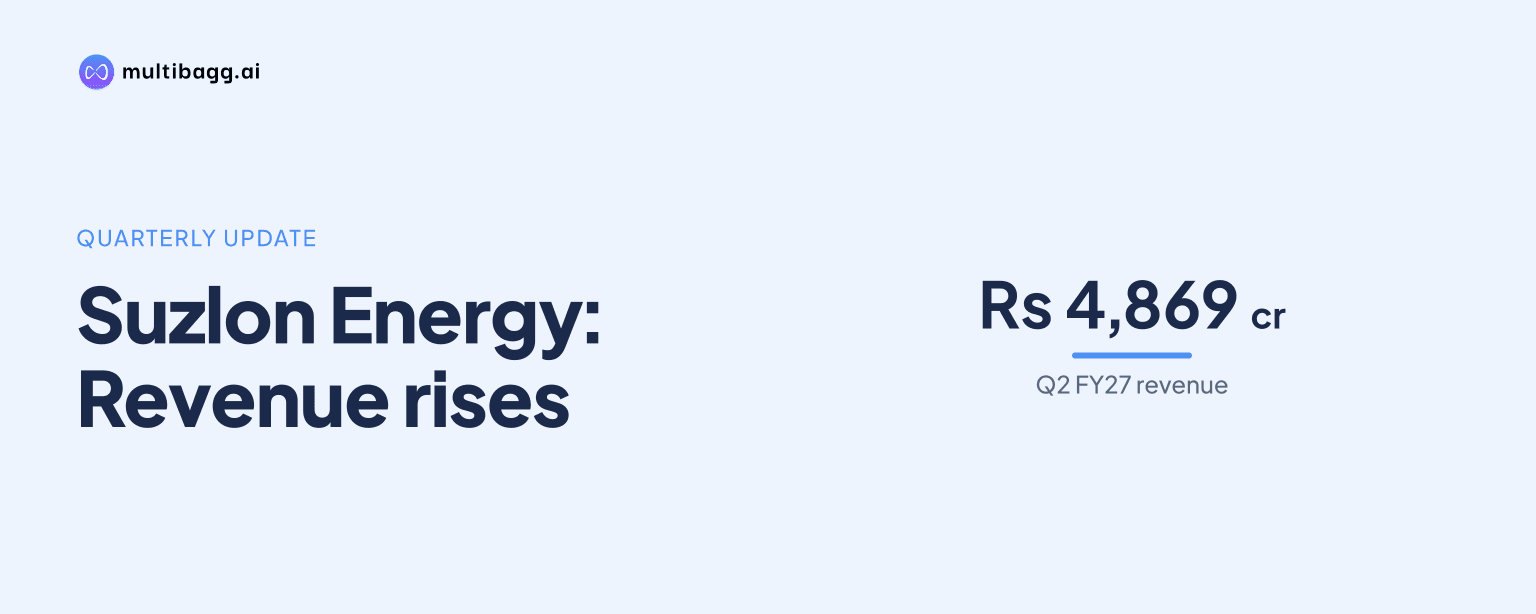
Suzlon Energy Limited reported Q2 FY27 revenue of ₹4,869 crore, up 26% year on year, while profit after tax fell 69% to ₹394 crore as the comparable prior-year period included significant deferred-tax-asset recognition benefits. Sequentially, revenue increased 27%, supported by 710 MW of deliveries and higher commissioning.
Know Suzlon Energy inside out
Results, valuation, peers and who's buying, in one view.
What did Suzlon report for Q2 FY27?
Suzlon reported sequential improvement in revenue, EBITDA and profit after tax during Q2 FY27. Revenue rose to ₹4,869 crore from ₹3,819 crore in Q1 FY27, a 27% quarter-on-quarter increase. EBITDA increased 21% sequentially to ₹720 crore, while PAT rose 29% from the preceding quarter to ₹394 crore.
The year-on-year comparison for profit requires context. Suzlon said Q2 FY26 and H1 FY26 PAT had included significant deferred tax asset, or DTA, recognition benefits. On the reported basis, Q2 FY27 PAT was 69% lower year on year. Revenue, however, increased 26% year on year, according to the company’s quarterly disclosure.
For the first half of FY27, Suzlon reported revenue of ₹8,688 crore, up 24% year on year. H1 EBITDA stood at ₹1,315 crore and PAT was ₹699 crore. The company cautioned that the previous year’s DTA recognition means reported profit figures are not directly comparable across the periods.
How did deliveries and commissioning support the quarter?
Suzlon’s 710 MW of Q2 deliveries, up 40% quarter on quarter, supported its revenue growth despite the monsoon season. Management described this as its highest-ever second-quarter delivery performance in India. The quarter is generally considered leaner for field activity because monsoon conditions can constrain wind project construction and installation work.
Commissioning was a key operational improvement. Installations increased from 269 MW in Q2 FY26 to 454 MW in Q2 FY27, a rise of more than 69%. H1 FY27 installations reached 723 MW, while the company said it had 1.25 GW of erected turbines in the pipeline for future commissioning.
These figures indicate that Suzlon converted a larger volume of projects through delivery and installation during the quarter. For customers, commissioning is important because it moves a wind project closer to commercial generation. For the company, the pace of commissioning also affects execution visibility across its turbine supply, installation and related service operations.
Got a follow-up? Ask IRIS
Why did Suzlon’s EBITDA margin decline year on year?
Suzlon’s consolidated EBITDA margin declined to 14.8% in Q2 FY27 from 18.8% a year earlier because of lower turbine-generator contribution margins, commodity and foreign-exchange volatility, and higher expenses. The company said wind turbine generator, or WTG, contribution margin fell to 21.2% from 26.9%, primarily due to changes in customer, segment and scope mix.
Operating expenses were about ₹80 crore higher than in Q2 FY26. Around ₹50 crore of this increase was linked to Suzlon 2.0-related branding, travel and general and administrative costs, according to management. The company described these as non-recurring costs while also identifying currency and commodity movements as important factors behind the margin pressure.
Management said it is working on several levers to optimise these effects over the near to medium term. Its FY27 margin guidance was reset to 15.1%, with potential upside of 1%. The guidance provides a reference point for investors assessing whether improved execution and cost actions can offset the impact of product mix and input-price volatility.
What is Suzlon’s order book and wind-sector opportunity?
Suzlon said a 6 GW order book, higher commissioning activity and Indian wind-sector demand underpin its current growth plan. The company placed the quarter in the context of India crossing 59 GW of installed wind capacity, describing wind energy as increasingly relevant to energy security, manufacturing and decarbonisation.
The company also referred to an emerging repowering opportunity. Management said Suzlon had secured its first three repowering orders with Tata and estimated the domestic repowering opportunity at about 25 GW. Repowering generally involves replacing older wind turbines with newer equipment that can generate more electricity from existing wind sites.
For investors, the order book and erected-turbine pipeline are relevant measures of future execution workload, but they do not remove the factors that affected Q2 margins. Revenue recognition and profitability can still be shaped by project schedules, the scope of contracts, commodity costs, foreign exchange movements and the mix of customers served during a quarter.
Conclusion
Suzlon delivered stronger sequential financial and operating performance in Q2 FY27, with revenue rising to ₹4,869 crore, EBITDA reaching ₹720 crore and deliveries increasing to 710 MW. Yet the 14.8% EBITDA margin and the 69% reported decline in PAT highlight the effect of product mix, currency and commodity volatility, higher operating expenses, and the prior year’s tax-related benefit.
The next areas to watch are progress in commissioning the 1.25 GW erected-turbine pipeline, execution of the 6 GW order book, and performance against FY27 EBITDA margin guidance of 15.1% with potential upside of 1%. Updates on cost optimisation, WTG contribution margin and the development of repowering orders will also be relevant to Suzlon’s operating outlook.