








Team India Guaranty Limited Approves NCDs and ₹350 Crore Limit
Max Plan at ₹4,999/yr₹8,999

Find your next multibaggerBe a Pro Investor
Research stocks and track your picks on the go. Download the app.
Key highlights
- Team India Guaranty approved a proposal to raise its borrowing limit from ₹200 crore to ₹350 crore.
- The proposed ₹150 crore increase represents 75% over the existing borrowing limit.
- Team India Guaranty also approved private-placement fundraising through non-convertible debentures.
- Both the borrowing-limit increase and NCD proposal require shareholder approval through a postal ballot.
powered by IRIS
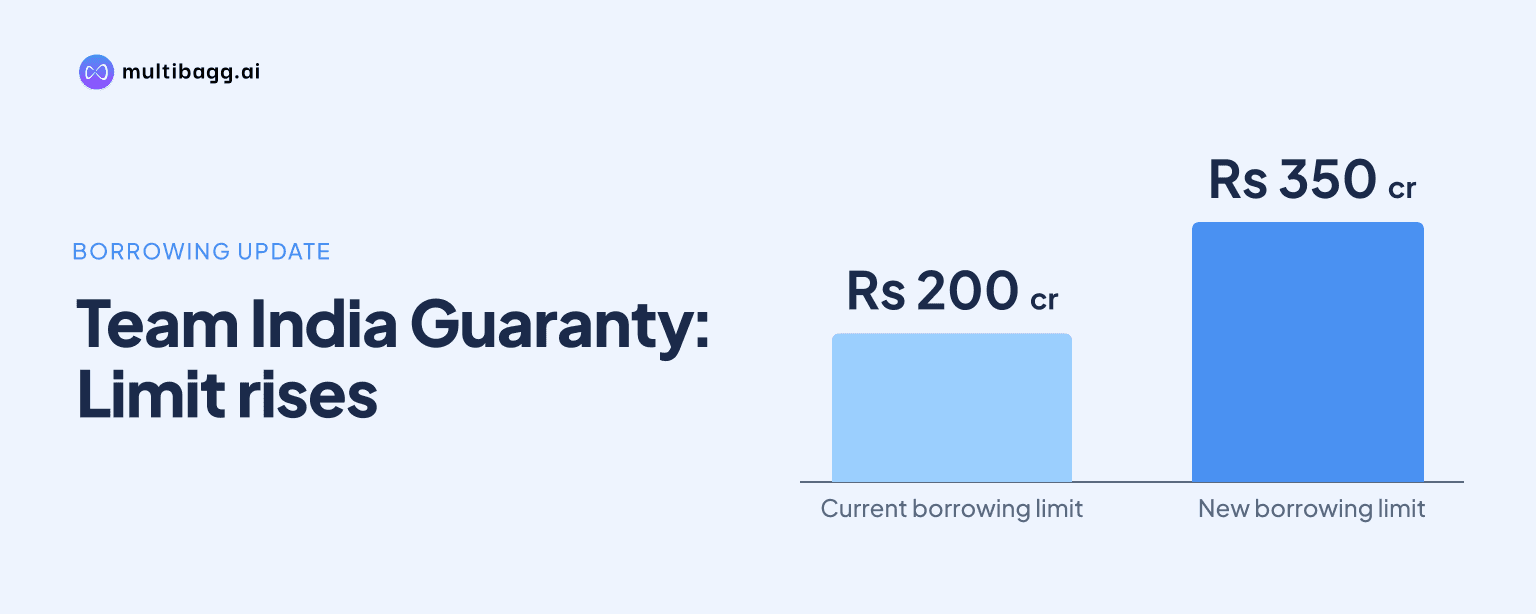
Team India Guaranty Limited approved a proposal on November 26, 2026, to raise funds through privately placed non-convertible debentures and increase its borrowing limit from ₹200 crore to ₹350 crore, subject to shareholder approval. The proposed ₹150 crore increase expands the company’s financing authority but does not itself confirm that debt has been raised.
Know Team India Guaranty inside out
Results, valuation, peers and who's buying, in one view.
What did Team India Guaranty approve?
Team India Guaranty approved two connected financing proposals: an increase in its borrowing powers and the issuance of non-convertible debentures, or NCDs, through private placement. Both measures require the approval of the company’s members before they can take effect.
The company proposed raising its borrowing ceiling to ₹350 crore from ₹200 crore. This represents an increase of ₹150 crore, or 75% over the existing limit. A borrowing limit is the maximum authority shareholders permit the company to use for borrowings; it is not a statement of the amount currently borrowed or an immediate commitment to draw the full amount.
The second proposal concerns NCDs issued on a private-placement basis. NCDs are debt instruments that generally carry a fixed or specified return and do not convert into equity shares. The filing does not specify the NCD issue size, coupon rate, tenure, investors, security, or timing of any issuance.
How will Team India Guaranty seek shareholder approval?
Team India Guaranty will seek member approval through a postal ballot process for the borrowing-limit increase and the proposed private placement of NCDs. The board had also considered the draft postal ballot notice required to place these matters before shareholders.
The earlier board-meeting intimation was made under Regulation 29(1)(d) of the SEBI Listing Obligations and Disclosure Requirements Regulations, 2015. The proposal to enhance borrowing powers is linked to Section 180(1)(c) of the Companies Act, 2013, which requires shareholder consent for borrowings beyond specified limits.
Until the member approvals are obtained, the board’s decision remains a proposal awaiting ratification. Shareholders will therefore be voting on the company’s authority to borrow up to the revised ceiling and to issue NCDs through private placement, rather than on a disclosed completed debt transaction.
Why is the NCD proposal relevant to Team India Guaranty’s funding plans?
The NCD proposal is relevant because it gives Team India Guaranty a defined debt-fundraising route alongside the request for higher borrowing authority. Private placement allows securities to be offered to identified investors instead of being issued through a public offer, subject to the applicable legal and regulatory framework.
The filing does not disclose the intended use of proceeds. It also does not state whether the borrowing authority would be used entirely for NCDs, for other borrowings, or only when required. As a result, the proposed ₹350 crore ceiling should not be treated as an announced debt raise of that amount.
Team India Guaranty operates in corporate financial services. The company’s disclosed sales from India were ₹5.20 crore in fiscal 2026, compared with ₹3.69 crore in fiscal 2025, based on the geographical sales figures provided. The company has also reported a rise in standalone net profit for the September 2026 quarter, according to the supplied company snapshot, although this filing focuses on financing approvals rather than quarterly earnings.
Got a follow-up? Ask IRIS
What does the filing mean for investors and the market?
For investors, the main point is that Team India Guaranty is seeking flexibility to access debt funding up to a higher authorised level. The final financial effect will depend on whether shareholders approve the proposals, the actual amount borrowed, the cost of funding, and the terms attached to any NCD issuance.
No immediate market reaction to the November 26 filing is provided in the available information. The latest quoted price in the supplied data was ₹232.20 on November 23, 2026, with a 0.77% five-day decline and a 21.05% fall since the start of the year. That price data predates the filing and cannot be used to attribute any share-price movement to the board’s approval.
The proposal may be relevant to the company’s future balance-sheet position because additional debt, if raised, can increase interest obligations and repayment requirements. However, the filing contains no figures on current borrowings, debt-to-equity, planned deployment, or expected interest cost. Investors will need the postal ballot notice and any subsequent debt-issuance disclosures for those details.
What should shareholders monitor before the postal ballot?
Shareholders should monitor the postal ballot notice for the exact resolutions, voting timetable, explanatory statement, and terms of the proposed NCD issuance. These documents could clarify the maximum amount proposed under the NCD route, the purpose of the funding, and any conditions attached to the borrowing authority.
It will also be important to distinguish between approval of a borrowing limit and actual borrowings. A higher limit provides capacity, while any subsequent NCD placement would establish the amount, tenure, pricing, and repayment profile that could affect Team India Guaranty’s financial position.
Conclusion
Team India Guaranty has moved to widen its financing options by approving a private-placement NCD proposal and seeking to raise its borrowing ceiling by ₹150 crore to ₹350 crore. The development is an approval to seek authority, not confirmation of a completed NCD issue or utilisation of the full borrowing limit.
The next disclosed step is the postal ballot process for shareholder approval. Investors should watch for the notice, voting outcome, and any later disclosure setting out the amount and commercial terms of an NCD issue.

