










Three M Paper Boards raises debt as capex and cash needs rise
Key highlights
- Three M Paper Boards’ CWIP rose to Rs 11.24 crore at September 30, 2026 from Rs 1.41 crore at March 31, 2026.
- Three M Paper Boards’ long-term borrowings increased to Rs 36.35 crore from Rs 21.09 crore.
- Three M Paper Boards reported net cash used in operating activities of Rs 2.29 crore for the half year ended September 30, 2026.
- Three M Paper Boards recorded Rs 9.85 crore of fixed-asset purchases and Rs 15.48 crore of net long-term borrowing proceeds.
powered by IRIS
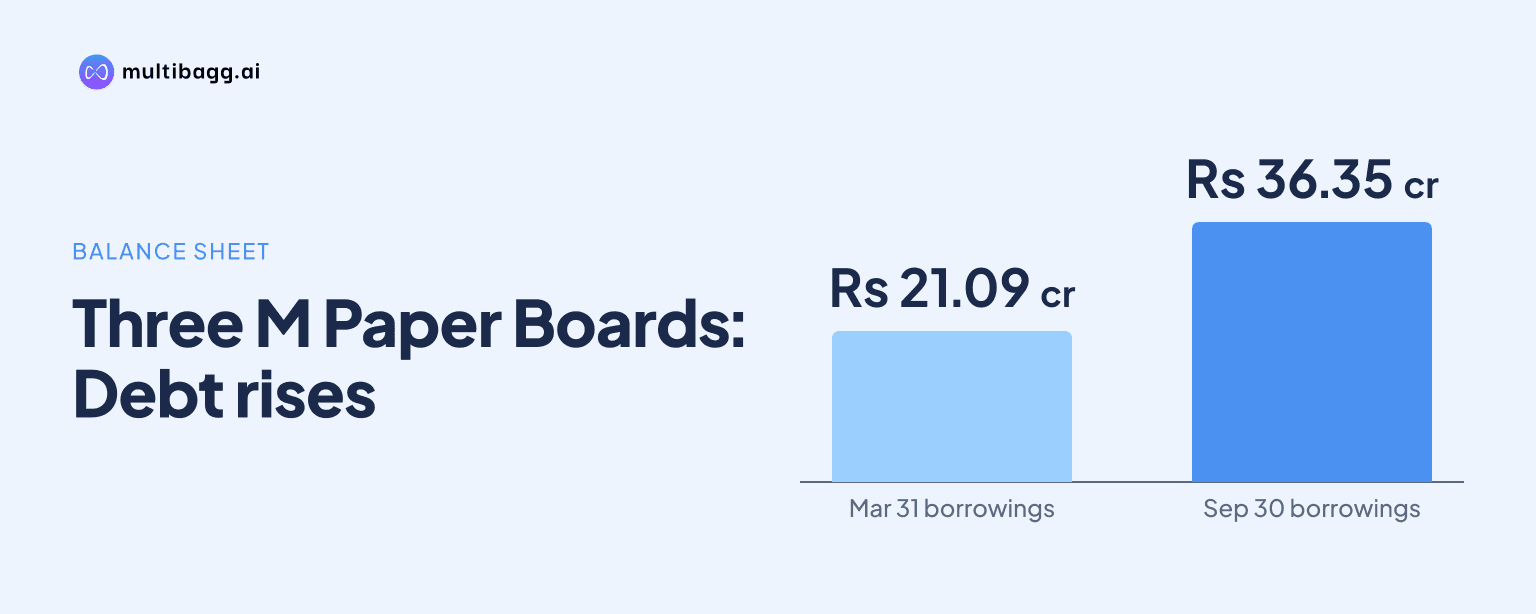
Three M Paper Boards Limited increased long-term borrowings by Rs 15.26 crore to Rs 36.35 crore at September 30, 2026, while capital work-in-progress reached Rs 11.24 crore and net cash used in operating activities was Rs 2.29 crore for the half year. The filing records Rs 9.85 crore of fixed-asset purchases during the period.
Know Three M Paper Boards inside out
Results, valuation, peers and who's buying, in one view.
How did Three M Paper Boards finance its capital spending?
Three M Paper Boards reported net proceeds of Rs 15.48 crore from long-term borrowings in the half year ended September 30, 2026, while it spent Rs 9.85 crore on purchases of fixed assets. After interest paid of Rs 3.36 crore, net cash generated from financing activities was Rs 12.12 crore for the half year.
Capital work-in-progress, or CWIP, rose to Rs 11.24 crore at September 30, 2026 from Rs 1.41 crore at March 31, 2026. The Rs 9.83 crore increase broadly coincided with the Rs 9.85 crore fixed-asset purchase outflow shown in the cash-flow statement, although the filing does not separately reconcile those two measures.
The company did not identify the CWIP project, its commissioning date, its capacity or its expected financial contribution. The disclosed figures therefore show a build-up in uncompleted capital assets and a higher long-term borrowing balance, but they do not establish the use of individual borrowing proceeds.
Property, plant and equipment stood at Rs 103.28 crore at September 30, 2026, down from Rs 107.35 crore at March 31, 2026. This movement came despite the Rs 9.85 crore fixed-asset purchases and alongside depreciation of Rs 4.09 crore in the September 2026 half year; the filing provides no detailed bridge between additions, depreciation and the closing property, plant and equipment balance.
What changed in Three M Paper Boards’ debt and balance sheet?
Three M Paper Boards’ long-term borrowings increased to Rs 36.35 crore at September 30, 2026 from Rs 21.09 crore at March 31, 2026. Short-term borrowings changed little, rising to Rs 54.30 crore from Rs 54.07 crore over the same six-month balance-sheet comparison.
Borrowings across the two disclosed categories consequently rose to Rs 90.65 crore from Rs 75.16 crore. The cash-flow statement records Rs 15.48 crore of net long-term borrowing proceeds in the half year, compared with Rs 12.79 crore for the year ended March 31, 2026, a comparison between periods of different lengths.
Shareholders’ funds increased to Rs 115.02 crore at September 30, 2026 from Rs 111.01 crore at March 31, 2026. Share capital was unchanged at Rs 19.24 crore, while reserves and surplus increased to Rs 95.78 crore from Rs 91.77 crore, alongside reported profit after tax of Rs 4.02 crore for the half year.
Total assets rose by Rs 22.82 crore to Rs 294.63 crore at September 30, 2026. Besides the Rs 9.83 crore increase in CWIP, short-term loans and advances increased to Rs 32.26 crore from Rs 27.02 crore, and other current assets rose to Rs 26.70 crore from Rs 15.87 crore.
Got a follow-up? Ask IRIS
Why did Three M Paper Boards report negative operating cash flow?
Three M Paper Boards reported net cash used in operating activities of Rs 2.29 crore for the half year ended September 30, 2026, compared with net cash generated from operating activities of Rs 7.61 crore for the year ended March 31, 2026. These are not like-for-like periods, but the disclosed cash-flow direction changed from an annual inflow to a half-year outflow.
Operating profit before working-capital changes was Rs 11.75 crore in the September 2026 half year. The cash-flow statement separately records a Rs 11.06 crore increase in short-term loans and advances and a Rs 10.84 crore increase in other current assets, which were among the stated working-capital cash uses.
The filing also records a Rs 3.36 crore decrease in trade receivables and a Rs 77.53 lakh decrease in inventories. Other disclosed movements included a Rs 1.47 crore increase in other current liabilities and Rs 22.67 lakh increase in trade payables, but cash generated from operations was negative Rs 1.32 crore before income-tax payments of Rs 97.28 lakh.
Net cash used in investing activities was Rs 9.83 crore, principally reflecting the Rs 9.85 crore purchase of fixed assets. Financing cash generation of Rs 12.12 crore covered the investing outflow and operating cash deficit, leaving cash and cash equivalents at Rs 9.55 lakh on September 30, 2026, versus Rs 11.98 lakh at the start of the period.
How did Three M Paper Boards’ earnings change in the half year?
Three M Paper Boards reported revenue from operations of Rs 145.20 crore for the half year ended September 30, 2026, compared with Rs 125.98 crore in the half year ended September 30, 2025. Revenue therefore increased by Rs 19.22 crore year on year, while profit before tax declined to Rs 3.91 crore from Rs 10.19 crore.
Profit after tax was Rs 4.02 crore in the September 2026 half year, compared with Rs 11.35 crore in the corresponding prior-year half year. The financial results show finance costs of Rs 3.86 crore for September 2026, against nil finance costs in the September 2025 column, while raw-material consumption rose to Rs 87.28 crore from Rs 75.91 crore.
The company reported total expenses of Rs 142.07 crore for the September 2026 half year, up from Rs 116.55 crore a year earlier. Other expenses increased to Rs 36.56 crore from Rs 33.07 crore, while employee-benefit expense rose to Rs 7.67 crore from Rs 6.73 crore.
Three M Paper Boards states that it exclusively manufactures and sells paper and paper boards and therefore discloses one segment under Accounting Standard 17. Its unaudited results were reviewed by the audit committee and approved by the board on November 13, 2026; the limited-review report said nothing had come to the auditor’s attention to indicate a material misstatement.
Conclusion
Three M Paper Boards’ September 2026 half-year statements show that capital spending, higher CWIP and additional long-term borrowings occurred alongside negative operating cash flow. Long-term borrowings increased Rs 15.26 crore, CWIP increased Rs 9.83 crore and financing inflows of Rs 12.12 crore offset investment spending and the operating cash outflow.
The next financial update should indicate whether the Rs 11.24 crore of CWIP is transferred into property, plant and equipment and whether the increase in short-term loans and advances and other current assets moderates. The filing discloses no project timetable, capacity target, capital-expenditure plan or debt-repayment schedule, leaving those matters unresolved after September 30, 2026.