










Time Technoplast Limited Q2 revenue rises 32%, net profit up 27%
Key highlights
- Time Technoplast reported September-quarter consolidated revenue of Rs 1,994.19 crore, up 32% year on year.
- Net profit after tax increased 27% year on year to Rs 148.31 crore in the September 2026 quarter.
- Composite products revenue rose about 35% to Rs 785.41 crore, faster than polymer products’ roughly 31% growth.
- Operating EBITDA margin was 13.28% in the September 2026 quarter, compared with 14.80% a year earlier.
powered by IRIS
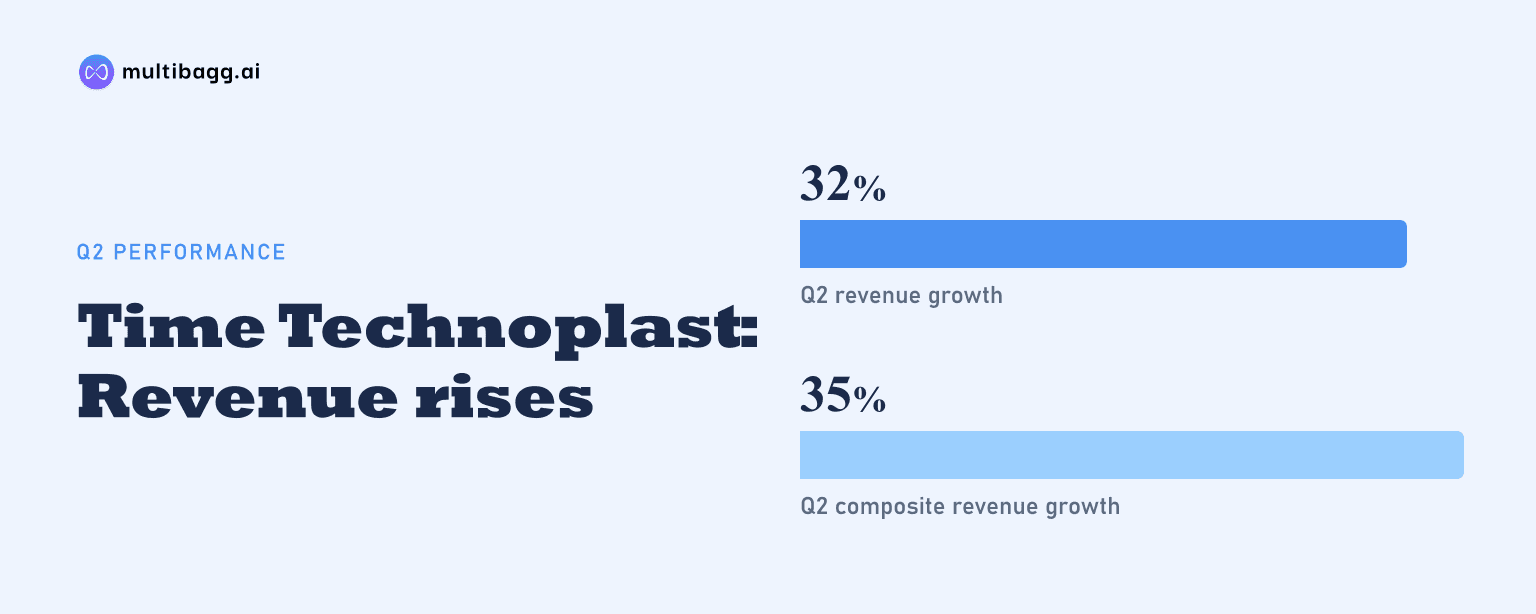
Time Technoplast reported consolidated revenue from operations of Rs 1,994.19 crore for the quarter ended September 30, 2026, up 32% from Rs 1,511.11 crore a year earlier, while net profit rose 27% to Rs 148.31 crore from Rs 117.23 crore. Both polymer and composite products recorded higher sales, although operating EBITDA margin declined to 13.28% from 14.80%.
Know Time Technoplast inside out
Results, valuation, peers and who's buying, in one view.
How did Time Technoplast perform in the September 2026 quarter?
Time Technoplast delivered higher quarterly sales and profit in the quarter ended September 30, 2026. Revenue from operations rose by Rs 483.08 crore year on year to Rs 1,994.19 crore, and total income, including Rs 1.91 crore of other income, reached Rs 1,996.10 crore. Profit before tax increased to Rs 197.69 crore from Rs 156.61 crore, while tax expense rose to Rs 49.38 crore from Rs 39.37 crore.
Net profit after tax was Rs 148.31 crore, compared with Rs 117.23 crore in the September 2025 quarter and Rs 117.86 crore in the preceding June 2026 quarter. This represented a 27% year-on-year increase and a 26% sequential increase. Basic and diluted earnings per share were Rs 2.96, against Rs 2.54 a year earlier and Rs 2.35 in the June 2026 quarter.
Which businesses drove Time Technoplast’s revenue growth?
Time Technoplast’s polymer products remained its larger business and generated Rs 1,208.78 crore of September-quarter revenue, up from Rs 927.15 crore in the year-earlier period. The Rs 281.63 crore increase was about 31%, and polymer products accounted for roughly 61% of consolidated revenue of Rs 1,994.19 crore during the quarter.
Composite products generated Rs 785.41 crore, compared with Rs 583.96 crore in the quarter ended September 30, 2025, an increase of about 35%. Composite products therefore grew faster than polymer products in percentage terms, though they remained the smaller segment by revenue. The filing reports no inter-segment revenue deduction, so the two segment revenue figures total reported consolidated revenue.
Segment profit before tax and interest for polymer products increased to Rs 119.23 crore from Rs 101.49 crore, while composite products contributed Rs 91.59 crore versus Rs 75.54 crore. The combined segment result rose to Rs 210.82 crore from Rs 177.03 crore. After Rs 15.04 crore of interest cost and Rs 1.91 crore of other unallocable income, consolidated profit before tax was Rs 197.69 crore.
Why did Time Technoplast’s margins decline despite profit growth?
Time Technoplast’s operating EBITDA margin was 13.28% in the September 2026 quarter, down from 14.80% in the September 2025 quarter and 13.31% in the June 2026 quarter. EBITDA means earnings before interest, tax, depreciation and amortisation. The margin movement occurred even as revenue grew 32%, meaning reported operating profit expanded more slowly than sales in percentage terms.
Materials consumed rose to Rs 1,509.80 crore from Rs 1,083.67 crore, an increase of Rs 426.13 crore, while employee benefits rose to Rs 81.98 crore from Rs 73.12 crore. Depreciation and amortisation increased to Rs 52.29 crore from Rs 45.73 crore, and other expenses rose to Rs 153.54 crore from Rs 137.00 crore. Total expenditure was Rs 1,798.41 crore, compared with Rs 1,355.59 crore a year earlier.
Lower finance costs partly supported the increase in profit after tax. Finance costs fell by Rs 6.46 crore year on year to Rs 15.04 crore and declined from Rs 16.88 crore in the June 2026 quarter. However, net profit margin was 7.43%, below 7.75% in the September 2025 quarter, though above 6.96% in the June 2026 quarter.
Got a follow-up? Ask IRIS
What changed in Time Technoplast’s balance sheet and cash flow?
Time Technoplast reported total assets of Rs 5,879.24 crore at September 30, 2026, compared with Rs 5,638.65 crore at March 31, 2026. Property, plant and equipment increased to Rs 1,597.66 crore from Rs 1,331.50 crore, while capital work-in-progress declined to Rs 47.05 crore from Rs 229.77 crore. Inventories rose to Rs 1,418.96 crore and trade receivables to Rs 1,524.56 crore.
Total equity rose to Rs 4,357.23 crore from Rs 4,166.21 crore over the same six-month period. Non-current borrowings fell to Rs 119.39 crore from Rs 149.31 crore, and current borrowings declined to Rs 438.34 crore from Rs 490.13 crore. The debt-equity ratio was 0.13 at September 30, 2026, versus 0.20 a year earlier and 0.16 at March 31, 2026.
Net cash from operating activities for the half year ended September 30, 2026 was Rs 371.81 crore, up from Rs 271.66 crore in the comparable prior-year half. Capital expenditure and other investing outflows resulted in investing cash outflow of Rs 163.71 crore, compared with Rs 107.84 crore. Net financing outflow was Rs 197.77 crore, including Rs 81.71 crore of net borrowing repayments and Rs 76.59 crore of dividends paid.
How is Time Technoplast using its QIP proceeds?
Time Technoplast had used Rs 478.57 crore of the Rs 800 crore qualified institutional placement, or QIP, proceeds by September 30, 2026. The company allotted 3,97,77,247 equity shares on November 11, 2025 at Rs 201.12 each, raising Rs 781.13 crore net of Rs 18.87 crore of issue expenses. Reported QIP utilisation included Rs 400 crore for repayment or prepayment of borrowings.
Of the remaining planned uses, Rs 33.98 crore had been used for machinery and equipment for automation and re-engineering against an allocation of Rs 89.37 crore. Time Technoplast had used Rs 20.43 crore of Rs 54.90 crore allocated to its wholly owned subsidiary, Time Ecotech Private Limited, for recycling-plant equipment at Umbergaon, Gujarat, and Gadarpur, Uttarakhand. Rs 321.43 crore remained unutilised and was temporarily invested in deposits, cash-credit balances and a monitoring account.
The company had also used Rs 2.89 crore out of Rs 14.80 crore planned for de-odorising equipment. The largest unspent allocation was Rs 219.66 crore within the Rs 222.06 crore earmarked for inorganic growth, including acquisitions, strategic investments and joint ventures, as well as general corporate purposes. The filing does not disclose a timetable for using those remaining funds.
Conclusion
The September-quarter figures show that sales gains in both operating segments lifted profit and operating cash generation, while the mix of expenses resulted in lower operating and net profit margins than a year earlier. Reduced borrowings and finance costs accompanied the rise in consolidated profit before tax to Rs 197.69 crore.
The next disclosed matters to watch are deployment of the Rs 321.43 crore of unutilised QIP proceeds, particularly Rs 219.66 crore allocated for inorganic growth and corporate purposes, and planned spending on automation, recycling and de-odorising equipment. Separately, the board approved Bharat Kumar Vageria’s reappointment as managing director for five years from February 6, 2027, subject to shareholder approval.