










Timex Group India Limited Q2 Income Rises 47% on E-Commerce
Key highlights
- Timex Group India Limited reported 47% year-on-year total income growth in Q2 FY27.
- Timex Group India Limited reported 40% year-on-year total income growth in H1 FY27.
- E-Commerce and Trade were the stated drivers of Timex Group India's growth.
- Timex Group India Limited released its FY27 presentation on November 4, 2026.
powered by IRIS
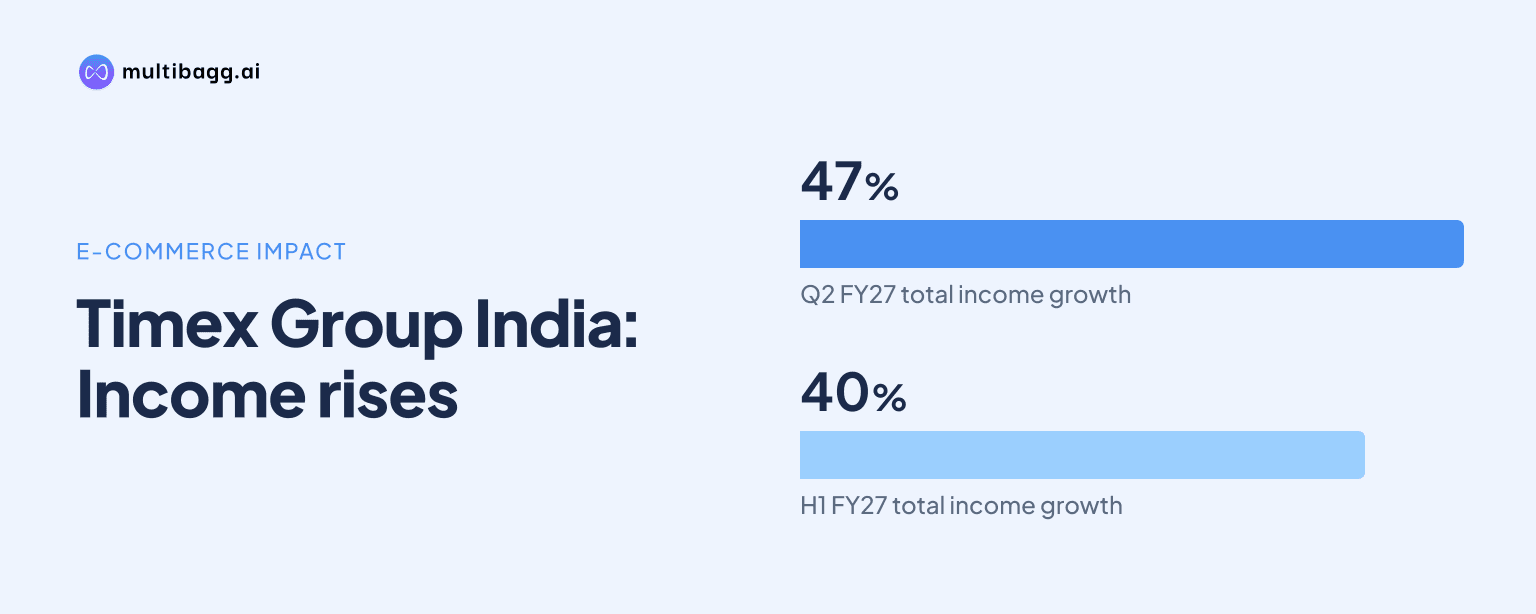
Timex Group India Limited reported a 47% year-on-year rise in total income for Q2 FY27, driven by E-Commerce and Trade. The watches and accessories company also recorded 40% growth in total income for the first half of FY27, while EBITDA and profit before tax advanced strongly during the reported periods.
Know Timex Group India inside out
Results, valuation, peers and who's buying, in one view.
How did Timex Group India perform in Q2 FY27?
Timex Group India delivered a 47% year-on-year increase in total income in Q2 FY27, according to its investor presentation released on November 4, 2026. The company reported that its income growth extended to the first half of the financial year, with H1 FY27 total income increasing 40% from the corresponding prior-year period.
The presentation also indicated strong advances in EBITDA and profit before tax, or PBT. However, the disclosed material does not provide the absolute income, EBITDA or PBT figures, nor does it specify the percentage growth in these profitability measures. As a result, the release establishes an improvement in operating and pre-tax performance but does not allow a calculation of profit margins from the available data.
The reported increase matters because total income captures the scale of the company’s business activity across its sales channels. The parallel improvement in EBITDA and PBT suggests that profitability moved higher alongside income, although the extent of operating leverage cannot be assessed without the underlying financial amounts.
What drove Timex Group India's income growth?
E-Commerce and Trade were the stated drivers of Timex Group India’s growth in the presentation. The company sells watches and related products through several routes, including e-commerce platforms, its brand webstore, distributors, dealers, franchise-operated outlets, modern trade chains, and institutional buyers.
The company’s trade channel therefore covers a broad physical distribution network, while e-commerce provides an online route to consumers. The presentation identifies both channels as key contributors, but it does not disclose their individual revenue contribution, channel-wise growth rates, or the number of stores, dealers or online partners involved.
Timex Group India operates in the watches and accessories segment and markets products under brands including Timex, Helix, Guess, Gc, Versace, Salvatore Ferragamo, Nautica and Adidas Originals. Its portfolio spans different consumer segments, but the release does not attribute the Q2 income increase to a specific brand, price category or product launch.
What risks did Timex Group India identify?
Timex Group India cited marketing, competition, demand and macroeconomic conditions as risks in its presentation. These factors are relevant to a consumer-facing watch business because sales can be affected by customer spending patterns, brand visibility, promotional activity and competitive offerings across online and offline channels.
Marketing expenditure is a key consideration for brands that need to retain consumer awareness and support distribution. Competition may come from other watchmakers, fashion-accessory labels and digital channels offering extensive choice and price comparison. The presentation does not quantify marketing spending, competitive pressure or the potential financial effect of these risks.
Demand and macroeconomic risks are also important because discretionary purchases can respond to changes in consumer confidence and household budgets. Timex Group India has disclosed the risk categories, but it has not given a forecast for FY27 income or profitability in the provided material. The reported Q2 and H1 growth figures should therefore be read as historical performance rather than a forward-looking projection.
Got a follow-up? Ask IRIS
How does the result affect Timex Group India's business position?
The result shows that Timex Group India generated higher total income in both the quarter and the first half, with E-Commerce and Trade identified as the central growth engines. For investors, the 47% Q2 increase and 40% H1 increase provide measurable evidence that the company expanded income compared with the same periods a year earlier.
The strong movement in EBITDA and PBT is also relevant because it indicates that the income increase was accompanied by higher operating and pre-tax profit. Yet the absence of reported absolute values means investors cannot determine whether costs grew slower than income, whether margins widened, or how much profit was earned in rupee terms.
For customers and channel partners, the emphasis on E-Commerce and Trade underlines the company’s continued use of both digital and physical routes to market. The available release does not report changes to product availability, pricing, dealer terms, store operations or after-sales services. It also does not report any specific operational impact on local communities or employees.
Why are the Q2 and H1 comparisons important for investors?
The Q2 and H1 comparisons are important because they show growth across two reporting periods rather than only one quarter. Q2 FY27 income growth of 47% was higher than the 40% increase reported for H1 FY27, although the presentation does not provide Q1 income data or enough detail to calculate how each quarter contributed to the half-year result.
Timex Group India’s business includes designing, manufacturing and trading watches in India and internationally, as well as after-sales services and information technology support services for group companies. Its multi-brand portfolio and broad distribution structure provide context for why channel execution in trade and e-commerce can influence reported income.
The presentation gives a directional view of financial momentum while leaving several analytical gaps. There are no disclosed absolute revenue figures, segment results, cash-flow data, margin percentages, earnings per share figures or management guidance in the supplied material. Those details would be needed for a fuller assessment of valuation, profitability quality and financial position.
Conclusion
Timex Group India’s Q2 FY27 update points to a substantial increase in business activity, with total income rising 47% year-on-year and H1 income increasing 40%. E-Commerce and Trade led the expansion, while stronger EBITDA and PBT indicate that earnings measures improved alongside income, subject to the limited numerical detail provided.
Investors will next watch whether the company provides absolute income and profit figures, margin information and channel-level performance in future disclosures. The unresolved issues identified in the presentation are the effect of marketing intensity, competitive conditions, demand trends and macroeconomic factors on the company’s subsequent performance.