










Transworld Shipping Lines signs five vessel sales, two buys
Key highlights
- Transworld Shipping Lines signed MOAs to sell five vessels in the quarter ended 30 September 2026.
- Transworld Shipping Lines signed MOAs to buy two dry-bulk ships, M.V. Valsamitis and M.V. Saltwind Explorer.
- Transworld Shipping Lines reported Q2 FY27 consolidated EBITDA of Rs 80 crore, versus Rs 18 crore in Q2 FY26.
- Transworld Shipping Lines reported Q2 FY27 consolidated PAT of Rs 56 crore, compared with a Rs 11 crore loss a year earlier.
powered by IRIS
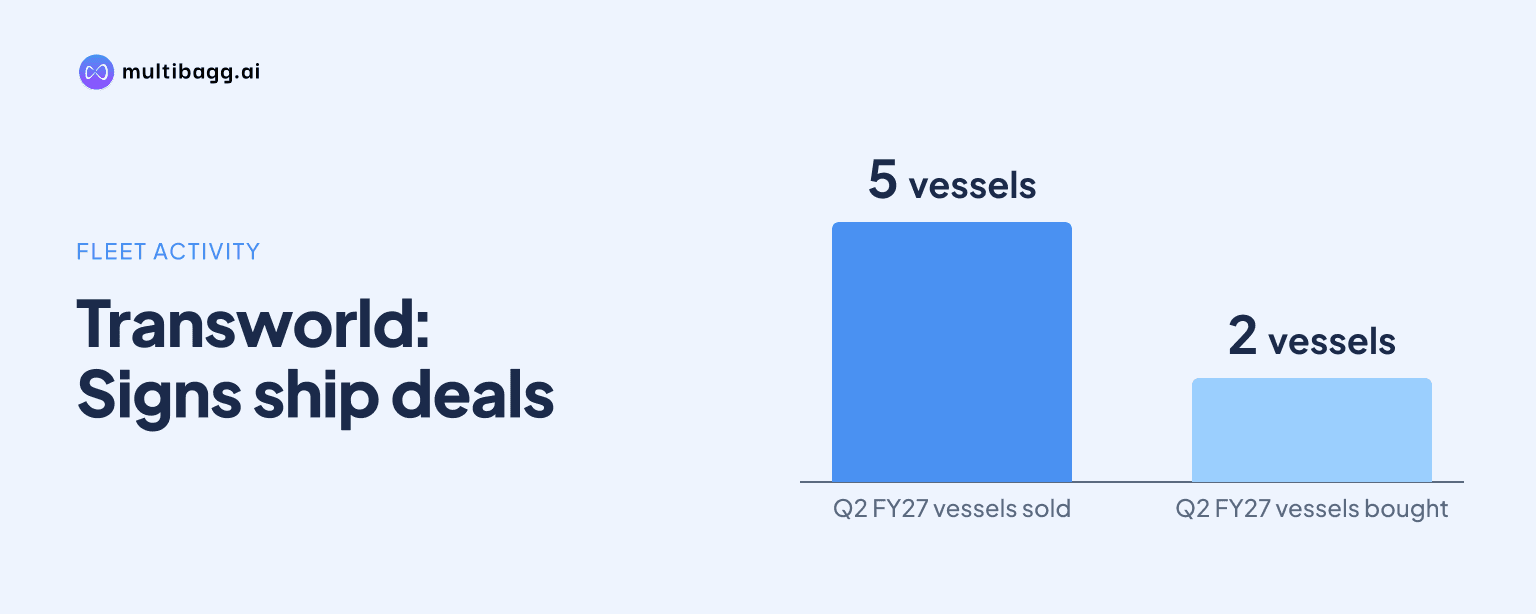
Transworld Shipping Lines Limited signed memorandums of agreement in the quarter ended 30 September 2026 to sell five vessels and buy two dry-bulk ships, while consolidated earnings before interest, tax, depreciation and amortisation reached Rs 80 crore in Q2 FY27. Transworld Shipping Lines said its current fleet stands at one dry Handysize bulk vessel.
Know Transworld Shipping Lines inside out
Results, valuation, peers and who's buying, in one view.
Which vessels is Transworld Shipping Lines selling and buying?
Transworld Shipping Lines entered into a memorandum of agreement, or MOA, in the quarter ended 30 September 2026 to sell five vessels: M.V. SSL Kaveri, M.V. SSL Brahmaputra, M.V. SSL Visakhapatnam, M.V. SSL Sabarimalai and TBC Kailash. The company said the divestment forms part of a strategy to optimise fleet composition and enhance operating efficiency.
Transworld Shipping Lines also entered an MOA to purchase two dry-bulk vessels, M.V. Valsamitis and M.V. Saltwind Explorer, during the September 2026 quarter. The 6 November 2026 announcement does not state transaction values, completion dates, vessel capacities, vessel ages or funding arrangements for either the five sale agreements or the two purchase agreements.
The company’s disclosed current fleet is one dry Handysize bulk vessel, even though it has agreed to sell five vessels and purchase two dry-bulk ships. This difference indicates that the 30 September 2026 disclosure describes agreements and intended transactions rather than a post-completion fleet count.
Why is Transworld Shipping Lines changing its fleet?
Transworld Shipping Lines said the combined divestment and acquisition plan is intended to align its fleet with changing market dynamics and customer requirements. Alongside the two agreed dry-bulk purchases, the company said it is evaluating modern container vessels and/or dry-bulk ships.
Charter-hire income is Transworld Shipping Lines’ primary revenue source after its transaction involving container vessels with Avana Logistek Limited, part of Unifeeder ISC FZCO, and the deployment of bulk carriers in global markets. That operating model places vessel deployment and charter-market conditions at the centre of its fleet decisions in the September 2026 quarter.
Management said suitable vessel acquisition opportunities remain limited, while available assets are priced at levels it considers commercially unviable. Transworld Shipping Lines said its acquisition efforts under prevailing market conditions had not yielded the desired outcomes so far, despite the two MOAs for M.V. Valsamitis and M.V. Saltwind Explorer.
What dry-bulk market conditions did Transworld Shipping Lines report?
Transworld Shipping Lines said the dry-bulk market was supportive during the quarter ended September 2026, particularly for Handysize and Supramax vessels carrying grains, fertilisers, coal, steel products and other minor bulks. It cited a 2026 base case of about US$15,500 a day for Handymax and Handysize vessels.
Supramax spot earnings were about US$23,200 a day as at 13 October 2026, according to the company’s industry review. The global dry-bulk fleet was approximately 1,078 million deadweight tonnes, or DWT, and the orderbook represented about 16.4% of existing capacity.
About 16% of the dry-bulk fleet was 20 years old or older, which Transworld Shipping Lines said indicates a meaningful medium-term replacement requirement. However, the company also identified elevated vessel prices and limited availability of suitable modern second-hand tonnage as constraints on acquisitions.
Container ships remain within Transworld Shipping Lines’ stated evaluation scope. Global active container capacity was approximately 34.3 million twenty-foot equivalent units, or TEU, against an orderbook of around 14.9 million TEU, while charter rates for the 2,500-3,500 TEU segment were about US$40,000 to US$45,000 a day in October 2026.
Got a follow-up? Ask IRIS
What is the Bainbridge Navigation DMCC joint-venture plan?
Transworld Shipping Lines approved an investment for a joint venture with Bainbridge Navigation DMCC to establish a shipping pool company focused on the Handysize vessel segment. Its stated objective is to consolidate operations and improve efficiency in the dry-bulk shipping market, where the company reported one dry Handysize vessel in its current fleet.
The 6 November 2026 release does not disclose the investment amount, ownership split, formation date, vessel count for the pool or expected financial contribution. The scale and timetable of the proposed Handysize platform therefore cannot be quantified from the announcement.
The Handysize focus overlaps with the segment cited in Transworld Shipping Lines’ September 2026 market assessment. The company also identified disruption around the Strait of Hormuz, Gulf of Oman and Red Sea as a source of vessel rerouting, higher insurance costs and more complex operations.
How did Transworld Shipping Lines perform in Q2 FY27?
Transworld Shipping Lines reported consolidated revenue of Rs 141 crore in Q2 FY27, compared with Rs 143 crore in Q2 FY26 and Rs 102 crore in Q1 FY27. Revenue was Rs 2 crore lower than a year earlier but Rs 39 crore higher than in the preceding quarter, and the release did not attribute either movement to a specific vessel transaction.
Consolidated EBITDA was Rs 80 crore in Q2 FY27, up from Rs 18 crore in Q2 FY26 and Rs 56 crore in Q1 FY27. Profit before tax, or PBT, and profit after tax, or PAT, were each Rs 56 crore, compared with a Rs 11 crore loss in Q2 FY26 and a Rs 30 crore loss in Q1 FY27.
Basic and diluted earnings per share were Rs 25.56 in Q2 FY27, versus negative Rs 5.12 in Q2 FY26 and Rs 13.44 in Q1 FY27. These results provide the financial backdrop to the September 2026 MOAs, but Transworld Shipping Lines did not say that quarterly profit funded the acquisitions or that the proposed vessel transactions affected Q2 FY27 earnings.
Conclusion
Transworld Shipping Lines has set out a fleet restructuring that combines agreements to sell five named vessels, purchase two named dry-bulk ships and establish a Handysize-focused shipping pool with Bainbridge Navigation DMCC. Its Q2 FY27 consolidated PAT was Rs 56 crore, compared with a Rs 11 crore loss in Q2 FY26, while revenue declined Rs 2 crore year on year to Rs 141 crore.
The next disclosures to watch are completion terms for the five disposals and two purchases, plus progress on the Handysize joint venture. Management has said suitable vessels remain scarce and available assets are commercially unviable at prevailing prices, leaving further acquisitions dependent on the market conditions it described on 6 November 2026.