










Trent first-half operating cash flow falls as inventory rises
Key highlights
- Trent’s net cash from operating activities fell to Rs 1,485.58 crore in the six months ended 30 September 2026 from Rs 1,532.39 crore a year earlier.
- Working capital used Rs 391.60 crore in the first half of 2026, compared with a Rs 167.81 crore cash contribution in the prior-year period.
- Inventory absorbed Rs 551.57 crore of cash, while the inventory balance rose to Rs 2,840.91 crore at 30 September 2026 from Rs 2,289.01 crore at 31 March 2026.
- Trent spent Rs 696.83 crore on property, plant and equipment and investment property, and ended the period with Rs 181.26 crore of cash and cash equivalents.
powered by IRIS
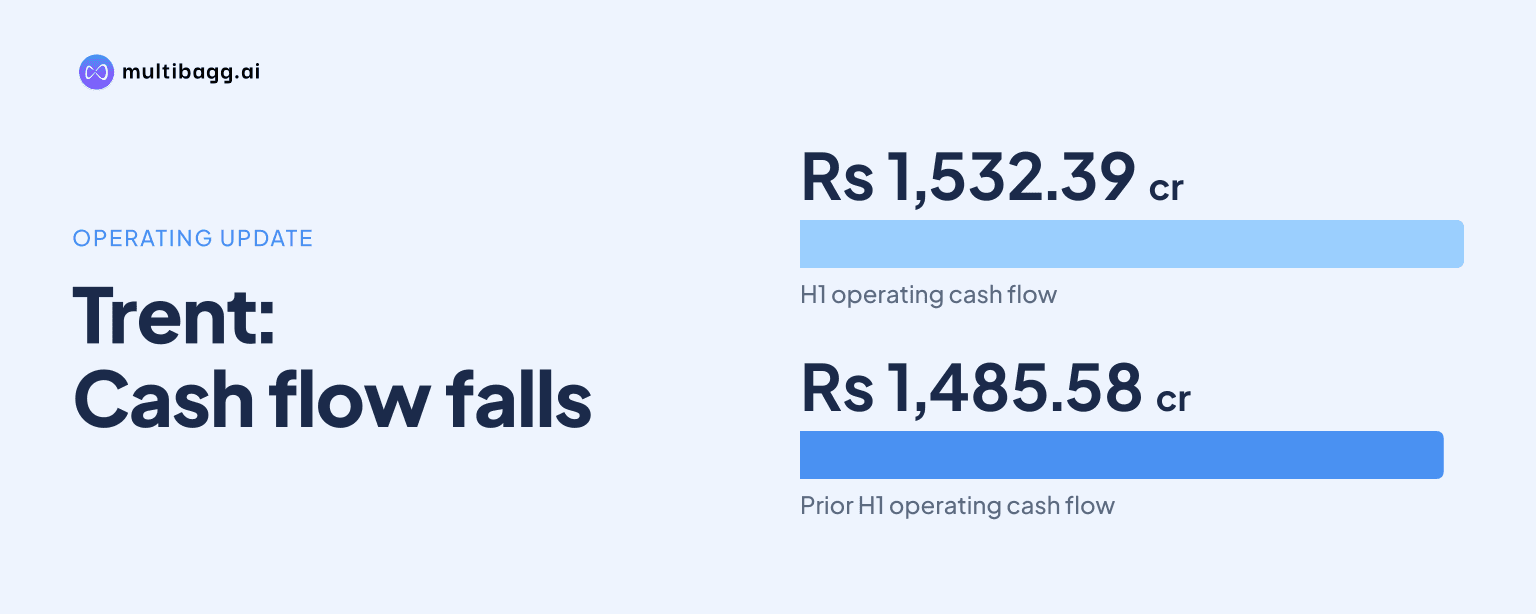
Trent Limited reported net cash from operating activities of Rs 1,485.58 crore for the six months ended 30 September 2026, down from Rs 1,532.39 crore a year earlier. The decline occurred although net profit rose to Rs 986.16 crore, because inventory absorbed Rs 551.57 crore and total working-capital movements turned into a cash use.
Know Trent inside out
Results, valuation, peers and who's buying, in one view.
Why did Trent’s operating cash flow fall in the first half?
Trent’s operating cash flow fell because working capital used Rs 391.60 crore in the six months ended 30 September 2026, compared with a Rs 167.81 crore cash contribution in the corresponding 2025 period. This reversal partly offset operating profit before working-capital changes rising to Rs 2,216.47 crore from Rs 1,629.10 crore.
Cash generated from operations nevertheless increased to Rs 1,824.87 crore from Rs 1,796.91 crore, reflecting the Rs 587.37 crore increase in operating profit before working-capital changes. Direct taxes paid rose to Rs 339.29 crore from Rs 264.52 crore, reducing net operating cash to Rs 1,485.58 crore from Rs 1,532.39 crore.
Which working-capital items used Trent’s cash?
Inventory was Trent’s largest listed working-capital cash use, absorbing Rs 551.57 crore in the six months ended 30 September 2026, compared with Rs 197.19 crore in the prior-year period. Trade receivables and other current assets used another Rs 235.90 crore, versus Rs 114.76 crore a year earlier.
Loans and other non-current assets used Rs 89.48 crore, broadly unchanged from the Rs 90.26 crore use in the six months ended 30 September 2025. Trade payables and other current liabilities supplied Rs 536.92 crore, compared with Rs 525.50 crore in the earlier period, while non-current liabilities used Rs 51.57 crore against a Rs 44.52 crore contribution previously.
The combined movements produced a Rs 391.60 crore working-capital outflow in 2026, rather than the Rs 167.81 crore inflow reported in 2025. The year-on-year swing was therefore Rs 559.41 crore, exceeding the Rs 46.81 crore decline in net cash from operating activities because operating profit before working-capital changes increased.
How did Trent’s profit rise while operating cash flow declined?
Trent’s net profit rose to Rs 986.16 crore for the six months ended 30 September 2026 from Rs 798.12 crore a year earlier, while profit before tax increased to Rs 1,310.90 crore from Rs 1,041.67 crore. Revenue from operations climbed to Rs 11,627.05 crore from Rs 9,701.16 crore over the same periods.
The difference between earnings and cash flow reflected balance-sheet movements and taxes paid rather than lower reported profit. Depreciation and amortisation was Rs 829.96 crore, compared with Rs 618.13 crore, and net finance income and cost was Rs 70.17 crore, compared with Rs 56.95 crore.
Trent also recorded a Rs 30.80 crore share of loss from associates and joint ventures in the 2026 first half, compared with a Rs 8.11 crore share of profit in the 2025 period. These adjustments, together with the working-capital items, helped reconcile profit before tax to the Rs 2,216.47 crore operating-profit measure used in the cash-flow statement.
Got a follow-up? Ask IRIS
What changed in Trent’s inventory and current assets?
Trent’s inventory balance increased to Rs 2,840.91 crore at 30 September 2026 from Rs 2,289.01 crore at 31 March 2026. The Rs 551.90 crore increase in the balance-sheet item closely corresponds with the Rs 551.57 crore inventory cash outflow reported for the six-month period.
Other current assets rose to Rs 917.09 crore at 30 September 2026 from Rs 660.97 crore at the March year-end, while trade receivables declined to Rs 35 crore from Rs 51.14 crore. The cash-flow statement combines trade receivables and other current assets into a Rs 235.90 crore cash outflow and does not separate their individual cash effects.
Total current assets increased to Rs 4,856.40 crore from Rs 4,058.30 crore. Current liabilities also rose, to Rs 3,522.29 crore from Rs 3,210.99 crore, including trade payables of Rs 1,684.78 crore compared with Rs 1,167.45 crore at 31 March 2026.
How did investing and financing affect Trent’s cash balance?
Trent used Rs 781.35 crore in investing activities during the six months ended 30 September 2026, compared with Rs 1,029.11 crore in the prior-year period. Purchases of property, plant and equipment and investment property were Rs 696.83 crore, while investment purchases of Rs 2,559.40 crore were partly offset by Rs 2,499.12 crore of investment sales.
Financing activities used Rs 804.30 crore, compared with Rs 648.63 crore a year earlier. The 2026 financing flow included Rs 500 crore of long-term borrowing redemptions, Rs 460.54 crore of lease-liability payments, Rs 107.25 crore of finance costs and Rs 212.79 crore of dividends, partly offset by Rs 476.28 crore of short-term borrowings.
The combined cash flows led to a Rs 100.10 crore decrease in cash and cash equivalents, compared with a Rs 145.13 crore decline in the previous first half. Trent ended 30 September 2026 with Rs 181.26 crore of cash and cash equivalents, down from Rs 281.36 crore at 31 March 2026.
Conclusion
Trent’s first-half results show that higher earnings did not translate into higher operating cash flow in the six months ended 30 September 2026. Revenue rose by Rs 1,925.89 crore and net profit by Rs 188.04 crore, but larger inventory and other working-capital cash needs, along with higher direct taxes paid, reduced operating cash flow by Rs 46.81 crore.
The next reporting period will indicate whether the Rs 2,840.91 crore inventory balance and Rs 917.09 crore of other current assets continue to absorb cash. It will also show the effect of continued fixed-asset spending after Rs 696.83 crore of purchases in the first half and financing outflows that included Rs 500 crore of long-term borrowing redemptions.