








Raajmarg Infra Investment Trust seeks Rs 22,000 crore approval
MAX Plan at ₹4,999/yr

Find your next multibaggerBe a Pro Investor
Research stocks and track your picks on the go. Download the app.
Key highlights
- The Trust seeks an omnibus acquisition cap of Rs 22,000 crore for NHAI road assets in FY 2026-27.
- NHAI holds 15% of the Trust’s units, making the proposed acquisition a related-party transaction.
- NHAI envisages offering about 1,500 kilometres of additional roads to the Trust over three to five years.
- The Trust also seeks authority to issue up to Rs 13,000 crore of units and borrow up to 49% of InvIT asset value.
powered by IRIS
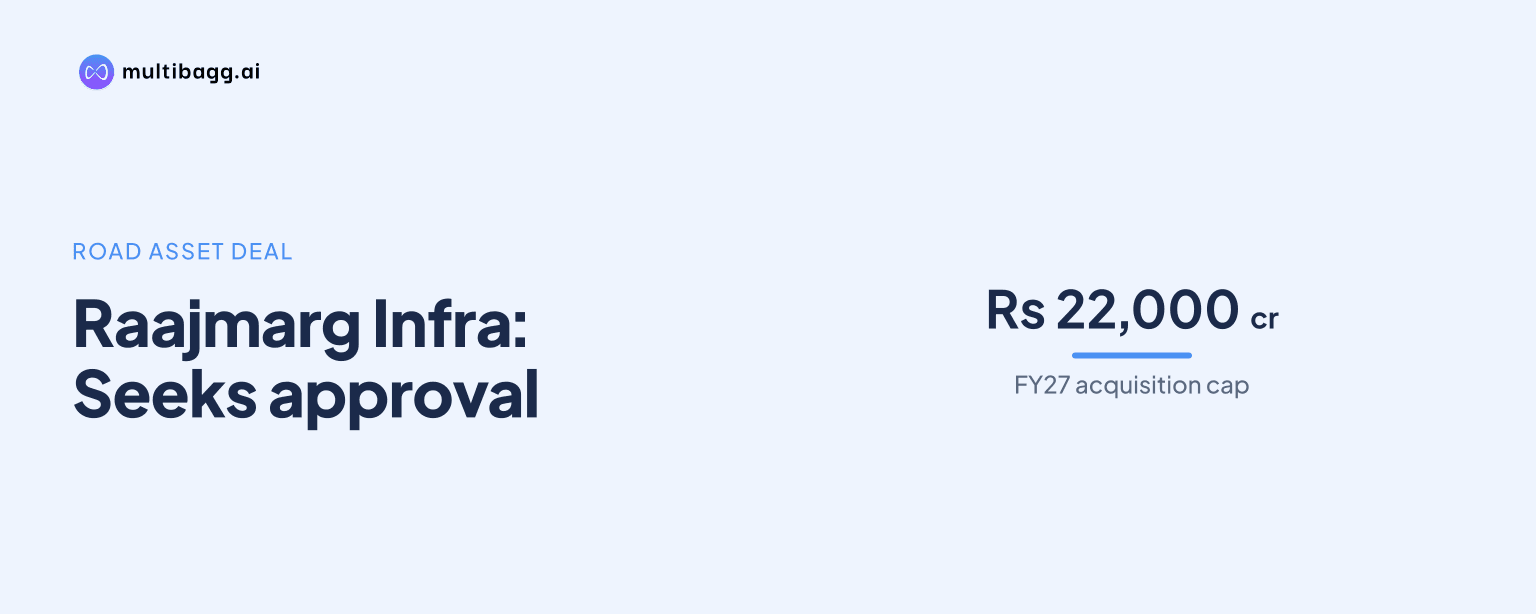
Raajmarg Infra Investment Trust is seeking unitholder approval to acquire National Highways Authority of India road concession rights worth up to Rs 22,000 crore during FY 2026-27. The proposal exceeds 25% of the Trust’s asset value, while the indicative pipeline covers about 1,500 kilometres that NHAI envisages offering over three to five years.
Know RaajMarg Infra Investment Trust inside out
Results, valuation, peers and who's buying, in one view.
What approval is the Trust seeking for NHAI roads?
The Trust is seeking omnibus approval to acquire one or more NHAI road assets during FY 2026-27 for an aggregate value of up to Rs 22,000 crore. The acquisition would be undertaken through one or more project special purpose vehicles, or SPVs, which would assume concession rights and related obligations under the relevant agreements.
The Rs 22,000 crore cap covers the base concession fee payable in one or more tranches and may also involve an additional concession fee. Where issue proceeds exceed the base fee, the excess, after issue expenses, initial improvement costs and other mutually agreed costs, would be payable to NHAI as an additional concession fee. The filing says consideration would be determined on an arm’s-length basis.
The proposal is not a completed acquisition. NHAI sent letters dated October 22, 2026 and November 25, 2026, and the board of Raajmarg Infra Investment Managers Private Limited, the Trust’s investment manager, considered the transaction on November 28, 2026. Completion remains conditional on due diligence, conditions precedent, approvals, successful bidding where required, and executed concession documents.
Which roads are in the Trust’s Round 2 pipeline?
The Trust’s indicative Round 2 pipeline includes roads in Andhra Pradesh, Chhattisgarh, Haryana, Telangana, Uttar Pradesh and Maharashtra, within NHAI’s proposed 1,500-kilometre offering over the next three to five years. The filing does not disclose asset-level valuation, toll collections, traffic data or concession tenures for the listed roads.
The routes include Renigunta-Naidupetta on NH-71 in Andhra Pradesh from kilometre 0 to 57.046, Bilaspur-Pathrapalli on NH-130 in Chhattisgarh from kilometre 0 to 53.3, and Mancherial-Rapellewada on NH-363 in Telangana from kilometre 0 to 42. Telangana also features the Suryapet-Khammam NH-365BB section from kilometre 0.42 to 59.046.
Haryana’s list includes the Paniyala Mor-Narnaul-Pacheri Kalan route and the Rewari-Narnaul section of NH-11 plus Rewari Bypass, whose stated stretches total 58.9 kilometres. Uttar Pradesh includes the Chakeri-Usraina-Fatehpur-Khokharaj-Prayagraj NH-19 route and four Aligarh-Kanpur NH-34 packages, while Maharashtra includes the 60-kilometre Pimpalgaon-Nashik-Gonde section on NH 848 and 60.
The Trust states that this road list is indicative and subject to bid finalisation, further evaluation by management and the board, and discussions. The Rs 22,000 crore authority would therefore provide capacity for one or more acquisitions rather than commit the Trust to acquire every listed road.
Got a follow-up? Ask IRIS
Why is the NHAI acquisition a related-party transaction?
The proposed acquisition is a related-party transaction because NHAI is the Trust’s sponsor and currently holds 15% of its units. Under the Securities and Exchange Board of India (Infrastructure Investment Trusts) Regulations, 2014, or SEBI InvIT Regulations, and Indian Accounting Standard 24, that holding gives NHAI significant influence over the Trust.
The SEBI InvIT Regulations require related-party transactions to be undertaken at arm’s length, under relevant accounting standards, in unitholders’ interests and consistently with the Trust’s investment strategy. Prior unitholder approval is required when yearly related-party asset acquisitions or sales exceed 5% of InvIT asset value, while a non-borrowing transaction of at least 25% of asset value must also go before unitholders.
The Trust says completed and proposed related-party acquisitions in FY 2026-27, including this proposal, exceed the 25% threshold. Its audit committee considered and approved the transaction on November 28, 2026, and the investment manager’s board approved it on the same date following the committee’s recommendation.
The investment manager recommends a simple-majority vote, meaning votes in favour must exceed 50% of votes cast on the resolution. The filing identifies NHAI, its officers N.R.V.V.M.K. Rajendra Kumar and Mridul Dubey, and their relatives as interested parties in the resolutions.
How could the Trust finance the acquisitions?
The Trust may finance concession fees through issue proceeds, debt financing raised by the Trust or relevant project SPVs, or a combination of those sources. Any funding must remain within the Rs 22,000 crore acquisition cap, applicable transaction documents and the permitted borrowing limit.
Separately, the Trust is seeking authority to issue units worth up to Rs 13,000 crore in one or more tranches through a follow-on offer or another permitted method. The proposed authorisation would remain valid for one year from receipt of unitholder approval, with the board setting price, size, investor categories and other terms under applicable law.
Issue proceeds may be injected as equity or debt into present or future project SPVs for concession-fee payments, capital expenditure and initial improvement work. They may also be used for issue-related expenses, permitted interim deployment and general corporate purposes. The filing does not specify an issue price, number of units, final debt amount or financing mix.
The Trust also seeks approval for consolidated borrowings and deferred payments, net of cash and cash equivalents, of up to 49% of InvIT asset value. That authority would require a credit rating, compliance with the borrowing policy and the SEBI InvIT Regulations, and could support acquisitions, refinancing and operating requirements.
When will unitholders vote on the Trust’s proposals?
Unitholders will vote at an extraordinary meeting through video conferencing and other audio-visual means on December 20, 2026. The cut-off date is December 12, 2026, while remote e-voting runs from 9.00 a.m. Indian Standard Time on December 17, 2026 to 5.00 p.m. on December 19, 2026.
The Rs 22,000 crore related-party acquisition resolution and the 49% borrowing resolution require simple majorities. The separate Rs 13,000 crore unit-issue proposal requires a special majority. These approvals are separate, so approval of one would not establish the final terms of either of the others.
Conclusion
The proposed resolutions would give the Trust authority to pursue a second round of NHAI concession-right acquisitions worth up to Rs 22,000 crore in FY 2026-27, alongside potential unit issuance of Rs 13,000 crore and borrowings of up to 49% of InvIT asset value. The key change is a broad acquisition and financing framework, not an announced completed purchase.
The next disclosed event is the December 20, 2026 extraordinary meeting, after remote voting closes on December 19, 2026. Even if unitholders approve the resolutions, the final roads, bid outcomes, concession fees, funding mix and transaction documents remain unresolved, while NHAI’s indicated pipeline extends about 1,500 kilometres over three to five years.

