










Unihealth Hospitals Limited H1 Revenue Rises 14.7% to ₹76.45 Crore
Key highlights
- Unihealth Hospitals reported H1 FY27 revenue of ₹76.45 crore, up 14.7% year-on-year.
- Operating cash flow was positive at ₹23.83 crore in H1 FY27.
- EBITDA stood at ₹25.91 crore, with a reported margin of 33.31%.
- Capital expenditure of ₹74.87 crore supported hospital expansion in India and Uganda.
powered by IRIS
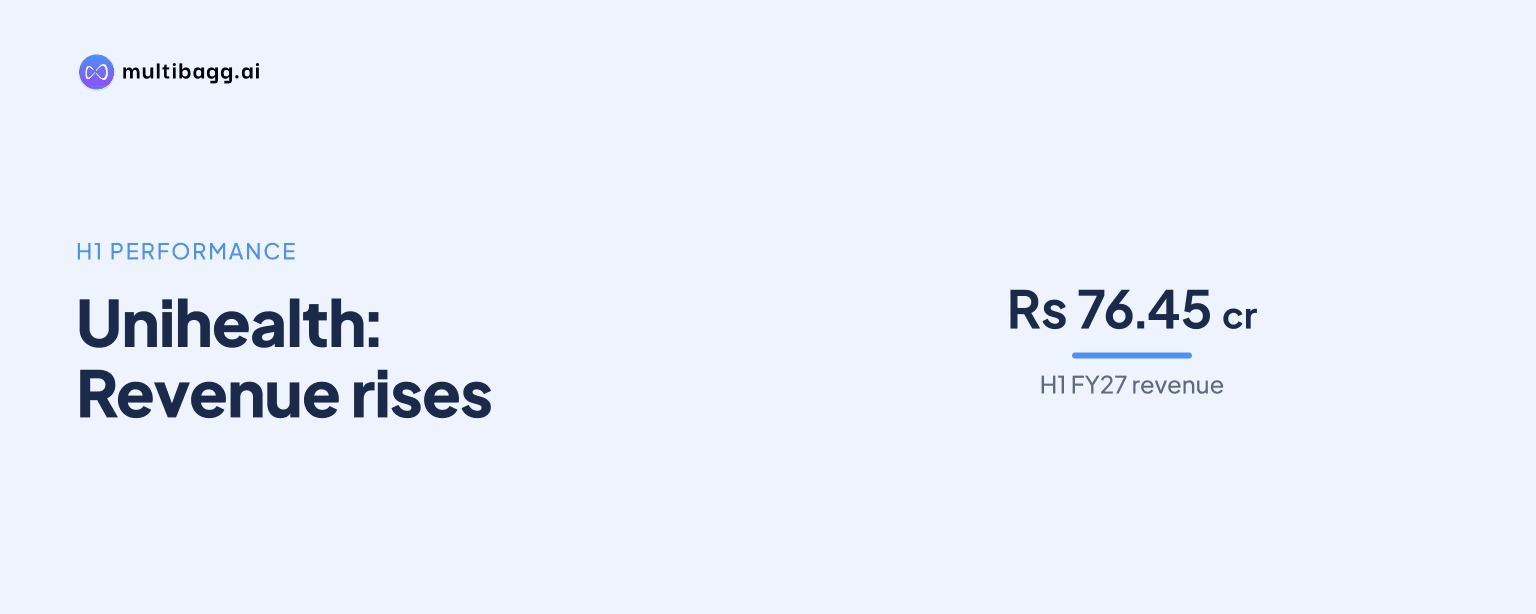
Unihealth Hospitals Limited reported H1 FY27 revenue of ₹76.45 crore, up 14.7% year-on-year, alongside operating cash flow of ₹23.83 crore. The results show that Unihealth Hospitals generated cash from operations while spending ₹74.87 crore on hospital expansion in India and Uganda.
Know Unihealth Hospitals inside out
Results, valuation, peers and who's buying, in one view.
What did Unihealth Hospitals report for H1 FY27?
Unihealth Hospitals reported revenue from operations of ₹76.45 crore for the half year ended September 30, 2026, compared with ₹66.67 crore in the corresponding period a year earlier. The reported year-on-year increase was 14.7%, reflecting higher activity across the hospital network as the company continued to commission physical capacity.
The company reported EBITDA of ₹25.91 crore, translating into an EBITDA margin of 33.31%. Operating cash flow was positive at ₹23.83 crore. This means cash generated through operating activities was close to the reported EBITDA during the period, despite the company being in an expansion phase.
Unihealth Hospitals' board approved the half-year results on November 14, 2026. The update was reported on November 16, following the disclosure of the results for the April-September 2026 period. Comparable consolidated quarterly and same-quarter figures were not available in the disclosed information.
Why do the profit figures require careful reading?
The disclosed figures present more than one profit measure, which should not be treated as interchangeable. A results summary reported profit after tax of ₹21.52 crore, down 24.8% year-on-year from ₹28.63 crore, while the half-year information stated profit after tax attributable to owners of ₹14.22 crore.
The disclosed half-year data also said profit after tax was ₹21.63 crore against ₹2.83 crore a year earlier, supported by a tax credit of ₹3.29 crore. The difference between total profit after tax and profit attributable to owners is relevant for investors assessing earnings available to the company's shareholders.
The filing also noted that a change in depreciation added ₹0.14 crore to profit. This disclosure provides context for reported earnings, particularly when comparing profit levels across periods. Revenue, operating cash flow and capital expenditure are therefore important additional measures for evaluating the underlying operating performance.
How is Unihealth Hospitals using its operating cash flow?
Unihealth Hospitals used its financial capacity to support a capital expenditure programme of ₹74.87 crore during H1 FY27. The expenditure funded hospital expansions in India and Uganda, where the company operates and is adding capacity.
The company said its network had reached 400 operational beds across the two countries. Expansion-led hospital businesses usually incur costs before newly commissioned facilities reach mature utilisation levels. In this context, positive operating cash flow from established units is a relevant indicator because it shows that core operations generated cash during a period of heavy investment.
Operating cash flow of ₹23.83 crore was lower than the reported capital expenditure, indicating that the expansion outlay was substantially larger than cash generated from operations in the half year. The disclosed figures do not specify the precise funding mix for the entire capital expenditure programme, so no conclusion can be drawn from the release on the contribution of borrowings, internal reserves or other sources.
Got a follow-up? Ask IRIS
What does the H1 performance mean for investors and operations?
The H1 performance shows that Unihealth Hospitals increased revenue while retaining positive operating cash generation, but profitability measures and margin trends remain important areas for investors to monitor. Revenue growth of 14.7% demonstrates an increase in operations, while the ₹74.87 crore capex programme indicates that management is continuing to prioritise capacity creation.
For hospital operations, additional beds in India and Uganda can broaden the company’s service footprint once commissioned and integrated into the network. However, the release does not provide hospital-wise occupancy, average revenue per occupied bed, patient volumes, pricing data or utilisation for the new capacity. Those operating data points would be needed to assess the pace at which expansion converts into recurring revenue.
The EBITDA margin of 33.31% and positive operating cash flow provide a measure of the cash-generating ability of existing operations. At the same time, the separate disclosures on total profit after tax, profit attributable to owners, the tax credit and depreciation adjustment make it important to distinguish operating performance from items that can affect reported earnings in a period.
What is the broader context for Unihealth Hospitals' expansion?
Unihealth Hospitals is pursuing a cross-border hospital network strategy spanning India and Uganda. The H1 FY27 results indicate that physical capacity commissioning remained a central part of the company’s plan, with 400 operational beds reported across the network.
The pace of capital expenditure is material relative to the half-year revenue base. Capex of ₹74.87 crore was close to the ₹76.45 crore of revenue reported for H1 FY27. This does not by itself establish the eventual return on those investments, but it underlines that the company is in a period of active infrastructure build-out rather than a phase focused only on near-term earnings.
For shareholders, the key disclosed trade-off is clear: established operations produced positive cash flow, while capital spending remained high to expand the hospital network. The financial outcome from this strategy will depend on operational performance at the expanding facilities, which was not quantified in the results update.
Conclusion
Unihealth Hospitals delivered H1 FY27 revenue of ₹76.45 crore, 14.7% higher year-on-year, and generated ₹23.83 crore of operating cash flow. These outcomes came alongside ₹74.87 crore of capital expenditure for expansion in India and Uganda, showing that the company is funding a sizeable growth programme while its core operations continue to generate cash.
Investors will next need to track the execution of the expansion programme, the operational contribution from the 400-bed network and the relationship between capital spending, margins and cash generation. The disclosed results also make future clarity on profit attribution, tax-related effects and facility-level operating metrics important for evaluating the growth strategy.