










Vapi Enterprise review flags unprovided employee benefits
Key highlights
- Vapi Enterprise’s September 30, 2026 review said the effect of the Ind AS 19 employee-benefit provision gap was unascertainable.
- Vapi Enterprise’s accounting software had no audit-trail edit-log feature, according to the November 5, 2026 review report.
- Vapi Enterprise reported September-quarter net profit of Rs 36.84 lakh, compared with Rs 35.34 lakh a year earlier.
- Vapi Enterprise reported total assets of Rs 39.18 crore at September 30, 2026, versus Rs 38.25 crore at March 31, 2026.
powered by IRIS
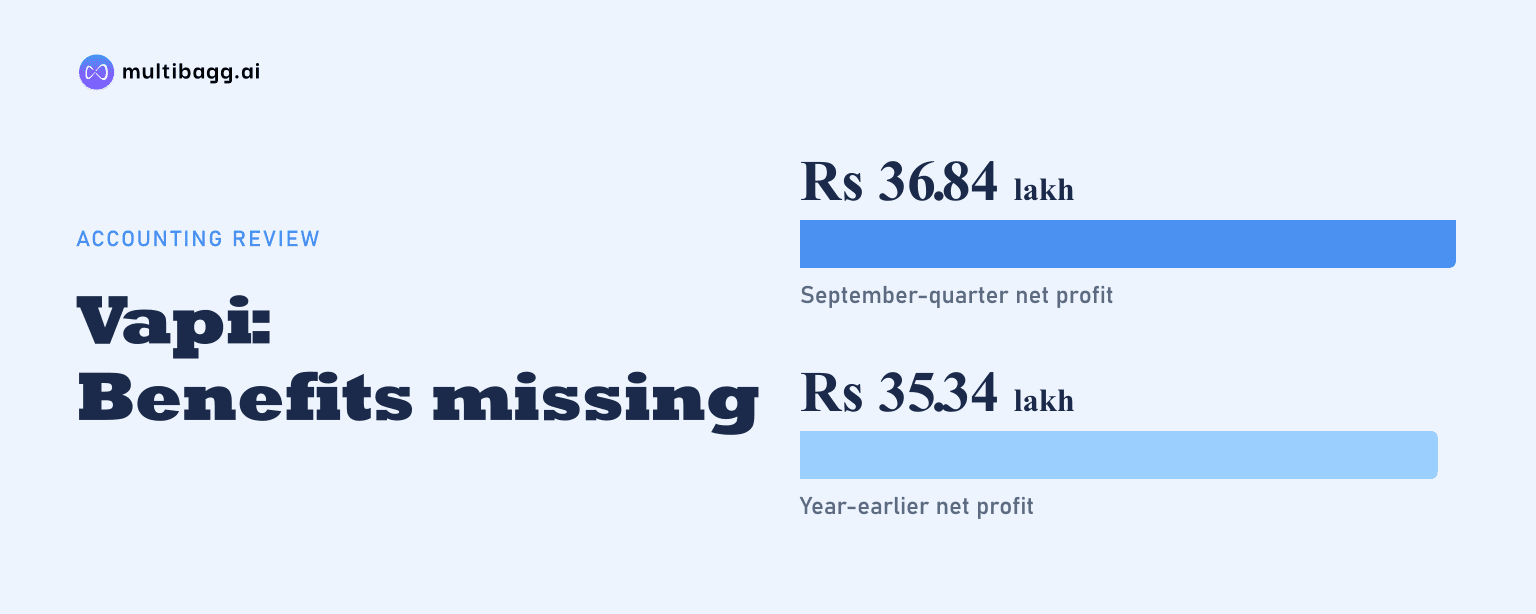
Vapi Enterprise Limited’s limited review for the quarter ended September 30, 2026 found non-provisioning of employee benefits under Indian Accounting Standard 19, or Ind AS 19, leaving effects on assets, liabilities, loss and reserves unascertainable, while Vapi Enterprise reported quarterly net profit of Rs 36.84 lakh.
Know Vapi Enterprise inside out
Results, valuation, peers and who's buying, in one view.
What did Vapi Enterprise’s limited review flag?
Vapi Enterprise’s reviewers identified two matters in their November 5, 2026 report: non-compliance with Ind AS 19 on employee benefits and the absence of an audit-trail facility in the accounting software used for the books. M I Shah And Co. included the matters in an emphasis-of-matters paragraph for the unaudited results for the quarter ended September 30, 2026.
The November 5, 2026 report says employee benefits had not been provided for under Ind AS 19, but does not state the rupee amount of the missing provision. It specifically says the resulting effect on assets and liabilities, as well as loss and reserves, is not ascertainable. The filing therefore does not quantify how the September 30, 2026 financial position or earnings would change if the benefits were recognised.
The reviewers nevertheless said that, based on their review, nothing had come to their attention causing them to believe the September 2026 statement failed to disclose information required under Regulation 33 of the Securities and Exchange Board of India, or SEBI, Listing Obligations and Disclosure Requirements Regulations, 2015. The report says the work was a limited review under Standard on Review Engagements 2410, rather than an audit, and that the reviewers did not express an audit opinion.
How could Ind AS 19 non-compliance affect Vapi Enterprise’s accounts?
Vapi Enterprise’s unprovided employee-benefit obligation could affect its balance sheet and reported profit or loss, but the reviewers said the amount could not be determined from the information reviewed for September 30, 2026. The stated uncertainty extends to assets, liabilities, loss and reserves rather than only to the employee-benefit expense line.
For the September 2026 quarter, Vapi Enterprise reported employee-benefit expenses of Rs 6.70 lakh, compared with Rs 6.71 lakh in the September 2025 quarter. For the half year ended September 30, 2026, the line was Rs 13.40 lakh against Rs 13.21 lakh a year earlier. These reported expenses do not establish the amount of any unprovided Ind AS 19 obligation, which the November 5 review separately describes as unascertainable.
Vapi Enterprise reported net profit after tax of Rs 36.84 lakh for the quarter ended September 30, 2026, compared with Rs 35.34 lakh in the prior-year quarter. Half-year net profit was Rs 72.42 lakh, down from Rs 74.94 lakh for the half year ended September 30, 2025. As the review did not quantify the employee-benefit provision, the filing does not permit a recalculation of either period’s result.
Got a follow-up? Ask IRIS
What did the audit-trail finding mean for Vapi Enterprise?
Vapi Enterprise used accounting software that had no feature for recording an audit trail, also called an edit log, according to the November 5, 2026 review report. The reviewers referred to the Institute of Chartered Accountants of India’s revised 2024 implementation guidance on reporting under Rule 11(g) of the Companies (Audit and Auditors) Rules, 2014.
The filing does not say that a specific accounting entry was altered, nor does it quantify a financial-statement effect from the missing feature as of September 30, 2026. Its finding is narrower: the software Vapi Enterprise used to maintain its books did not contain the feature for recording an audit trail or edit log.
The review report says the reviewers performed test checks in connection with the audit-trail reporting guidance. It does not disclose a remediation programme, a planned software replacement date or a date by which an edit-log feature may be introduced. The filing therefore identifies the control limitation in the September 2026 review without setting a timetable for resolution.
How do Vapi Enterprise’s results and balance sheet compare?
Vapi Enterprise reported total income of Rs 57.12 lakh in the September 2026 quarter, down Rs 2.93 lakh from Rs 60.05 lakh in the September 2025 quarter. As it reported no income from operations in either quarter, all reported total income in both periods came from other operating income.
Total expenses fell to Rs 10.90 lakh in the September 2026 quarter from Rs 13.37 lakh a year earlier, while other expenses declined to Rs 4.18 lakh from Rs 6.62 lakh. The lower reported expenses accompanied the increase in quarterly net profit to Rs 36.84 lakh from Rs 35.34 lakh, despite the decline in total income. The unascertainable Ind AS 19 matter means the filing does not provide adjusted expense or profit figures.
At September 30, 2026, Vapi Enterprise reported total assets of Rs 39.18 crore, compared with Rs 38.25 crore at March 31, 2026. Total equity was Rs 37.83 crore at September 30, 2026, up from Rs 37.10 crore at the prior financial year-end, while non-current liabilities were Rs 52.94 lakh compared with Rs 52.55 lakh.
The balance-sheet movement included an increase in other non-current assets to Rs 20.18 crore at September 30, 2026 from Rs 12.95 crore at March 31, 2026. Other current assets decreased to Rs 17.76 crore from Rs 24.85 crore over the same dates. The review report’s statement that the employee-benefit effect on assets and liabilities is unascertainable limits assessment of how these reported balances could be affected.
Conclusion
Vapi Enterprise’s September 2026 limited review identifies two unresolved accounting-governance matters alongside quarterly net profit of Rs 36.84 lakh. The reviewers said employee benefits had not been provided for in line with Ind AS 19 and could not determine the effect on assets, liabilities, loss or reserves. They also reported that the accounting software used for the books lacked an audit-trail edit-log feature.
The next disclosure to watch is whether Vapi Enterprise quantifies and recognises the employee-benefit provision and reports audit-trail capability in its accounting software. The November 5, 2026 report discloses neither a remediation plan nor a target date for either matter, leaving both issues unresolved in the supplied filing.