










Victoria Enterprises equity deficit widens to Rs 1.60 crore
Key highlights
- Victoria Enterprises reported total equity of negative Rs 1.60 crore at September 30, 2026, versus negative Rs 39.45 lakh at March 31, 2026.
- Victoria Enterprises used Rs 2.14 crore in operating activities during the six months ended September 30, 2026.
- Cash and cash equivalents were Rs 42.35 lakh at September 30, 2026, down from Rs 1.01 crore at March 31, 2026.
- Non-current borrowings rose to Rs 72.74 crore at September 30, 2026 from Rs 71.15 crore at March 31, 2026.
powered by IRIS
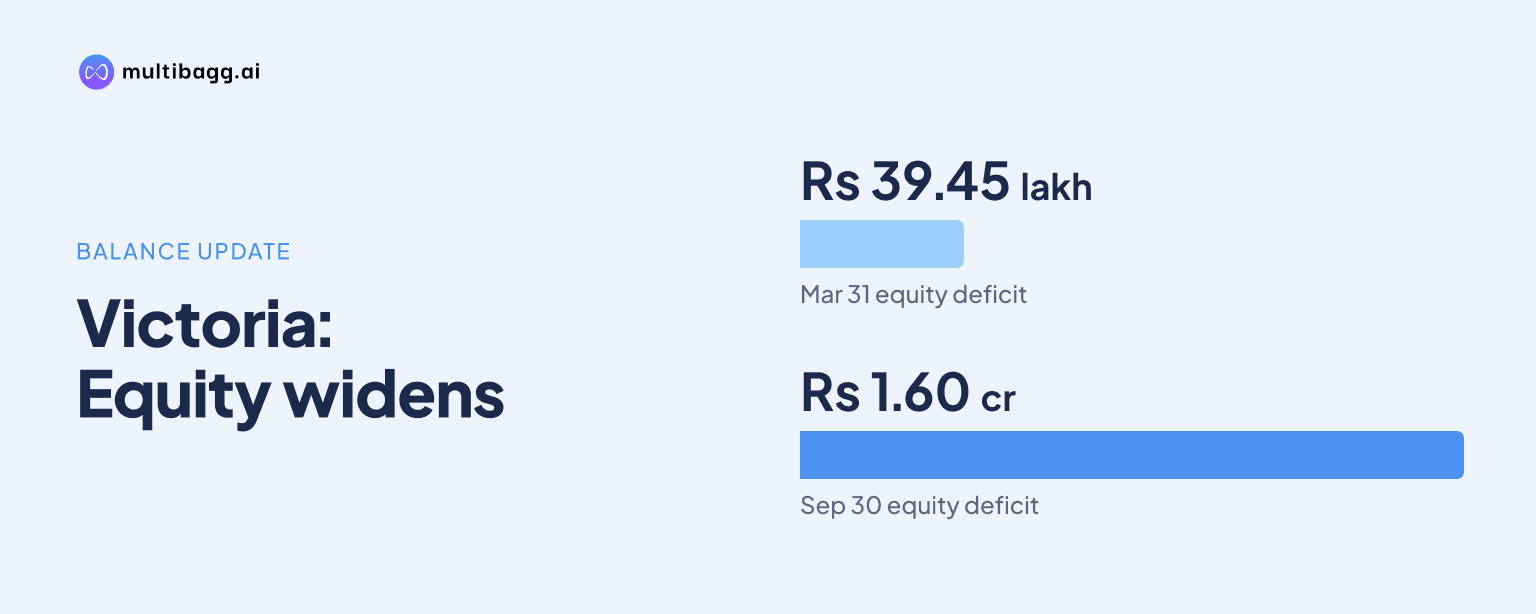
Victoria Enterprises Limited reported total equity of negative Rs 1.60 crore at September 30, 2026, after a Rs 1.20 crore loss for the six months, while operations used Rs 2.14 crore of cash. Victoria Enterprises’ equity deficit had been negative Rs 39.45 lakh at March 31, 2026.
Know Victoria Enterprises inside out
Results, valuation, peers and who's buying, in one view.
Why did Victoria Enterprises’ equity deficit widen?
Victoria Enterprises’ equity deficit widened because the six-month loss reduced other equity by about Rs 1.20 crore. Paid-up equity share capital was unchanged at Rs 50 lakh on September 30, 2026 and March 31, 2026, but other equity moved to negative Rs 2.10 crore from negative Rs 89.45 lakh. Total equity therefore shifted from negative Rs 39.45 lakh to negative Rs 1.60 crore.
The company reported a loss of Rs 1.20 crore for the half year ended September 30, 2026, compared with a profit of Rs 19.64 crore in the corresponding half year ended September 30, 2025. Its September 2026 quarter produced a loss of Rs 72.95 lakh, following a loss of Rs 47.30 lakh in the June 2026 quarter. The results statement recorded total income of Rs 0.50 lakh in the latest half year, against Rs 53.68 crore a year earlier.
The comparative shift also reflects the composition of expenses and income across the two periods. Total expenses were Rs 1.23 crore in the six months to September 2026, compared with Rs 27.36 crore in the prior-year half year, while the earlier period included revenue from operations of Rs 53.65 crore. Victoria Enterprises identifies its sole business and geographical segment as real-estate development and consultancy in real estate in India.
What caused Victoria Enterprises’ operating cash outflow?
Victoria Enterprises used Rs 2.14 crore in operating activities during the six months ended September 30, 2026, as operating profit before working-capital changes was negative Rs 90.95 lakh and asset increases absorbed further cash. The cash-flow statement reported cash generated from operations of negative Rs 2.14 crore, with no income tax paid amount shown for the six-month period.
Inventory increased by Rs 67.84 lakh, trade receivables rose by Rs 9.53 lakh and other assets increased by Rs 16.09 lakh. Those uses were partly offset by a Rs 42.08 lakh increase in trade payables and a Rs 14.33 lakh increase in other financial liabilities. Loans and advances provided a Rs 28,000 cash inflow, while other financial assets used Rs 1.29 lakh.
The latest cash-flow period covers six months, whereas the comparative cash-flow column covers the year ended March 31, 2026, so the two periods are not like for like. Still, the reported direction changed from net operating cash generation of Rs 12.01 crore for that full year to a Rs 2.14 crore outflow in the latest half year. Inventories on the balance sheet rose to Rs 71.16 crore at September 30, 2026 from Rs 70.48 crore at March 31, 2026.
How did Victoria Enterprises’ cash and borrowings change?
Victoria Enterprises ended September 30, 2026 with cash and cash equivalents of Rs 42.35 lakh, down from Rs 1.01 crore at March 31, 2026. The cash-flow statement recorded a net decrease of Rs 38.70 lakh during the six months. Its cash reconciliation listed Rs 4.12 lakh of cash on hand and Rs 38.23 lakh of bank balances, totalling Rs 42.36 lakh, or Rs 1 more than the balance-sheet amount.
Financing activities brought in Rs 1.58 crore through proceeds from long-term borrowings during the six-month period. Investing activities used Rs 3.01 lakh, comprising Rs 3.51 lakh spent on property, plant and equipment, partly offset by Rs 50,000 of interest received. The financing inflow partly funded the operating outflow and resulted in the reported reduction in cash.
Non-current borrowings stood at Rs 72.74 crore on September 30, 2026, compared with Rs 71.15 crore on March 31, 2026. Total liabilities increased to Rs 89.59 crore from Rs 88.32 crore, while current liabilities declined to Rs 16.62 crore from Rs 16.91 crore. Trade payables to parties other than micro and small enterprises fell to Rs 7.81 crore from Rs 8.22 crore, whereas other financial liabilities rose to Rs 5.48 crore from Rs 5.33 crore.
Got a follow-up? Ask IRIS
What changed in Victoria Enterprises’ asset base?
Victoria Enterprises’ total assets increased marginally to Rs 88.00 crore at September 30, 2026 from Rs 87.93 crore at March 31, 2026. Current assets rose to Rs 81.44 crore from Rs 81.15 crore, driven principally by the Rs 67.84 lakh increase in inventories shown in the cash-flow statement. Non-current assets declined to Rs 6.56 crore from Rs 6.78 crore.
Property, plant and equipment decreased to Rs 4.97 crore from Rs 5.26 crore, despite Rs 3.51 lakh of capital expenditure during the half year. Loans were broadly unchanged at Rs 9.28 crore, compared with Rs 9.28 crore at March 31, 2026, while trade receivables increased to Rs 9.90 lakh from Rs 37,000. Other current assets increased to Rs 46.75 lakh from Rs 36.90 lakh.
The balance sheet shows that liabilities of Rs 89.59 crore exceeded total assets of Rs 88.00 crore at the reporting date, consistent with total equity of negative Rs 1.60 crore. Deferred tax liabilities decreased to Rs 22.20 lakh from Rs 24.91 lakh, and current provisions were Rs 29.29 lakh compared with Rs 29.56 lakh at March 31, 2026.
What did the auditor qualify in Victoria Enterprises’ results?
The auditor issued a qualified conclusion on Victoria Enterprises’ September 2026 standalone results because balances including receivables, payables, borrowings, loans, advances, vendor amounts, security deposits and customer advances remain subject to confirmation and reconciliation. The auditor said the possible effect of the related adjustments on profit or loss, assets and liabilities was not ascertainable and may be significant.
The review also cited pending reconciliation between balances in the financial statements and returns or submissions made to statutory authorities, including the Goods and Services Tax department. The auditor said the consequential effect, if any, was not ascertainable. This qualification accompanied the limited review of results approved by the board on November 13, 2026.
Management represented that procedures had been established for periodic review of these balances and that no substantial impact was expected upon reconciliation. Victoria Enterprises’ note says the board has controls to review the recoverability of assets and the payability of liabilities regularly, based on arrangements with the relevant parties. The qualification remains relevant to the Rs 88.00 crore asset base and Rs 89.59 crore liability base reported at September 30, 2026.
Conclusion
Victoria Enterprises’ September 2026 statements show that a Rs 1.20 crore six-month loss deepened the equity deficit to Rs 1.60 crore, while a Rs 2.14 crore operating cash outflow reduced cash to Rs 42.35 lakh. Inventory growth of Rs 67.84 lakh, alongside higher receivables and other assets, was a disclosed contributor to the working-capital cash use.
The next item to watch is the company’s stated reconciliation process for receivables, payables, borrowings, advances and statutory balances. Management expects no substantial impact, but the auditor said the financial effect remains unascertainable and may be significant; subsequent results will show whether those reconciliations affect the balances reported at September 30, 2026.