










Vidya Wires expects Rs 60-65 EBITDA per kg after H1 rise
Key highlights
- Vidya Wires reported H1 FY2027 consolidated EBITDA of Rs 59 per kg, versus about Rs 44 per kg in H2 FY2026.
- Management expects Vidya Wires EBITDA per kg to move towards Rs 60-65.
- Vidya Wires H1 FY2027 consolidated EBITDA rose to Rs 49.18 crore from Rs 38.26 crore in H1 FY2026.
- Vidya Wires expects CTC trial production by mid-December 2026 and revenue contribution from Q4 FY2027.
powered by IRIS
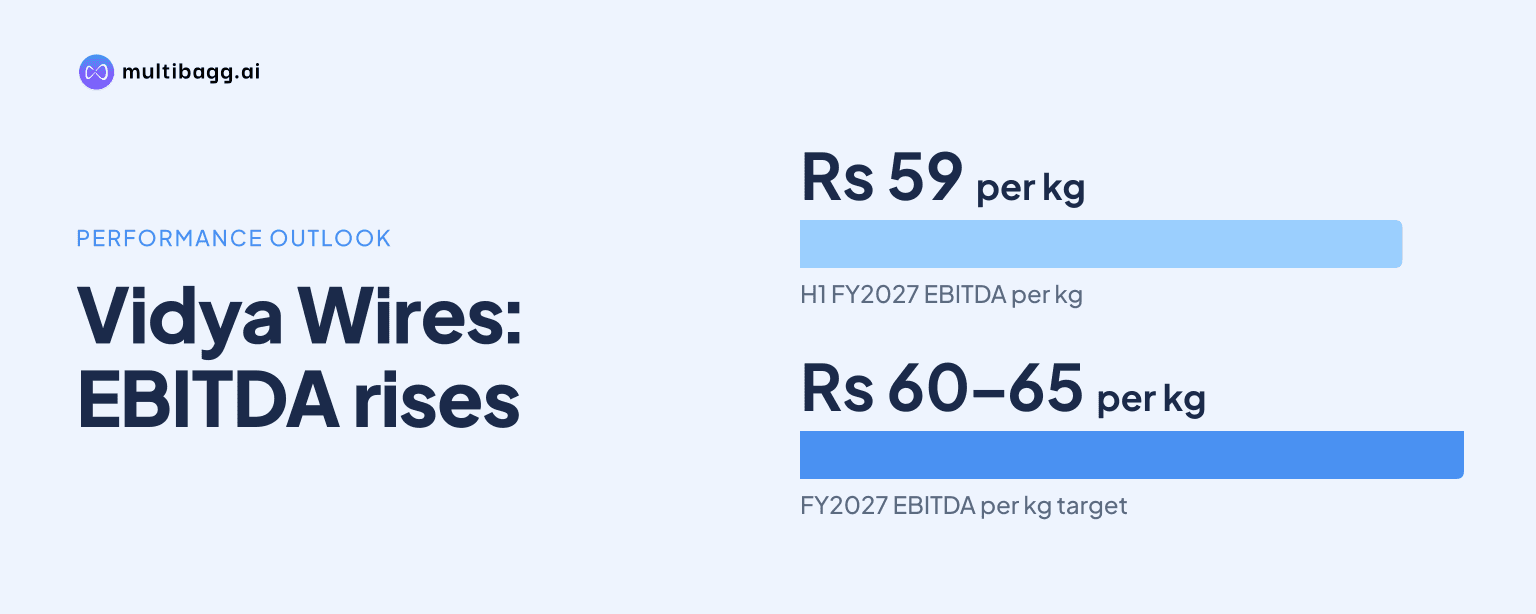
Vidya Wires Limited reported consolidated EBITDA of Rs 59 per kg in H1 FY2027, about 34% above Rs 44 per kg in H2 FY2026, and management said on November 5, 2026 that it expects the measure to reach about Rs 60-65 as ALCU volumes, aluminium approvals and continuously transposed conductor production develop.
Know Vidya Wires inside out
Results, valuation, peers and who's buying, in one view.
What EBITDA per kg does Vidya Wires expect?
Vidya Wires expects EBITDA of about Rs 60-65 per kg, Chief Financial Officer Naveen Pachisia said during the Q2 FY2027 call. He described this as an expectation, rather than formal guidance, after stating that consolidated H1 FY2027 EBITDA per kg was Rs 59 and should rise in absolute and per-kg terms.
The H1 FY2027 result of Rs 59 per kg compares with about Rs 44 per kg in H2 FY2026, a rise management calculated at roughly 34%. The comparison is on a consolidated EBITDA-per-kg basis, rather than as a percentage of revenue, which investors noted can be affected by movements in copper prices.
Vidya Wires did not provide separate EBITDA-per-kg data for ALCU and the older facility, or reported quarterly production volumes for Q1 and Q2 FY2027. Management said it would consider disclosing volume data in future communications, given the mix of two plants and multiple copper and aluminium products.
Why did ALCU weigh on quarterly profitability?
ALCU weighed on quarterly EBITDA because its fixed costs had started before volumes had increased sufficiently to absorb them, management said in response to a Q2 FY2027 question. An analyst had estimated a quarter-on-quarter decline in EBITDA per tonne from calculated volume data, but Vidya Wires did not confirm those quarterly calculations.
The H1 FY2027 results included the full cost of ALCU's first six months of operation while its volumes were still being built. Management said copper output was rising, while aluminium approvals still needed to convert into orders and the continuously transposed conductor, or CTC, line had yet to begin production.
Despite that start-up pressure, consolidated EBITDA increased to Rs 49.18 crore in H1 FY2027 from Rs 38.26 crore in H1 FY2026. Revenue from operations rose 42.63% to Rs 1,130.65 crore from Rs 792.70 crore, while profit after tax increased to Rs 31.97 crore from Rs 22.53 crore; Q2 revenue was Rs 580.94 crore, up 52.5% year on year.
How can ALCU support Vidya Wires' EBITDA per kg?
ALCU can support Vidya Wires' EBITDA per kg if its copper ramp-up, aluminium approvals and new product sales raise utilisation across the new plant. Copper lines began production in February 2026 and, within eight months, were operating at what management called a healthy share of capacity, with output increasing each month.
ALCU has lines for aluminium enamelled wires and strips, paper-covered aluminium strips, photovoltaic, or PV, ribbon, copper busbars and foils. Management said electric-vehicle products, round ripple wire and aluminium paper-covered products launched in February 2026 were being supplied on regular orders, while aluminium testing and customer approvals were still under way.
Management expected aluminium volumes to build from the end of Q3 FY2027 as approvals become regular orders. An analyst said ALCU revenue rose from about Rs 60 crore in Q1 FY2027 to about Rs 110 crore in Q2 FY2027, representing roughly 18% to 20% of group revenue, although Vidya Wires did not independently provide that segment revenue figure.
Got a follow-up? Ask IRIS
When will Vidya Wires start CTC production and finish capacity additions?
Vidya Wires expects CTC trial production by mid-December 2026 and expects the product to contribute revenue from Q4 FY2027. CTC serves power-transformer applications, and management said on November 5 that the plant was close to completion and that the initial focus was to start production.
The company had installed about 10,000 to 11,000 metric tonnes of its planned additional 18,000 metric tonnes of capacity at the time of the call. Management subsequently said the remaining capacity should be added before mid-December 2026, with installation and construction work at ALCU largely complete by the end of Q3 FY2027.
For high-voltage direct-current, or HVDC, transformer applications, Managing Director Shailesh Rathi said the company would first build a supply record with normal and mid-sized transformer customers. He estimated that progressing to HVDC applications could take six to nine months because customers would require performance experience and approvals.
What must happen for Vidya Wires to reach Rs 60-65 per kg?
Vidya Wires must convert ALCU's aluminium approvals and customer audits into recurring orders, commission CTC and raise output enough to absorb fixed costs if it is to reach about Rs 60-65 per kg. Management said operational issues at the new plant had been addressed and expected coming quarters to improve, but gave no numerical volume forecast for FY2027 or FY2028.
Management said capacity building was nearing completion and that its focus was moving to sales, with products aimed at renewable power, transformers, electric vehicles and data-centre applications. It also disclosed first ALCU export shipments to Israel and Nepal and an aim for exports to account for one-quarter of revenue after the expansion is complete, while noting that results would depend on Vidya Wires' execution and sales.
Conclusion
Vidya Wires' H1 FY2027 EBITDA per kg rose to Rs 59 from about Rs 44 in H2 FY2026, followed by management's expectation of about Rs 60-65. The improvement and outlook are tied to the ALCU product mix and ramp-up, but the company also acknowledged that start-up fixed costs had constrained quarterly profitability while volumes remain below their intended scale.
The next items to watch are CTC trial production by mid-December 2026, completion of the remaining capacity before mid-December and the expected build-up in aluminium volumes from the end of Q3 FY2027. Vidya Wires also said it would consider providing volume data in future investor materials, which could show the pace at which higher sales absorb ALCU's fixed costs.