










Virgo Polymers reports Rs 3.81 crore operating cash outflow
Key highlights
- Virgo Polymers reported a Rs 3.81 crore operating cash outflow for the six months ended September 30, 2026.
- Trade receivables increased Rs 10.76 crore to Rs 41.34 crore at September 30, 2026.
- Cash and cash equivalents were Rs 82.13 lakh at September 30, 2026, compared with Rs 6.55 crore at March 31, 2026.
- Short-term borrowings declined to Rs 9.91 crore from Rs 11.63 crore during the six-month period.
powered by IRIS
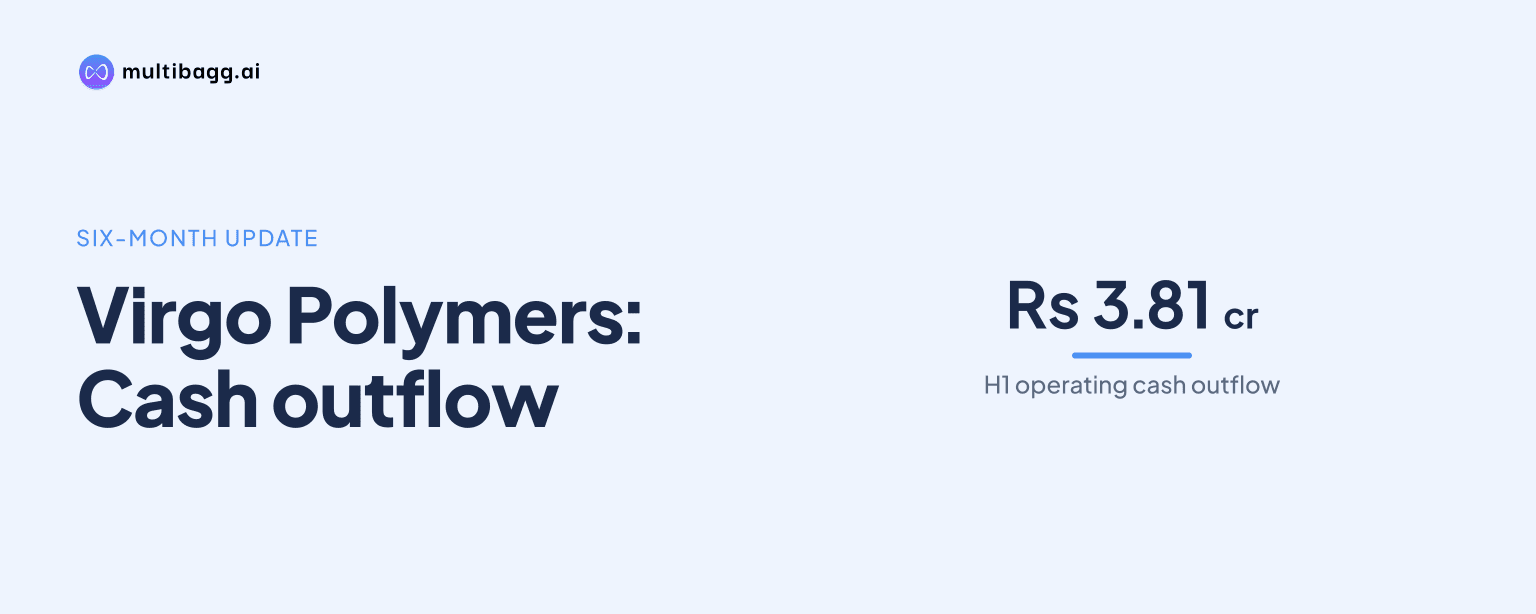
Virgo Polymers (India) Limited recorded a Rs 3.81 crore operating cash outflow for the six months ended September 30, 2026, as trade receivables increased Rs 10.76 crore to Rs 41.34 crore. The cash-flow statement shows Rs 94.91 lakh of operating profit before working-capital changes, while closing cash was Rs 82.13 lakh.
Know Virgo Polymers (India) inside out
Results, valuation, peers and who's buying, in one view.
Why did Virgo Polymers report an operating cash outflow?
Virgo Polymers reported net cash used in operating activities of Rs 3.81 crore for the six months ended September 30, 2026, because a Rs 4.76 crore net working-capital outflow exceeded operating profit before working-capital changes. The company reported Rs 94.91 lakh of operating profit before those movements, including adjustments for Rs 52.50 lakh of depreciation and Rs 38.49 lakh of interest and finance charges.
The cash-flow statement starts with profit before tax of Rs 3.92 lakh and adds back the two stated non-cash or financing-related charges. The resulting Rs 94.91 lakh was insufficient to cover the working-capital movements recorded during the period, producing the Rs 3.81 crore operating cash deficit.
The comparative cash-flow column covers the year ended March 31, 2026 rather than a six-month period. For that full year, Virgo Polymers reported Rs 50.82 crore of net operating cash inflow, Rs 4.97 crore of operating profit before working-capital changes and a Rs 45.85 crore working-capital inflow. The comparison shows both a different reporting duration and a reversal in the direction of working-capital cash movements.
What caused Virgo Polymers’ working-capital cash movement?
The largest disclosed use of working capital was a Rs 10.76 crore increase in sundry debtors for the six months ended September 30, 2026. The balance sheet records trade receivables of Rs 41.34 crore at September 30, compared with Rs 30.58 crore at March 31, 2026, matching the cash-flow movement.
Several working-capital items partly offset the debtor increase. Inventories generated Rs 2.13 crore of cash, loans and advances generated Rs 3.52 crore, and sundry creditors for purchases generated Rs 4.85 crore. Other current and non-current assets generated Rs 25.48 lakh, while the cash-flow statement reports no income-tax or minimum alternate tax cash movement for the period.
These inflows were reduced by a Rs 4.76 crore outflow under other current and non-current liabilities. In the year ended March 31, 2026, sundry debtors were shown as a Rs 46.71 crore cash inflow, while sundry creditors for purchases were a Rs 22.82 crore cash outflow. The filing therefore shows a reversal in both lines between the annual period and the six months to September 2026.
Got a follow-up? Ask IRIS
How did Virgo Polymers’ balance sheet change by September 2026?
Virgo Polymers’ total assets declined to Rs 60.10 crore at September 30, 2026, from Rs 62.01 crore at March 31, 2026. The receivables increase occurred alongside lower inventories, cash and cash equivalents, short-term loans and advances, and property, plant and equipment.
Inventories fell to Rs 2.84 crore from Rs 4.86 crore, while short-term loans and advances declined to Rs 95.70 lakh from Rs 4.48 crore. Property, plant and equipment decreased to Rs 7.95 crore from Rs 9.10 crore, and other current assets fell to Rs 2.65 crore from Rs 2.97 crore.
Cash and cash equivalents on the balance sheet fell to Rs 82.13 lakh at September 30 from Rs 6.55 crore at March 31. The cash-flow statement instead reports opening cash of Rs 6.78 crore, a Rs 5.95 crore net decline and closing cash of Rs 82.13 lakh. The filing does not reconcile the Rs 23.05 lakh difference between the March 31 balance-sheet cash figure and the cash-flow statement’s opening cash figure.
On the liabilities side, short-term borrowings decreased to Rs 9.91 crore from Rs 11.63 crore, and long-term borrowings declined to Rs 24.17 lakh from Rs 68.14 lakh. Trade payables fell to Rs 8.35 crore from Rs 12.21 crore, whereas other current liabilities rose to Rs 17.46 crore from Rs 13.48 crore. Retained earnings increased to Rs 15.68 crore from Rs 15.53 crore.
How did investing and financing activities affect Virgo Polymers’ cash?
Virgo Polymers used Rs 62.29 lakh in investing activities during the six months ended September 30, 2026, entirely for purchases of fixed assets. The cash-flow statement reports no proceeds from sale of investments and no calls in arrears received in the period.
Financing activities used Rs 2.77 crore, comprising a Rs 2.38 crore decrease in loan funds and Rs 38.49 lakh of interest and finance charges paid. Combined with the Rs 3.81 crore operating outflow and the Rs 62.29 lakh investing outflow, these movements resulted in the reported Rs 5.95 crore decrease in cash and cash equivalents.
For the year ended March 31, 2026, investing activities used Rs 36.14 lakh and financing activities used Rs 46.27 crore. The annual financing figure included a Rs 43.05 crore decrease in loan funds and Rs 3.22 crore of interest and finance charges paid. The filing does not disclose a future capital-expenditure budget, borrowing target or receivables-collection target.
What does Virgo Polymers disclose about its business and financial review?
Virgo Polymers reports one business segment, the manufacture of Flexible Intermediate Bulk Containers. Its unaudited standalone financial results for the quarter ended September 30, 2026 were approved by the board on November 12, 2026, after review and recommendation by the audit committee.
Venkat & Rangaa LLP issued its limited review report on November 12, 2026 under Standard on Review Engagement 2410. The auditor stated that a review provides moderate assurance and is not an audit, and said nothing had come to its attention indicating that the unaudited financial results contained a material misstatement.
The filing does not provide an ageing schedule for the Rs 41.34 crore trade-receivables balance, name the customers involved, or state whether the amount was collected after September 30, 2026. It also does not provide separate segment revenue, profit, receivables or cash-flow figures for its Flexible Intermediate Bulk Containers business.
Conclusion
Virgo Polymers’ cash-flow statement shows that the Rs 10.76 crore increase in receivables was the largest disclosed working-capital use during the six months ended September 30, 2026. Cash released from inventories, loans and advances, and sundry creditors did not offset the debtor movement and the outflow in other liabilities, leaving operating cash flow at negative Rs 3.81 crore.
The next financial disclosure should show whether trade receivables move from Rs 41.34 crore and whether cash changes from the Rs 82.13 lakh balance reported at September 30, 2026. Investors can also watch for any management disclosure on collections, borrowing plans or capital expenditure, none of which was provided in the November 12, 2026 filing.