










Virtuoso Optoelectronics Limited PLI supports 75-80% in-house
Key highlights
- VOEPL’s white-goods PLI sanction is Rs 100 crore, up from Rs 50.50 crore in Round 3.
- VOEPL targets 75-80% in-house AC component content, compared with 60% currently.
- Compressor revenue is expected to rise from about 8% in FY26 to about 15% in FY27.
- Compressor capacity is planned to increase from 28 lakh units in FY26 to 60 lakh units.
powered by IRIS
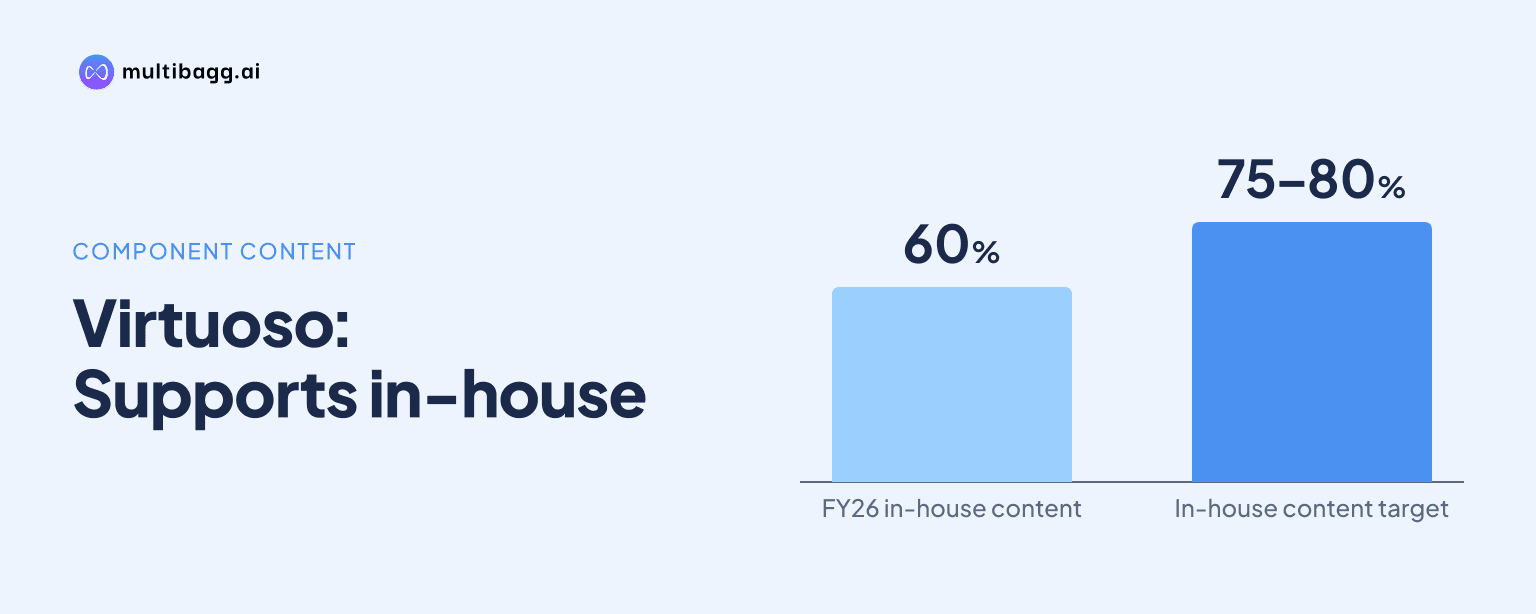
Virtuoso Optoelectronics Limited (VOEPL) received a Rs 100 crore sanction under the Production-Linked Incentive scheme for white-goods air-conditioner backward integration, increased from Rs 50.50 crore in Round 3, and management says it supports a plan to lift in-house AC component content from 60% to 75-80%.
Know Virtuoso Optoelectronics inside out
Results, valuation, peers and who's buying, in one view.
How does VOEPL’s Rs 100 crore PLI sanction support localisation?
VOEPL says its Rs 100 crore Production-Linked Incentive, or PLI, sanction supports backward integration for white-goods air conditioners. The presentation says the sanction was increased from Rs 50.50 crore in Round 3 and that VOEPL was among 26 approved companies. Management presents the sanction as support for its integration roadmap, rather than as reported revenue or operating profit.
The policy transition also covers compressor localisation. The presentation says Quality Control Order, or QCO, linked compressor-import exemptions extend until March 2027, with a limited 40% import exemption. Management describes this arrangement as a transition runway while domestic capacity is built, linking it to deeper backward integration and expansion into additional consumer-durable categories.
What is VOEPL’s in-house AC component target?
VOEPL’s stated target is to raise in-house AC component content from 60% currently to 75-80%. The current split is 60% in-house and 40% bought out, while management identifies the move toward 75% or more as a structural gross-margin driver. The 75-80% figure is a management objective, not a reported FY26 result.
The existing component stack includes polymers, expanded polystyrene, or EPS, heat exchangers, copper tubing, sheet metal, plastics and tooling. Expansion of EPS, plastics, electronic manufacturing services, or EMS, and other component capabilities is ongoing and expected to be completed by H1FY27. VOEPL also says its new tool room is operational and being scaled to reduce product-development turnaround time.
Management’s margin case rests on producing a greater share of parts used in each finished product. The presentation reports earnings before interest, taxes, depreciation and amortisation, or EBITDA, margins of 6-8% for ACs, compared with 10-12% for refrigeration and 10-15% for EMS. It does not quantify the consolidated margin effect that would result from achieving 75-80% in-house content.
How is compressor production changing VOEPL’s revenue mix?
VOEPL has commenced compressor manufacturing through its subsidiary, Virtuoso Compressor Private Limited, and says production was running at more than 50% utilisation three months ahead of schedule. The presentation describes the business as manufacturing refrigeration compressors in India through a technological partnership with a Chinese group, while the 40% import exemption runs through March 2027.
Management expects compressors to account for about 15% of FY27 revenue, up from about 8% in FY26. This expected 7-percentage-point increase contrasts with ACs, whose share declined from about 75% in FY25 to about 60% in FY26 and is expected to remain near 60% in FY27. The comparison indicates that management expects diversification to come mainly from expanding compressor sales rather than another reduction in AC share.
VOEPL says non-AC verticals already contribute approximately 40% of revenue. Alongside compressors, its product mix includes refrigeration, washing machines, water dispensers, components and EMS. Plastic and EPS parts are manufactured through wholly owned subsidiary Virtuoso Polymers Private Limited, providing another mechanism for increasing internally produced component content.
Got a follow-up? Ask IRIS
What capacity and customer actions underpin VOEPL’s plan?
VOEPL’s integration plan is paired with capacity expansion across components and finished products. Compressor capacity is listed at 28 lakh units in FY26, with planned capacity of 60 lakh units. AC indoor and outdoor unit capacity is listed at 10 lakh sets in FY26 and 18 lakh sets after expansion, while EMS capacity is planned to increase from 4 lakh components per hour to 8 lakh in Phase 1 and 12 lakh in Phase 2.
Management aims to raise utilisation above 75% at new facilities in Nashik, Sanand, Chennai and Virtuoso Polymers Private Limited. The presentation says Nashik Phase 2, Sanand and Chennai are ramping up, and characterises filling existing capacity in FY27 as a low-incremental-capital-expenditure route to growth. Facility-level utilisation rates are not disclosed, apart from compressor production exceeding 50%.
The commercial plan also combines original equipment manufacturing, or OEM, with original design manufacturing, or ODM. VOEPL says it launched an AC ODM range and added a new marquee customer under that model in FY26. Management is working toward a diversified base of 8-10 customers, compared with an earlier position where a few customers contributed most revenue, although the presentation does not identify customers or state their individual revenue shares.
Conclusion
The PLI sanction, compressor start-up and component expansion form a connected manufacturing strategy: use policy support and new internal capabilities to produce more of the AC value chain within VOEPL. The reported 60% in-house component level, planned 60 lakh-unit compressor capacity and expected rise in compressor revenue to about 15% of FY27 sales provide measurable markers for that strategy.
The next items to watch are completion of the EPS, plastics and EMS expansion by H1FY27, progress toward more than 75% utilisation at new sites, and compressor scaling before the QCO-linked import exemption transition ends in March 2027. Management’s FY27 mix expectation, with ACs at about 60% and compressors at about 15%, is the clearest disclosed measure of execution.