










VA TECH WABAG LIMITED order book reaches Rs 20,200 crore
Key highlights
- WABAG reported an order book of about Rs 20,200 crore at 30 September 2026.
- WABAG recorded Rs 5,200 crore of order intake in H1 FY27.
- WABAG’s H1 FY27 consolidated revenue rose 20% year on year to Rs 1,887 crore.
- WABAG reported net cash excluding HAM of Rs 1,144.2 crore after 15 consecutive positive quarters.
powered by IRIS
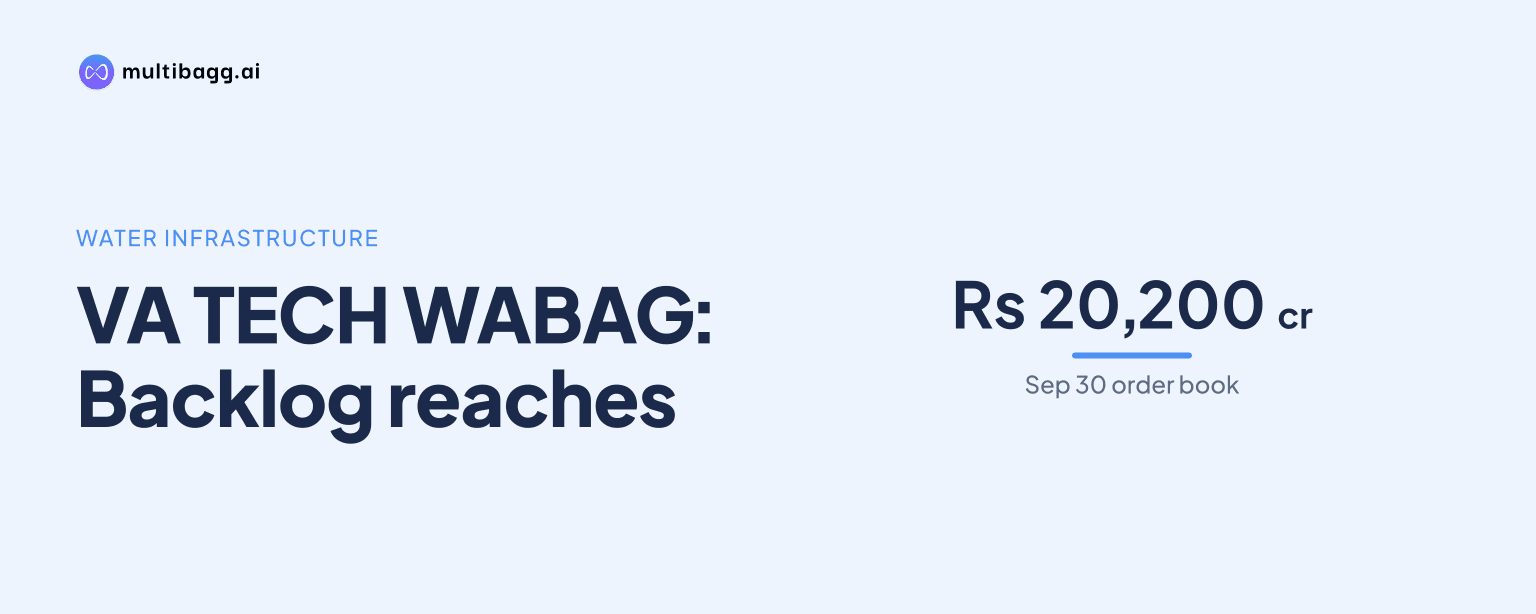
On 30 September 2026, VA TECH WABAG LIMITED reported an order book of about Rs 20,200 crore after Rs 5,200 crore of H1 FY27 order intake, crossing Rs 20,000 crore for the first time. WABAG said the backlog exceeded four times annual revenue, while H1 consolidated revenue rose 20% year on year to Rs 1,887 crore.
Know Va Tech Wabag inside out
Results, valuation, peers and who's buying, in one view.
How large is WABAG’s order book after H1 FY27?
WABAG’s order book was about Rs 20,200 crore at 30 September 2026, following Rs 5,200 crore of order intake in the half year ended on that date. Chairman and Managing Director Rajiv Mittal said the company had crossed Rs 20,000 crore in order book for the first time.
Management said the order book was more than four times WABAG’s annual revenue. The release does not specify when individual projects will be executed, their respective values, or how much of the Rs 20,200 crore backlog is expected to convert into revenue during FY27.
The Rs 5,200 crore H1 FY27 intake was about 2.8 times the Rs 1,887 crore of consolidated revenue recognised in the same six-month period. This comparison measures new contract awards against reported revenue, rather than providing a forecast because project execution schedules and conditions were not disclosed.
Which projects did WABAG identify in its new orders?
WABAG identified its entry into Kuwait and a Reliance Industries Limited contract for a desalination plant at Jamnagar as key wins associated with the Rs 20,200 crore order-book milestone. The release described the Jamnagar plant as one of India’s largest desalination plants, but did not disclose either contract’s value.
The company also cited its entry into the United Arab Emirates through Ajman, expansion in Europe through Donauinsel Water Works, and municipal orders from Bangalore Water Supply and Sewerage Board and Delhi Jal Board. These awards span Indian and international work, although WABAG did not provide a geographic or municipal-versus-industrial split of its 30 September 2026 backlog.
Management characterised the projects as complex and technology-intensive, with treated-water reuse and desalination identified as demand areas for municipal and industrial customers. The release did not quantify how much of the Rs 20,200 crore order book relates to desalination, reuse, municipal treatment or industrial projects.
How did WABAG perform financially in H1 FY27?
WABAG reported H1 FY27 consolidated revenue from operations of Rs 1,887 crore, up 20% year on year, alongside earnings before interest, tax, depreciation and amortisation, or EBITDA, of Rs 260.8 crore, up 21%. Consolidated profit after tax, or PAT, rose 29% year on year to Rs 194.7 crore for the half year ended 30 September 2026.
PAT increased faster than both revenue and EBITDA in H1 FY27, based on the company’s reported growth rates of 29%, 20% and 21%, respectively. WABAG did not disclose prior-year absolute figures in the release, so the stated year-on-year percentages are the available comparison for the operating and profit measures.
On a standalone basis, WABAG reported EBITDA of Rs 226.9 crore and PAT of Rs 168.7 crore, each with year-on-year growth of 20% and 29%, respectively. Consolidated PAT was Rs 26 crore above standalone PAT in H1 FY27, reflecting the release’s separate reporting of group and standalone results.
Got a follow-up? Ask IRIS
What cash position did WABAG report at September 2026?
WABAG reported gross cash of Rs 1,218.2 crore and net cash of Rs 1,144.2 crore excluding hybrid annuity model, or HAM, assets, at 30 September 2026. The company said this was its 15th consecutive quarter of positive net cash.
Management attributed the result to margins and working-capital management. Gross cash exceeded net cash excluding HAM by Rs 74 crore, while the release did not provide equivalent cash balances for the preceding quarter or the prior-year half.
The 30 September 2026 cash figures accompany H1 consolidated revenue of Rs 1,887 crore and an order book of about Rs 20,200 crore. They are balance-sheet measures at the half-year end, not a disclosure of cash generation by the Kuwait, Jamnagar, Ajman or municipal contracts individually.
What is WABAG’s plan for future orders?
WABAG said it would remain selective and seek more “Large” and “Mega” technology-led projects after recording Rs 5,200 crore of H1 FY27 order intake. Management said it aimed to deliver growth and margins in line with strategic targets, but did not provide numerical targets for revenue, margin, orders or cash.
Management also cited a healthy bid pipeline and demand for treated-water reuse and desalination across municipal and industrial sectors. The company did not quantify its pipeline or identify dates for potential future awards, leaving the Rs 20,200 crore order book at 30 September 2026 as the disclosed workload base.
WABAG said it operates in more than 25 countries with around 2,000 water professionals and has designed and built more than 1,500 municipal and industrial water and wastewater treatment plants over three decades. That operating footprint provides context for the H1 FY27 projects identified in Kuwait, the United Arab Emirates, Europe and India.
Conclusion
WABAG ended H1 FY27 with about Rs 20,200 crore of orders, following Rs 5,200 crore of intake, while consolidated revenue, EBITDA and PAT reached Rs 1,887 crore, Rs 260.8 crore and Rs 194.7 crore. The named Kuwait, Jamnagar, Ajman, European and Indian municipal projects show that the backlog includes domestic and international water-sector work.
The next disclosure to watch is execution of the Rs 20,200 crore backlog alongside management’s stated selective pursuit of large and mega technology-led contracts. Management has cited a healthy bid pipeline and demand for reuse and desalination, but the 5 November 2026 release gives no numerical forward target or award timetable.