










Welspun Living Limited approves Rs 3,200 crore towel expansion
Key highlights
- Welspun Living approved capital expenditure of up to Rs 3,200 crore on November 21, 2026.
- The project targets about 29,000 MT of annual terry towel capacity by December 31, 2028.
- Welspun Living reported 96,000 MT of consolidated towel capacity and 83% utilisation as of September 30, 2026.
- WHSL may raise up to Rs 2,400 crore of debt, alongside up to Rs 800 crore of parent funding.
powered by IRIS
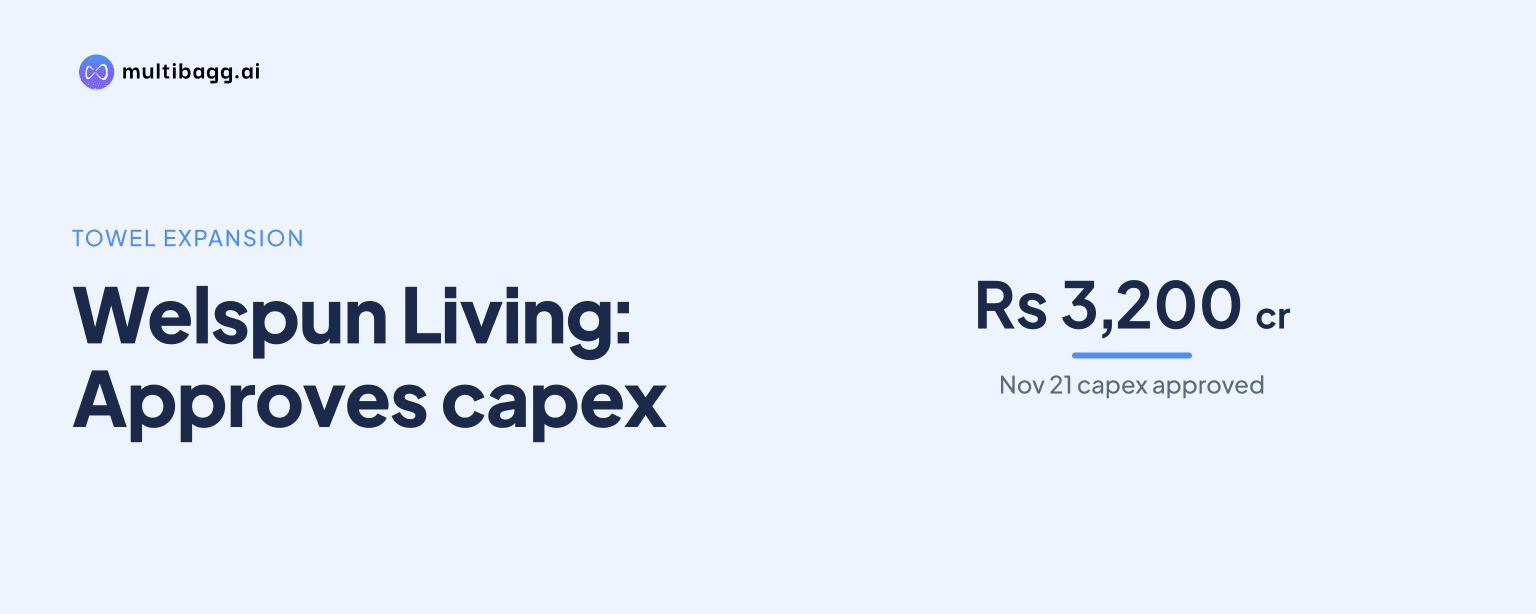
Welspun Living Limited approved up to Rs 3,200 crore of capital expenditure on November 21, 2026, targeting an addition of about 29,000 metric tonnes (MT) a year of terry towel capacity by December 31, 2028. The plan also includes 15,000 MT of weaving capacity, 31,000 MT of yarn capacity and a research and development centre.
Know Welspun Living inside out
Results, valuation, peers and who's buying, in one view.
What capacity is Welspun Living adding by 2028?
Welspun Living plans to add about 29,000 MT a year of terry towel capacity at the consolidated level by December 31, 2028. It reported existing consolidated terry towel capacity of about 96,000 MT a year and utilisation of 83% as of September 30, 2026. If the announced towel addition is completed, the arithmetic capacity total would be about 125,000 MT a year.
The project separately includes about 15,000 MT a year of weaving capacity and about 31,000 MT a year of yarn capacity. The yarn additions cover coarse-count, fine-count and open-end yarn. Welspun Living said the rationale is demand outlook, scale and cost benefits, while noting that the capacity, financing and timetable statements are forward-looking and subject to approvals, market conditions and project execution.
The proposed towel capacity is about 30% of the current 96,000-MT consolidated base. The weaving and yarn figures are additional manufacturing capacities, rather than separately disclosed increases in finished-towel output. Their stated purpose is to enhance backward integration, adding more yarn and weaving stages within the manufacturing chain.
How will Welspun Living fund the Rs 3,200 crore project?
Welspun Living plans to fund the up-to-Rs 3,200 crore programme through up to Rs 800 crore of parent investment in Welspun Home Solutions Limited (WHSL) and up to Rs 2,400 crore of borrowings by WHSL. WHSL is a wholly owned subsidiary, and the company intends to deploy the parent funding in one or more tranches through either preference shares or debentures.
The parent contribution represents 25% of the maximum project outlay, while the proposed WHSL borrowing represents 75%. WHSL proposes to raise term loans from banks or financial institutions, and Welspun Living will provide a corporate guarantee. The filing says this guarantee is a contingent liability and that there is no immediate impact on consolidated debt except to the extent of the guarantee if WHSL cannot meet its repayment obligations.
The preference-share route is 8% non-cumulative optionally convertible redeemable preference shares, with a 20-year tenure and redemption period. The debenture route is optionally convertible debentures carrying a coupon of government security yield, or G-Sec, plus a 1% margin, also with a 20-year tenure and redemption period. The debentures would have a face value of Rupees 10 each, while the preference-share issue would be based on valuations determined from time to time.
Got a follow-up? Ask IRIS
What is WHSL's role in the expansion?
WHSL will execute and finance the expansion as Welspun Living's wholly owned subsidiary. The filing identifies WHSL's industry as textiles, including home textiles, advanced textiles and flooring. Its turnover rose from Rs 199.52 crore in FY24 to Rs 224.98 crore in FY25 and Rs 537.78 crore in FY26.
WHSL's FY26 turnover was Rs 312.80 crore higher than its FY25 turnover, based on the disclosed figures. Its net worth stood at Rs 298.51 crore as of March 31, 2026, compared with the up-to-Rs 800 crore parent investment approved for the project. The announcement does not provide a project-level return estimate, cash-flow forecast or repayment schedule for the proposed debt.
The parent funding is a related-party transaction because WHSL is wholly owned by Welspun Living. Welspun Living said the transaction is at arm's length and that promoters, the promoter group and group companies have no interest in WHSL other than through Welspun Living. Its 100% equity holding in WHSL will remain unchanged, and the investment will be made in cash through normal banking channels.
Which approvals and project terms are still pending?
WHSL shareholder approval is to be obtained on November 27, 2026 for the proposed preference shares or debentures and the borrowing. Welspun Living's board approved the capital expenditure on November 21, 2026, and WHSL's board also obtained the requisite approvals on that date.
Final loan terms remain unresolved because WHSL and its lenders will determine the tenor, repayment schedule, indicative interest rate, security and other terms. The disclosed Rs 2,400 crore is therefore a borrowing ceiling, not confirmation that debt has been drawn or that lending rates and collateral have been finalised.
Welspun Living expects capital expenditure completion by December 31, 2028, roughly two years after the November 21, 2026 approval. The filing does not disclose facility locations, phased commissioning dates or an annual ramp-up schedule for the 29,000-MT towel addition. It says further material developments will be disclosed over time.
Conclusion
Welspun Living has approved a manufacturing expansion of up to Rs 3,200 crore that combines a 29,000-MT terry towel addition with 15,000 MT of weaving and 31,000 MT of yarn capacity. The proposal would increase the stated towel capacity base of about 96,000 MT, while allocating up to Rs 2,400 crore of the outlay to WHSL borrowings and up to Rs 800 crore to parent funding.
The next disclosed milestone is WHSL shareholder approval on November 27, 2026. Thereafter, the items to watch are the selected funding instrument, final bank-loan terms and guarantee exposure, project execution against the December 31, 2028 target, and changes in the 83% towel-capacity utilisation reported on September 30, 2026.