










WeWork India prepares backfill for Commonwealth Bank move
Key highlights
- Commonwealth Bank may shift some occupancy to a 1.2-million-square-foot Manyata campus next year.
- WeWork India said it is pursuing backfill and large contracts, but has not disclosed replacement tenants or the area at risk.
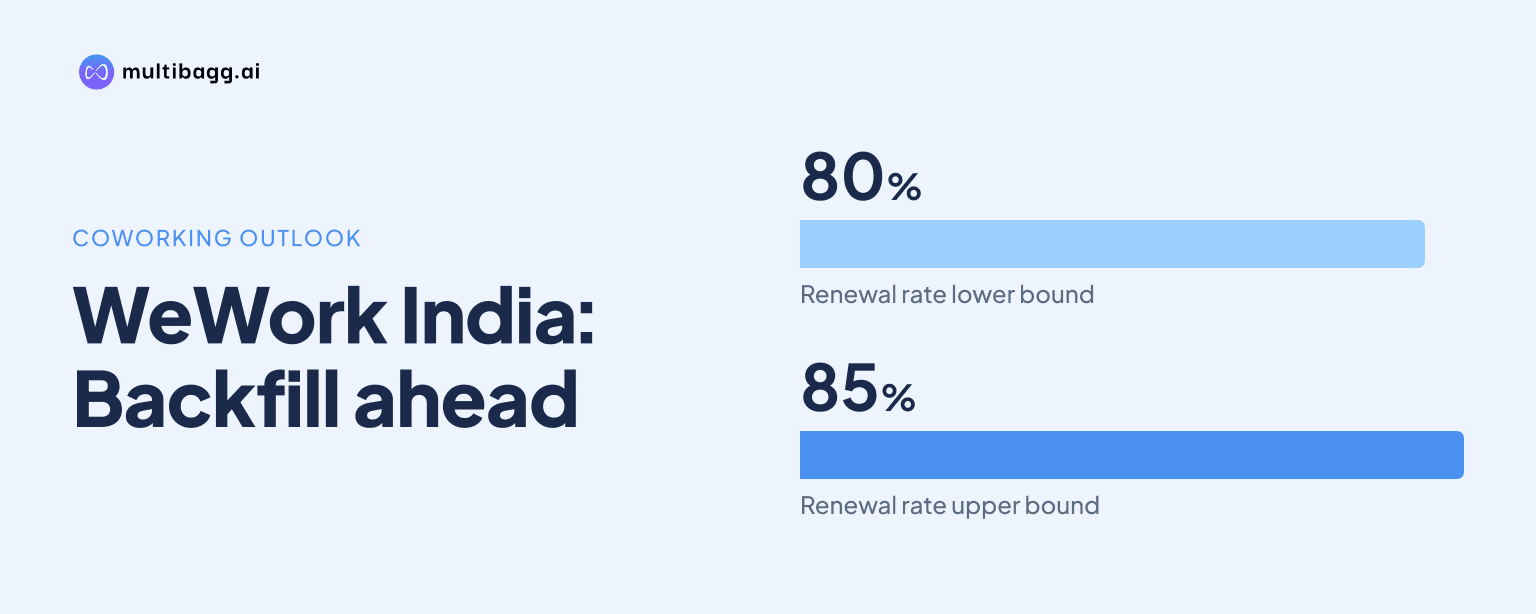
- WeWork India reported an 80% to 85% renewal rate, with renewed contracts typically lasting another 28 to 30 months.
- WeWork India had 150,000 seats after adding 4,500 seats and expects visibility to reach 155,000 by March.
powered by IRIS
WeWork India Management Limited said Commonwealth Bank of Australia may shift some occupancy to a 1.2-million-square-foot built-to-suit campus in Manyata next year. WeWork India said it has prepared for the potential churn for several years and is already pursuing backfill and large contracts intended to offset the customer’s move.
Know Wework India Management inside out
Results, valuation, peers and who's buying, in one view.
How large is WeWork India’s Commonwealth Bank exposure?
WeWork India’s potential exposure is significant in customer terms but unquantified in financial and space terms. Management described Commonwealth Bank as a large customer of nearly seven years and said the bank has taken a 1.2-million-square-foot built-to-suit campus with Embassy in Manyata.
Management said there would be “some shifting” to Commonwealth Bank’s own campus, rather than confirming that all of the customer’s WeWork India space would be vacated. The move could happen in the next year, but management said it was not certain about the month in which it would occur.
The 1.2-million-square-foot figure is the size of Commonwealth Bank’s planned campus, not a disclosed measure of its current footprint at WeWork India. The transcript gives no current occupied area, revenue contribution, number of seats or contract expiry date for the customer, so it does not establish the amount of occupancy that may need replacement.
This makes the announcement a disclosed potential large churn event rather than a completed exit. It differs from an ordinary renewal because the expected shift is linked to a separate built-to-suit facility in Manyata, while WeWork India’s usual contracts roll over on an average 28-to-30-month tenure.
How is WeWork India planning to replace Commonwealth Bank space?
WeWork India said it is already working on backfill and large contracts to offset any churn from Commonwealth Bank. Management said it had known about the customer’s timing and prospective move for a few years, allowing it to begin this work before the potential shift next year.
The company did not quantify the area being backfilled, identify replacement customers or disclose signed contracts connected to the potential move-out. Its comments therefore describe a management plan and ongoing commercial activity, rather than a reported reduction in vacancy or a completed replacement of the customer’s space.
Management also described a wider capacity pipeline, stating that letters of intent, or LOIs, had been signed for capacity of 13. It said there was visibility of more than 2 million square feet of additional assets under discussion or evaluation, beyond the assets covered by signed LOIs.
That more-than-2-million-square-foot pipeline is not presented as a direct substitute for Commonwealth Bank’s space. Management said some assets had not reached the LOI stage because it did not want to pay deposits too early, and it did not link any specific building, city or customer in the pipeline to the planned backfill.
Got a follow-up? Ask IRIS
What does WeWork India’s renewal record indicate about churn?
WeWork India said its renewal rate is about 80% to 85%, with renewed contracts generally extending for another average 28 to 30 months. Management presented this recurring renewal process as the normal pattern for its customer base, separate from the identified Commonwealth Bank move.
An analyst suggested that a 28-month average tenure could mean 35% to 40% of area expires in a year. Management did not confirm that annual-expiry calculation, but said the 80% to 85% of contracts that renew continue rolling forward for another 28 to 30 months.
Management said it did not see deep customer concentration elsewhere and did not expect a major renewal issue next year apart from Commonwealth Bank. This is an assessment by management, not a quantified concentration disclosure, because the call did not provide the revenue or seat share of the largest customers.
The contrast is between portfolio-level renewal activity and a customer-specific occupancy risk. Most expiring contracts are expected to renew at the stated 80% to 85% rate, whereas Commonwealth Bank may move some demand into its 1.2-million-square-foot campus for reasons unrelated to the general renewal cycle.
What capacity plans could support WeWork India’s leasing response?
WeWork India said it had reached 150,000 seats after opening another 4,500 seats on October 5. Management said it had visibility to reach 155,000 seats by March, although a building scheduled to open in March could instead open on April 1 or in the first week of April.
Management said the 150,000-to-155,000-seat range reflected reporting and delivery timing rather than a change in expansion plans. It cited client requirements and delayed landlord handovers as reasons that building openings can shift between quarters.
The company said it had around 95% visibility 12 months ahead and 70% to 80% visibility 18 to 24 months ahead. Management said it did not want to sign leases for FY29 or FY30 prematurely because demand, locations and market conditions may change before those assets are needed.
That measured approach differs from the immediate backfill work around Commonwealth Bank. Management said it is addressing the potential move-out now, while retaining flexibility over longer-dated capacity commitments that have not yet reached the LOI stage.
WeWork India also said its 2.9-times contract-value coverage was calculated only on operational capacity already hitting the profit and loss account and on live signed contracts. The measure excludes the unsigned pipeline of more than 2 million square feet, and management did not say whether a possible Commonwealth Bank shift was reflected in that coverage.
Conclusion
WeWork India has disclosed a specific potential churn event in Commonwealth Bank’s planned 1.2-million-square-foot Manyata campus, but management said it has been preparing for the move for several years. Its backfill work and pursuit of large contracts are intended to limit the effect, while the stated 80% to 85% renewal rate provides context for the company’s broader contract base.
The next development to watch is the timing and scale of Commonwealth Bank’s shift, which management said is uncertain by month and could occur next year. Management’s 150,000-to-155,000-seat target by March is also relevant, although it warned that March openings may move to April 1 or the first week of April because of building delivery timing.