










WeWork India Targets Rs 600 Crore-Plus FY28 Expansion Capex
Key highlights
- WeWork India expects FY28 capex of about Rs 600 crore or slightly more to support a larger seat rollout.
- Current-year capex is expected at about Rs 500 crore, making the FY28 indication roughly Rs 100 crore higher.
- WeWork India said FY28 capex should remain well below cash generated by the business during the year.
- Managed-office deals can close within two to three months and may push capex above Rs 600 crore while increasing revenue, EBITDA and PAT.],
powered by IRIS
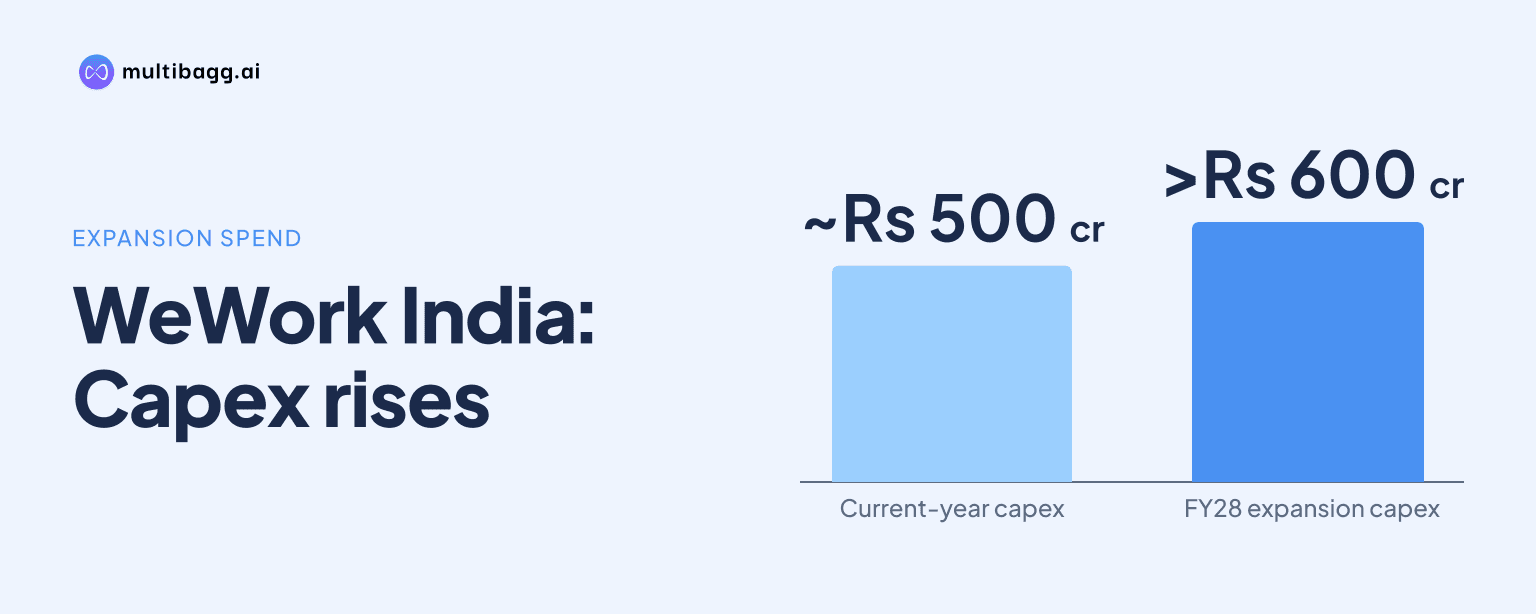
WeWork India Management Limited said FY28 capital expenditure could be about Rs 600 crore or slightly higher as it plans to add more seats than in the current year. Management expects the outlay to remain well below FY28 cash generated by the business, while additional demand-backed managed-office deals could increase both investment and growth.
Know Wework India Management inside out
Results, valuation, peers and who's buying, in one view.
What is WeWork India’s FY28 capex guidance?
WeWork India’s FY28 capital-expenditure guidance is about Rs 600 crore, with management saying the final outlay could be slightly higher. Karan Virwani linked the planned spending to a larger seat rollout than the company expects in the current year.
Management did not disclose a capex ceiling, a quarterly spending schedule or an FY28 seat-addition target. It said FY28 capex should remain well below cash generated by the business during the year, which is an expectation rather than a reported financial result because FY28 is forward-looking.
Why is WeWork India planning higher FY28 spending?
WeWork India is planning higher FY28 spending because management has visibility on adding more desks next year than in the current year. It said its approach is to maintain a consistent rollout rather than add assets under management, or AUM, without sufficient demand support.
The company said it had signed letters of intent, or LOIs, for a capacity figure of 13, while an analyst referred to current operational capacity of 9.8. Management also cited more than 2 million square feet of assets under discussion or evaluation beyond the signed LOIs, but said those opportunities were not yet commitments.
How does WeWork India’s FY28 capex compare with current-year spending?
WeWork India’s FY28 indication of about Rs 600 crore or more is above management’s current-year expectation of about Rs 500 crore. Management said spending in the remaining half of the current year would be lower than in the first half, although a recently signed large deal increased expected capital expenditure.
At the stated reference points, the FY28 plan is about Rs 100 crore above the current-year indication. The company did not provide actual first-half capex, a final current-year total or individual project costs, so the comparison is between management’s spending expectations rather than completed annual results.
Got a follow-up? Ask IRIS
What could lift WeWork India’s FY28 capex above Rs 600 crore?
New managed-office wins could lift WeWork India’s FY28 capex above the current Rs 600 crore reference point. Management said such deals can close in two to three months and that a higher number of wins would require more capital but also increase revenue, earnings before interest, tax, depreciation and amortisation, or EBITDA, and profit after tax, or PAT.
Management described managed-office transactions as 100% demand-backed in the exchange. It also said a rent-to-rent multiple of 3 times on some newer, larger managed-office deals was driven by capex, but did not disclose how many such transactions were incorporated in the FY28 spending indication.
How will WeWork India manage expansion and profitability risks?
WeWork India said it will limit longer-term space commitments until demand and location needs are clearer. Management cited about 95% visibility over 12 months and roughly 70% to 80% visibility over 18 to 24 months, while saying it did not need to sign space for FY28, FY29 or FY30 prematurely.
Customer churn is also part of the rollout planning. Management said renewal rates were about 80% to 85% and identified a possible move-out next year by Commonwealth Bank of Australia, which has taken a built-to-suit campus of about 1.2 million square feet with Embassy in Manyata; WeWork India said it was working on backfill and larger contracts.
On margins, management did not offer a fixed expansion target because openings, customer move-ins, minimum wages and energy tariffs can alter costs. It said it viewed next year’s EBITDA margin in a 20% to 23% range and expected PAT margin to hover between 7% and 10% as growth assets are introduced.
Conclusion
WeWork India’s FY28 plan calls for about Rs 600 crore or more of capex, compared with about Rs 500 crore in the current year, to support a bigger seat rollout. Management’s funding expectation is that the investment will remain below business cash generation, while managed-office demand could raise both capex and operating growth.
The next issue to watch is whether managed-office deals close within the two-to-three-month timeframe cited by management and take FY28 spending above its current indication. The pace of additions will also depend on demand visibility, the conversion of more than 2 million square feet of evaluated assets, and backfill progress around the possible 1.2 million-square-foot customer move-out.