








Winwin Insulators targets Rs 200 crore revenue next year

Find your next multibaggerBe a Pro Investor
Research stocks and track your picks on the go. Download the app.
Key highlights
- WS management is guiding for at least Rs 200 crore of revenue next year.
- A GAIL PNG connection was expected to start the Monday after the call and replace an LPG-related production constraint.
- WS expects a larger volume of commercial invoices in about 3 to 4 months after factory stabilisation.
- WS quotes 6 to 9 months for insulator deliveries, versus an industry standard of about 18 months cited by management.
powered by IRIS
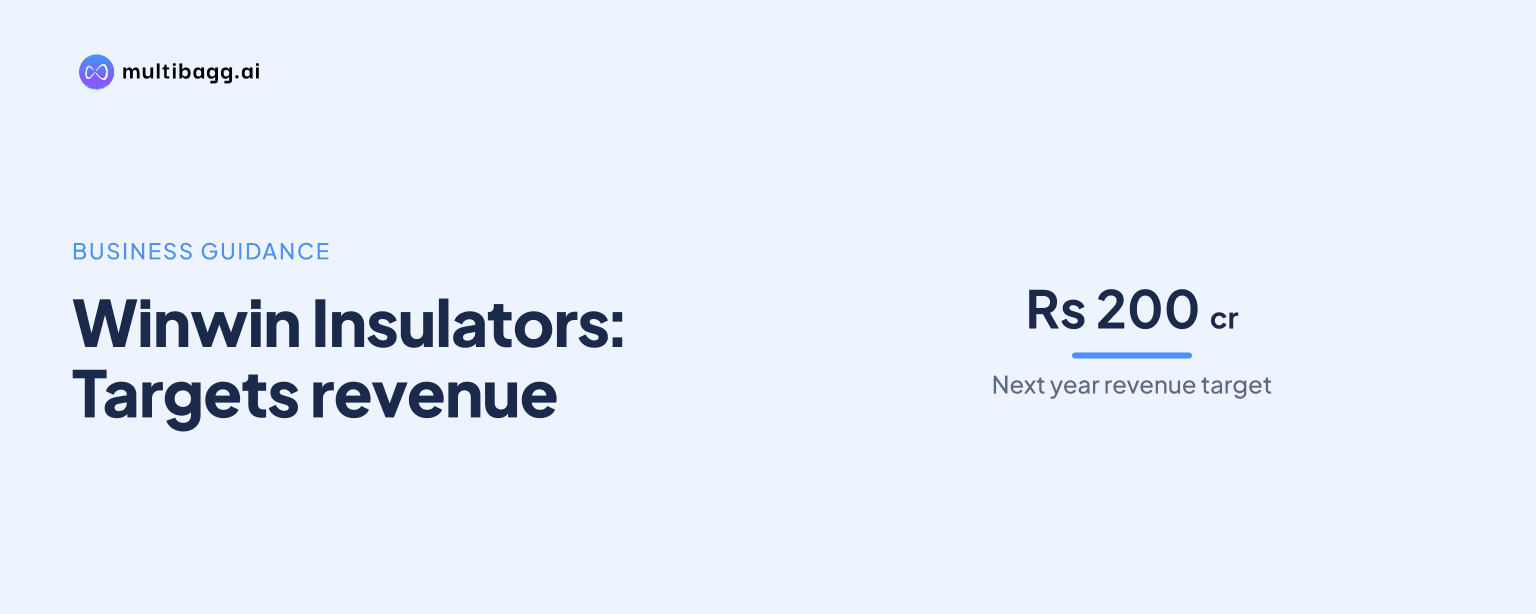
Winwin Insulators is targeting at least Rs 200 crore of revenue next year after a GAIL piped natural gas connection was expected to remove its fuel constraint and support full production. Management said the unit had begun production and customer billing, with a larger volume of commercial invoices expected in about three to four months.
Know Quality Power Electrical Equipments inside out
Results, valuation, peers and who's buying, in one view.
What revenue is WS targeting next year?
WS is guiding for at least Rs 200 crore of revenue next year, based on its order book and commitments to customers. Management said the figure could rise if it synchronises production, staffing and deliveries faster as the factory moves toward a full operating rhythm over the next quarter or so.
Management did not disclose WS's current revenue, the value of its order book or the specific financial year meant by “next year.” It did, however, say the factory had already started production and billing, so the Rs 200 crore target depends on scaling an operating unit rather than starting commercial production from zero.
WS is quoting insulator delivery periods of six to nine months, compared with an industry standard of about 18 months cited by management. The difference matters to the revenue plan because it could support orders and billing once production is stabilised, although management did not quantify how much of the Rs 200 crore target comes from each voltage class or customer.
How will the GAIL pipeline change WS production?
The GAIL piped natural gas, or PNG, connection is intended to remove the liquefied petroleum gas, or LPG, shortage that management said had put the factory in trouble. Management described the incoming PNG as cheaper gas and said its arrival would allow the plant to move to full-level production, subject to operational synchronisation during the following quarter.
The change is a production-input measure rather than a disclosed capacity expansion. Management said WS needs about three months to stabilise the factory even though output has begun, which means the availability of gas alone does not establish the pace at which the facility reaches the Rs 200 crore revenue target.
Management described the insulator facility as about 50 acres and said it is more comparable with a cement factory than a transformer factory. That description reflects the specialised manufacturing setup for porcelain products, while management also said there are fewer than a dozen suppliers globally able to deliver such transmission insulators and existing capacities are full.
Which high-voltage products is WS prioritising?
WS is prioritising 400 kilovolt, or kV, 765 kV and high-voltage direct current, or HVDC, transmission applications instead of lower-voltage business. Management said it is focusing on direct utilities in the United States and large transmission operators in India, where it can supply porcelain insulators alongside other grid equipment.
Management said WS had successfully type-tested 400 kV porcelain and has a two-part 765 kV design based on Westinghouse technology used for about 60 years. It described WS as one of two companies able to serve that 765 kV requirement, naming PPC Insulators as the other supplier, but did not disclose commercial orders arising from the 400 kV type test.
For the United States, management said a law introduced during the preceding two months bans Chinese equipment above 69 kV in the transmission category. Management said European suppliers were booked out and US capacity was limited, but these statements were management observations rather than independently reported market data or a quantified forecast of WS sales.
Management also said it would push the high-voltage opportunity over the next two quarters by seeking American orders under its own brand. Direct customer approval may take time, according to management, making approvals and order conversion a separate step from the technical capability represented by the 400 kV test and 765 kV design.
Got a follow-up? Ask IRIS
How does WS plan to use insulators to sell grid equipment?
WS plans to use its insulator availability to package instrument transformers and other grid components rather than sell porcelain alone to engineering, procurement and construction contractors or operators. Management said customers seeking insulator delivery would need to buy the wider grid-component package from the company.
The strategy is directed particularly at 765 kV projects, where management said a switchgear delivery can take about 18 months because porcelain is unavailable, not because the switchgear itself requires that much manufacturing time. WS's quoted six-to-nine-month insulator lead time is therefore intended to help customers bring forward delivery of a broader high-voltage system.
Management said it will launch 765 kV instrument transformers at Elecrama in the fourth quarter of the current year. It plans to use insulator access to promote these newer research-and-development products, but it did not state a revenue target, order value or launch date for the transformer range.
The commercial model limits stand-alone insulator sales in the channels management identified. Management said WS does not intend to sell only insulators to EPC contractors or operators unless they purchase entire grid components, so the value capture from the strategy depends on customers accepting bundled equipment orders.
What profitability and US plans did management disclose?
Management said orders booked into India despite an 8.25% duty were carrying earnings before interest and tax, or EBIT, margins of 20% to 25%. It added that margins could be above 30% without the duty, but this was management's assessment and not reported segment profitability or formal guidance for WS.
For the United States, management said WS intends to sell directly under its own brand rather than white-label insulators for other suppliers. It estimated that direct customer approval and integration could take one to one-and-a-half years, and said US margins could eventually be similar to or higher than Quality Power's stated 40%-plus level if that integration succeeds.
Management also said high-voltage demand could sustain for five to seven years and estimated transmission-category demand at about four times supply. It explicitly said there was no peer-reviewed data for a global insulator market size, so the demand-supply estimate and duration are management views rather than externally verified market measurements.
Conclusion
WS's Rs 200 crore revenue target rests on a near-term operational transition: the expected GAIL PNG supply is meant to end the LPG-related constraint, while production and billing are already under way. The planned ramp is linked to a six-to-nine-month delivery quotation, high-voltage porcelain capability and a bundled-sales approach that ties scarce insulators to instrument transformers and other grid equipment.
The next milestones are factory stabilisation over about three months, a larger flow of commercial invoices in about three to four months, and the fourth-quarter Elecrama launch of 765 kV instrument transformers. Management also plans to seek direct US approvals and convert the high-voltage opportunity into orders over the next two quarters, while the one-to-one-and-a-half-year US integration timetable remains to be achieved.

