








Wiscon revenue doubles as working capital absorbs operating cash

Find your next multibaggerBe a Pro Investor
Research stocks and track your picks on the go. Download the app.
Key highlights
- Wiscon’s consolidated revenue from operations rose about 122% to Rs 156.94 crore in the half year ended September 30, 2026.
- Wiscon’s consolidated profit after tax increased about 161% to Rs 16.30 crore from Rs 6.23 crore a year earlier.
- Trade receivables rose to Rs 99.61 crore and inventories rose to Rs 49.62 crore at September 30, 2026.
- Wiscon used Rs 8.48 crore in operating activities and generated Rs 19.00 crore from financing activities in the half year.
powered by IRIS
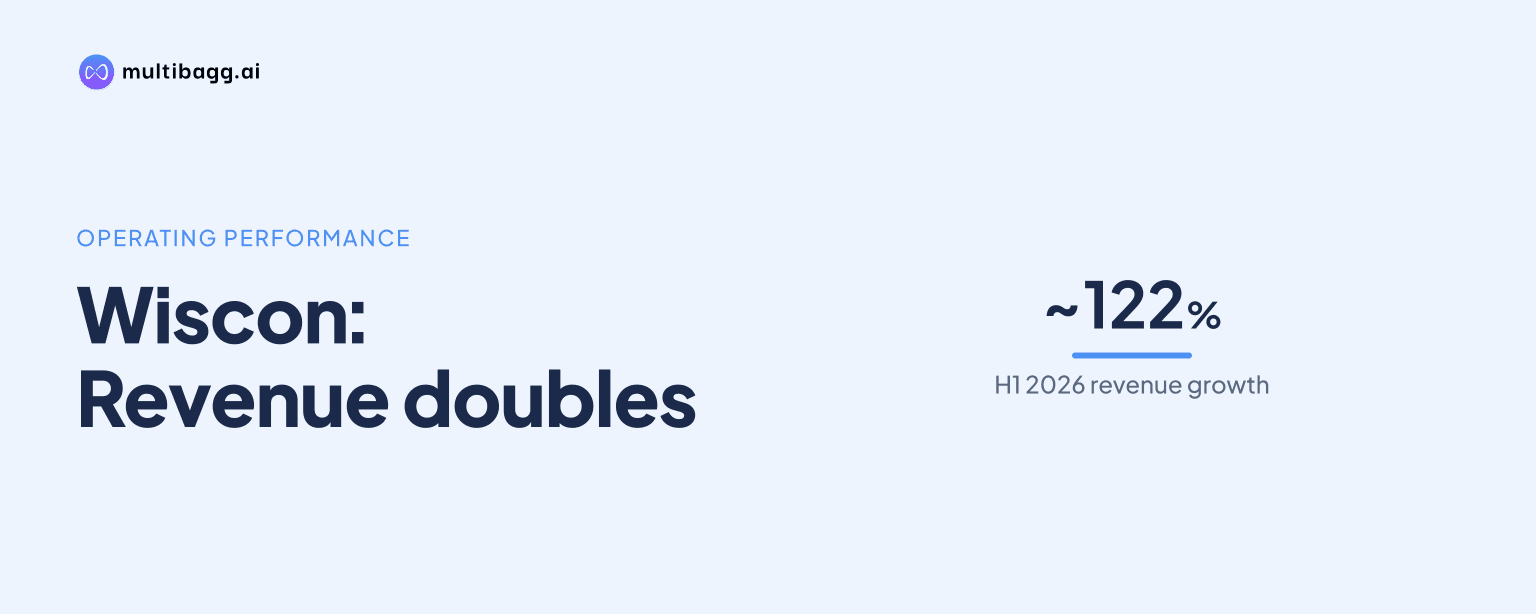
Wiscon Industries Limited reported consolidated revenue of Rs 156.94 crore for the half year ended September 30, 2026, up 122% year on year, while profit after tax rose 161% to Rs 16.30 crore; however, receivables and inventory absorbed cash, producing an operating cash outflow of Rs 8.48 crore.
Know Wiscon Industries inside out
Results, valuation, peers and who's buying, in one view.
How did Wiscon perform in the September 2026 half year?
Wiscon’s revenue from operations rose to Rs 156.94 crore in the half year ended September 30, 2026, from Rs 70.66 crore in the corresponding half year ended September 30, 2025. Total income increased to Rs 156.96 crore from Rs 70.78 crore, while other income declined to Rs 1.45 lakh from Rs 11.97 lakh. The increase was therefore driven by revenue from operations rather than other income.
Wiscon’s profit after tax increased to Rs 16.30 crore from Rs 6.23 crore, while profit before tax rose to Rs 22.09 crore from Rs 8.36 crore. Current tax expense was Rs 5.82 crore, compared with Rs 2.09 crore a year earlier. Basic and diluted earnings per share, or EPS, were both Rs 10.82, against Rs 4.14 in the prior-year half.
Wiscon also reported higher revenue and profit than in the immediately preceding half year ended March 31, 2026. Revenue from operations increased from Rs 126.22 crore in that half to Rs 156.94 crore in the September half, and profit after tax rose from Rs 13.95 crore to Rs 16.30 crore. Consolidated comparative data for the September 2025 half were approved by the board but were not subjected to review, according to the auditor’s report.
Which costs changed as Wiscon’s revenue increased?
Wiscon’s material-consumption cost rose to Rs 118.44 crore from Rs 42.17 crore, and purchases of stock-in-trade increased to Rs 29.50 crore from Rs 22.14 crore. Employee benefits expense more than doubled to Rs 5.09 crore from Rs 2.32 crore. These movements accompanied the Rs 86.28 crore increase in revenue from operations over the year-earlier half.
The change in inventories of finished goods, work in progress and stock-in-trade was negative Rs 24.82 crore, compared with negative Rs 8.58 crore a year earlier. Finance cost rose to Rs 1.12 crore from Rs 9.07 lakh, while depreciation and amortisation expense increased to Rs 44.52 lakh from Rs 21.40 lakh. Other expenses were Rs 5.09 crore, compared with Rs 4.05 crore.
Wiscon’s total expenses increased to Rs 134.87 crore from Rs 62.42 crore, compared with total income of Rs 156.96 crore and Rs 70.78 crore, respectively. On calculation from the reported figures, profit after tax represented about 10.4% of total income in the September 2026 half, compared with about 8.8% in the prior-year half. This is a calculation from the financial statements, not a margin stated by management.
Why did Wiscon’s receivables and inventory increase?
Wiscon’s trade receivables stood at Rs 99.61 crore at September 30, 2026, compared with Rs 47.59 crore at March 31, 2026, a rise of Rs 52.03 crore. Inventories increased by Rs 26.35 crore to Rs 49.62 crore from Rs 23.27 crore. Together, the two items rose by Rs 78.39 crore during the half in which revenue from operations was Rs 156.94 crore.
The consolidated cash-flow statement records a Rs 52.03 crore increase in trade receivables and a Rs 26.35 crore increase in inventories. It also shows a Rs 6.94 crore increase in other current and non-current assets, loans and advances. These cash uses were partly offset by a Rs 51.82 crore increase in trade payables and an Rs 84.41 lakh increase in current liabilities and provisions.
Wiscon’s current assets increased to Rs 164.64 crore at September 30 from Rs 79.05 crore at March 31, while current liabilities rose to Rs 125.46 crore from Rs 49.90 crore. Short-term borrowings rose by Rs 16.95 crore to Rs 32.24 crore, and trade payables increased by Rs 51.82 crore to Rs 77.08 crore. The balance-sheet expansion therefore included both higher operating assets and higher short-term funding obligations.
Got a follow-up? Ask IRIS
Did Wiscon convert first-half profit into operating cash?
Wiscon did not generate positive operating cash after working-capital changes in the September 2026 half. Operating profit before working-capital changes was Rs 24.34 crore, but cash generated from operations was negative Rs 8.31 crore after the movements in receivables, inventories, other assets and payables. After Rs 16.70 lakh of direct taxes paid, net cash used in operating activities was Rs 8.48 crore.
Wiscon used Rs 10.20 crore in investing activities, including Rs 8.50 crore in fixed deposits not considered cash equivalents and Rs 1.70 crore for property, plant and equipment. Financing activities generated Rs 19.00 crore, comprising Rs 16.95 crore of net secured borrowings and Rs 3.05 crore of net unsecured long-term borrowings, offset by Rs 1.00 crore of interest expenses paid.
Wiscon’s cash and cash equivalents increased by Rs 32.31 lakh to Rs 49.75 lakh at September 30, 2026, from Rs 17.44 lakh at March 31, 2026. The cash-flow statement compares the half-year position with the year ended March 31, 2026 because consolidated financial statements became applicable during the year. It does not provide a corresponding consolidated cash-flow statement for the September 2025 half.
What does Wiscon’s post-period IPO change?
Wiscon completed its initial public offering, or IPO, after September 30, 2026, with a fresh issue of 43,14,000 equity shares at Rs 204 per share and an offer for sale of 10,78,200 shares. The fresh issue generated gross proceeds of Rs 88.01 crore, while the offer for sale amounted to Rs 22.00 crore. Wiscon’s shares were listed on the BSE SME Platform on November 3, 2026.
Wiscon classified the IPO as a non-adjusting event after the reporting date. The fresh shares and their proceeds were consequently not included in paid-up share capital at September 30, 2026, or in EPS for the periods reported. Share capital was Rs 15.67 crore at September 30, compared with Rs 5.22 crore at March 31, following the May 30, 2026 allotment of 1,04,49,000 bonus shares.
Wiscon issued two bonus shares for every share held, with a face value of Rs 10 each. The company adjusted the weighted average number of equity shares in current and comparative EPS calculations as required under Accounting Standard 20. The consolidated statements include Dalmia Technologies Limited, described in the auditor’s report as Wiscon’s wholly owned subsidiary.
Conclusion
Wiscon’s September 2026 half-year results show that consolidated revenue and profit expanded faster than the year-earlier period, reaching Rs 156.94 crore and Rs 16.30 crore, respectively. At the same time, the Rs 78.39 crore combined increase in receivables and inventories exceeded operating profit before working-capital changes, contributing to an Rs 8.48 crore operating cash outflow.
The next reported results will show whether trade receivables of Rs 99.61 crore and inventories of Rs 49.62 crore convert into cash, and how short-term borrowings of Rs 32.24 crore develop. The source also identifies the completed Rs 88.01 crore IPO fresh issue as a post-reporting-period event, so its shares and proceeds were not reflected in the September 30 capital or EPS figures.

