










Yes Bank faces contempt plea over ₹8,415 crore AT-1 bonds
Key highlights
- Axis Trustee Services moved the Supreme Court on November 6 seeking enforcement of the AT-1 bond restoration ruling.
- The Supreme Court upheld the invalidation of Yes Bank's ₹8,415 crore AT-1 bond write-down.
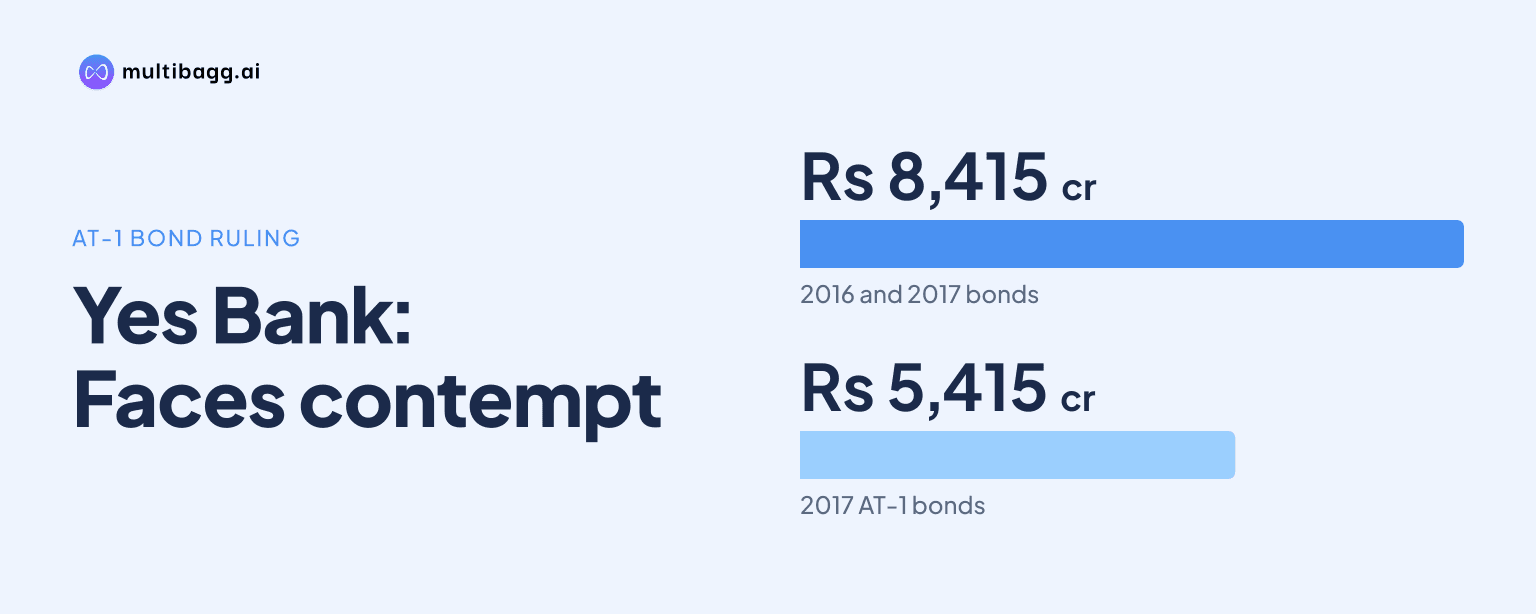
- The affected bonds comprise ₹3,000 crore issued in 2016 and ₹5,415 crore issued in 2017.
- The judgment did not require an immediate ₹8,415 crore cash repayment or quantify past coupon liability.
powered by IRIS
Yes Bank faces a contempt petition over its ₹8,415 crore AT-1 bond write-down after Axis Trustee Services said the lender had not provided a concrete roadmap to restore the securities despite the Supreme Court upholding the Bombay High Court ruling against the write-down.
Know Yes Bank inside out
Results, valuation, peers and who's buying, in one view.
Why have Yes Bank bondholders filed a contempt petition?
Yes Bank bondholders filed the petition because they say the lender has not implemented the court ruling that invalidated the write-down of its Additional Tier-1, or AT-1, bonds. Axis Trustee Services Ltd, acting for the bondholders, moved the Supreme Court on November 6 and sought directions requiring the bank to enforce the judgment and restore or reactivate the securities.
The trustee's action follows the Supreme Court's decision last month to uphold a January 2023 Bombay High Court ruling. The High Court had set aside the write-down carried out under Yes Bank's March 2020 reconstruction plan. The Supreme Court dismissed appeals filed by Yes Bank, the Reserve Bank of India and the government, leaving the High Court ruling intact.
According to the letter seen by Reuters, Axis Trustee Services said Yes Bank had not given bondholders a concrete plan for restoring the bonds. The trustee therefore sought the court's intervention to ensure compliance with the judgment rather than allowing the matter to remain unresolved while the bank considers further legal steps.
The petition does not itself establish an immediate payment obligation. It seeks implementation of the ruling that set aside the write-down. The method of reinstatement, accounting treatment and treatment of unpaid coupons remain matters that have not been quantified by the court in the information available.
What did the Supreme Court decide on the AT-1 write-down?
The Supreme Court upheld the Bombay High Court's finding that Yes Bank's write-down of ₹8,415 crore in AT-1 bonds was invalid. The ruling concerns bonds written down during the lender's March 2020 rescue and reconstruction, which was led by the Reserve Bank of India.
The affected instruments include ₹3,000 crore of AT-1 bonds issued in 2016 and ₹5,415 crore issued in 2017. The Bombay High Court had found that the bank's administrator did not have the authority to write down the bonds, with that power resting with the RBI. Yes Bank and other parties challenged that decision, but the Supreme Court dismissed the appeals on October 15.
The court's decision invalidated the write-down but did not order Yes Bank to make an immediate cash repayment of ₹8,415 crore. It also did not quantify any liability relating to coupons that were not paid after the securities were written down. Those distinctions are important because reinstatement of the instruments and a cash payout are not necessarily the same legal or accounting outcome.
Got a follow-up? Ask IRIS
What legal steps is Yes Bank considering?
Yes Bank has said it is examining the Supreme Court judgment, its implications and all available legal options before making further disclosures. Reports have said the lender is preparing to seek a review of the Supreme Court decision, while the RBI is evaluating whether it should join such a plea.
A review petition would be a narrow remedy. Legal experts cited in the source material said a review cannot simply repeat arguments already considered by the court. Yes Bank would need to show a recognised ground, such as a specific error in the judgment, to obtain a review of the October decision.
The lender has indicated that it will determine its next steps after reviewing the order in detail. It has also said it has appropriate capital-management levers and flexibility to undertake additional capital actions if required for its growth objectives. However, no final mechanism for reinstating the bonds has been disclosed.
The trustee's contempt petition adds urgency to the legal process because it asks the Supreme Court to direct compliance now. The petition comes while Yes Bank is assessing whether to pursue a review, creating two related but distinct issues: whether the ruling should be reconsidered and whether the existing ruling must be implemented in the meantime.
How does the dispute affect Yes Bank and AT-1 investors?
The dispute affects Yes Bank's capital structure because AT-1 bonds are instruments designed to absorb losses and form part of banks' regulatory capital framework. The ₹8,415 crore write-down had removed the relevant securities under the 2020 reconstruction plan. The court ruling reverses that write-down in legal terms, but the financial treatment has not yet been specified.
For bondholders, the central issue is restoration of securities that were written down during the rescue. Axis Trustee Services has argued that implementation requires a clear roadmap from Yes Bank. Bondholders also face uncertainty over the treatment of earlier coupon payments because the judgment did not set a figure for any past coupon liability.
For investors in Yes Bank, the available information does not point to an immediate cash payment of ₹8,415 crore. The eventual effect will depend on the outcome of any review proceedings, the court's response to the contempt petition, and the accounting and capital mechanism adopted for reinstatement.
The case also has wider relevance for India's bank resolution framework. The RBI had supported the 2020 write-down as part of the reconstruction, while the courts have focused on whether the authority used to execute that write-down was valid. The legal outcome therefore concerns both the specific bondholders and the governance of AT-1 instruments during bank rescues.
Conclusion
The contempt petition moves the Yes Bank AT-1 bond dispute from the validity of the March 2020 write-down to the implementation of the Supreme Court-backed ruling. Axis Trustee Services is seeking court directions because it says the ₹8,415 crore securities have not been restored and no concrete restoration plan has been provided.
The next developments to watch are Yes Bank's decision on a review petition, whether the RBI joins any such action, and the Supreme Court's response to the trustee's November 6 petition. Yes Bank has said it is evaluating the judgment and available legal options, while the court has not set an immediate cash repayment or past-coupon liability.