








Zee buyback projects standalone EPS to rise 8%
MAX Plan at ₹4,999/yr

Find your next multibaggerBe a Pro Investor
Research stocks and track your picks on the go. Download the app.
Key highlights
- Zee projects standalone EPS of Rs 1.35 after the buyback, up from Rs 1.25.
- Zee projects consolidated EPS of Rs 3.03 after the buyback, up from Rs 2.82.
- The Rs 600 crore buyback can retire up to 6,59,34,065 shares, or 6.86% of pre-buyback equity.
- The Rs 91 tender price was 23.81% above the November 12, 2026 closing price.
powered by IRIS
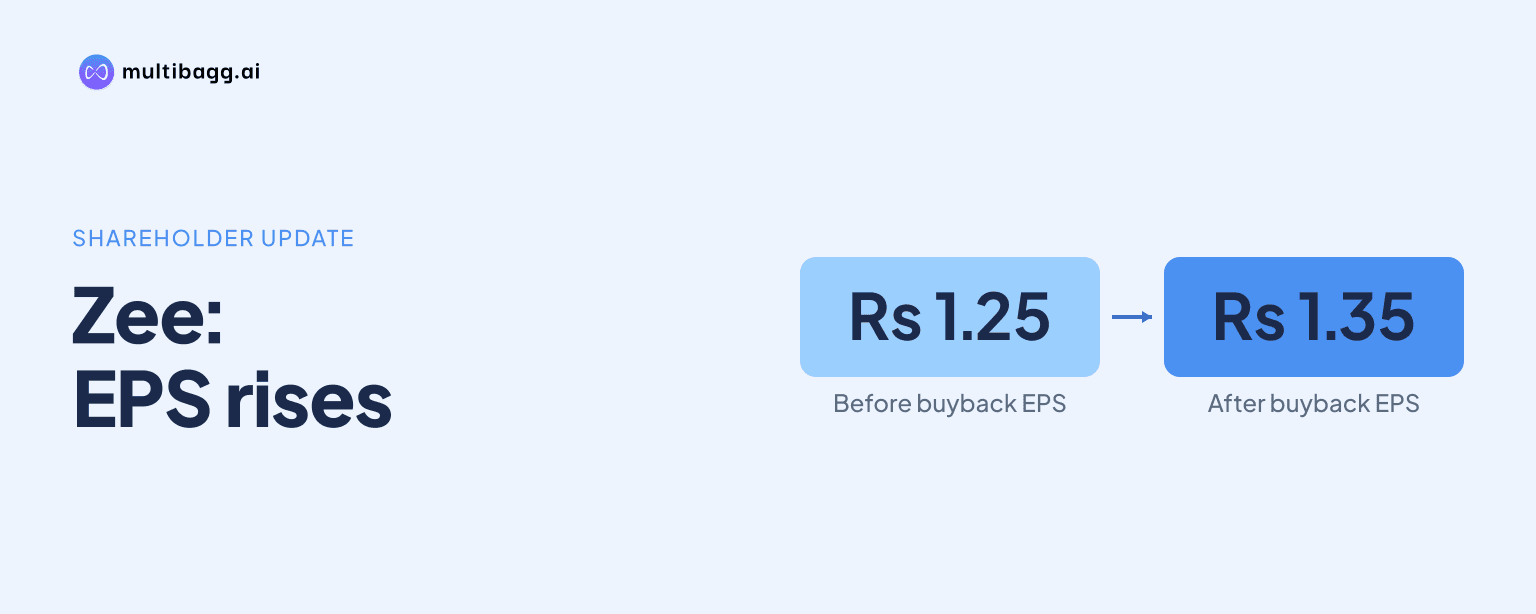
Zee Entertainment Enterprises Limited, referred to here as Zee, projects that its Rs 600 crore buyback, calculated from March 31, 2026 audited financials and assuming full acceptance, will raise standalone earnings per share by 8% to Rs 1.35 from Rs 1.25.
Know Zee Entertainment Enterprises inside out
Results, valuation, peers and who's buying, in one view.
How would Zee's buyback change EPS and returns?
Zee expects the proposed purchase of up to 6,59,34,065 equity shares to raise standalone basic and diluted earnings per share, or EPS, to Rs 1.35 from Rs 1.25. The Rs 0.10 increase equals 8% of pre-buyback standalone EPS, with the calculation assuming the maximum shares are bought back while using the March 31, 2026 financial position.
On a consolidated basis, Zee projects basic and diluted EPS of Rs 3.03 after the buyback, compared with Rs 2.82 before it. The Rs 0.21 per-share increase is about 7%, and the company defines EPS as profit after tax, or PAT, before other comprehensive income divided by the weighted average number of shares.
Return on net worth is also projected to rise in both reporting views. Standalone return on net worth would increase to 1.26% from 1.18%, while consolidated return on net worth would rise to 2.62% from 2.48%; Zee defines the measure as PAT divided by net worth.
Book value per share would increase in the full-acceptance calculation despite lower net worth, because the outstanding equity-share count would decline. Standalone book value is projected at Rs 107.24 against Rs 106.12 before the buyback, while consolidated book value is projected at Rs 115.71 against Rs 113.99.
What assumptions support Zee's EPS projection?
Zee's post-buyback measures assume 100% acceptance from eligible shareholders up to their buyback entitlement. The company calculated post-buyback net worth by deducting the Rs 600 crore proposed deployment, excluding transaction costs, and calculated shares for EPS by deducting the maximum 6,59,34,065 shares from the pre-buyback total.
The calculation does not assume higher operating profit. Zee says the buyback is not likely to cause a material impact on profitability or earnings because it expects to generate internal accruals; the projected EPS increase instead results from a smaller equity base after bought-back shares are extinguished.
The company had 96,05,19,420 fully paid equity shares of face value Rs 1 each as of March 31, 2026. On full acceptance, issued, subscribed and paid-up capital would fall to 89,45,85,355 shares, a reduction equal to 6.86% of the pre-buyback share count.
Zee used the National Stock Exchange closing price of Rs 72.14 on March 31, 2026 for its price-to-earnings, or P/E, calculations. At that fixed price, standalone P/E would move to 53.57 times from 57.71 times and consolidated P/E to 23.79 times from 25.54 times, reflecting the assumed higher EPS rather than a new market-price assumption.
Got a follow-up? Ask IRIS
How much cash will Zee deploy for the buyback?
Zee's board approved a buyback of up to Rs 600 crore on November 12, 2026, excluding brokerage, taxes, advisory fees and other transaction costs. The tender offer price is Rs 91 per equity share, and the maximum 6,59,34,065 shares represent 6.86% of total paid-up equity capital as of March 31, 2026.
The buyback amount equals 7.22% of standalone paid-up capital and free reserves of Rs 8,313.40 crore, and 6.61% of consolidated paid-up capital and free reserves of Rs 9,075 crore. Because the offer is below the 10% board-approval threshold, Zee says shareholder approval is not required under the Companies Act and the cited Securities and Exchange Board of India, or SEBI, buyback regulations.
Zee says it will use internal accruals, including current surplus, cash balances, current investments and other internal resources. It does not intend to raise debt specifically for the Rs 600 crore buyback, though it may borrow in the ordinary course of business if required.
The company deposited Rs 75 crore in cash in its escrow account under an agreement dated November 12, 2026. Zee also says that, assuming full acceptance, its total debt-to-equity ratio would remain 0.02 times on both standalone and consolidated bases and aggregate secured and unsecured debt would remain within the stated 2:1 statutory limit.
Why does Zee say profitability will not be materially affected?
Zee says the Rs 600 crore use of internal accruals is not likely to have a material impact on profitability or earnings. It nevertheless notes that cash spent on the buyback would reduce the amount available for investments that otherwise could have generated investment income.
The board said its review of Zee's financial and cash-flow position, business outlook, growth strategy and funding requirements led it to conclude that the prevailing share price did not adequately reflect business fundamentals, intrinsic value and future growth prospects. The Rs 91 offer price represented a 23.81% premium to the closing price on November 12, 2026, the date of board approval.
The Rs 91 price was also 32.61% above the one-month volume-weighted average price on BSE and 33.54% above the equivalent National Stock Exchange average before November 6, 2026. It was 39.25% and 38.95% above the respective two-week averages, according to Zee's offer document.
Promoters and promoter-group entities, which held 3.99% on the public-announcement date, said in letters dated November 11, 2026 that they would not participate. If all eligible shareholders tender to their entitlement and the offer is fully accepted, their aggregate holding would rise to 4.28% because the total share base would shrink; Zee says this would not change control or the existing management structure.
Conclusion
Zee's proposed tender-offer buyback is structured to improve per-share measures through a 6.86% reduction in the equity-share count rather than through an assumed increase in operating profit. On the March 31, 2026 base and full-acceptance assumption, it projects standalone EPS of Rs 1.35 and consolidated EPS of Rs 3.03, alongside increases in return on net worth and book value per share.
The next variable is the shareholder response to the Rs 91 offer, because Zee says actual ownership and financial metrics can vary with acceptance. The record date was November 25, 2026, and Zee has said it will not issue equity securities until buyback closure or raise further capital for one year after closure, except to discharge subsisting obligations.

