















Actions

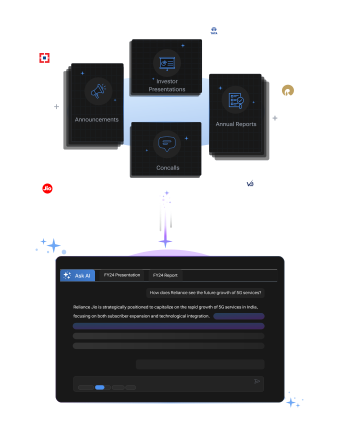
Get instant AI-powered insights about company performance, financials, and strategy. Ask questions about trends, competition, and developments while receiving responses backed by official documents and market data, with clear attribution to source documents.


Bearish
4
Neutral
4
Bullish
6
Bearish
4
Neutral
4
Bullish
38
Bearish
0
Neutral
0
Bullish
32
Investor Presentation
Q4 FY26
Investor Presentation
Q3 FY26
Investor Presentation
Q2 FY26
Investor Presentation
Q1 FY25
Investor Presentation
Q1 FY25
Investor Presentation
Q3 FY16
Auto Components
Auto Components & Equipments
550 Cr
Low Risk
56.6
39.5
1.1
4.2
1,250.20
650.00
Sales CAGR
Profit CAGR
ROE
ROCE
Discover detailed, AI-driven financial summaries that break down key metrics, trends, and insights—empowering you to make smarter investment decisions.
View Standalone
View Standalone
View Standalone
View Standalone
View Standalone
View Standalone
View Standalone
View Standalone
Triton Valves Ltd (TRITONV) is currently trading at 1,114.00 per share. Stock prices fluctuate during market hours on NSE and BSE based on demand, company updates, and overall market conditions. Refer to the live price chart above for the most recent price movement.
Triton Valves Limited manufactures precision valves and brass components across three verticals: automotive tyre/tubeless valves and TPMS, a brass/metals mill (backward integration), and climate control HVAC/R components, supported by a Mysuru R&D centre and multiple Indian warehouses for JIT deliveries to OEMs and global tier‑1 customers. The company is pivoting from a traditional auto‑ancillary to a higher‑margin technology supplier: Triton has begun mass production for Bosch TPMS and supplies patented battery vent valves to Ather and other EV OEMs, with management citing aggregate TPMS and EV battery opportunities that could meaningfully scale revenues over the next five years. Financially Triton showed improvement in operating profitability: standalone normalized YTD EBITDA rose to about INR 22.5 crore (approx. 7.1% margin) versus INR 17 crore prior year, while consolidated revenues grew over 25% YoY in the latest quarter; management targets further margin expansion toward a ~10% EBITDA trajectory over coming quarters. A key operational constraint is the loss‑making climate control vertical, currently pressured by what management describes as aggressive Chinese dumping; the company is actively pursuing trade remediation (MIP/anti‑dumping/QCO) while fast‑tracking the Climatech merger to unlock tax shields and GST credits estimated to generate a material short‑term cash benefit. Management plans modest, staged capex to support product ramps (INR 5–8 crore annually for automotive), will maintain working‑capital discipline, and aims to grow at a mid‑teens to low‑twenties percentage CAGR while managing raw‑material volatility and dollar exposure through hedging and internal operational hedges via the metals mill.
Over the past 52 weeks, Triton Valves Ltd has traded between a low of ₹650.00 and a high of ₹1,250.20. The 52-week high and low indicate the stock’s price range over the last year and help investors understand its volatility and recent trading levels.
Triton Valves Ltd has a market capitalization of approximately 550.37. Market capitalization represents the total value of a company’s outstanding shares and helps investors understand its size, stability, and relative risk compared to other listed companies.
Triton Valves Ltd’s investment profile depends on its business fundamentals, valuation, and long-term outlook. The stock currently trades at a PE ratio of 56.62 and operates in the its sector sector. Investors typically assess financial performance, growth prospects, and individual risk tolerance before making investment decisions.
Based on its market capitalization of 550.37 Cr, Triton Valves Ltd is classified as a Small Cap stock. Large-cap stocks are generally more stable, while mid-cap and small-cap stocks tend to offer higher growth potential along with higher price volatility.
Triton Valves Ltd operates in the its sector sector. Sector classification matters because companies in the same sector are often affected by similar economic conditions, regulatory changes, and competitive dynamics, which can influence overall stock performance.
The Price-to-Earnings (PE) ratio of Triton Valves Ltd is 56.62. The PE ratio compares a company’s share price to its earnings and is commonly used to assess valuation. Comparing the PE ratio with sector peers and historical levels provides better context.
