










Aanjaay’s operating cash outflow reaches Rs 8.59 crore
Key highlights
- Aanjaay reported an Rs 8.59 crore operating cash outflow for the half year ended September 30, 2026.
- Trade receivables decreased by Rs 58.49 crore to Rs 12.28 crore at September 30, 2026.
- Trade payables decreased by Rs 54.88 crore while inventory increased by Rs 10.85 crore during the half year.
- Cash and cash equivalents closed at Rs 1.73 crore, down from Rs 10.58 crore at March 31, 2026.
powered by IRIS
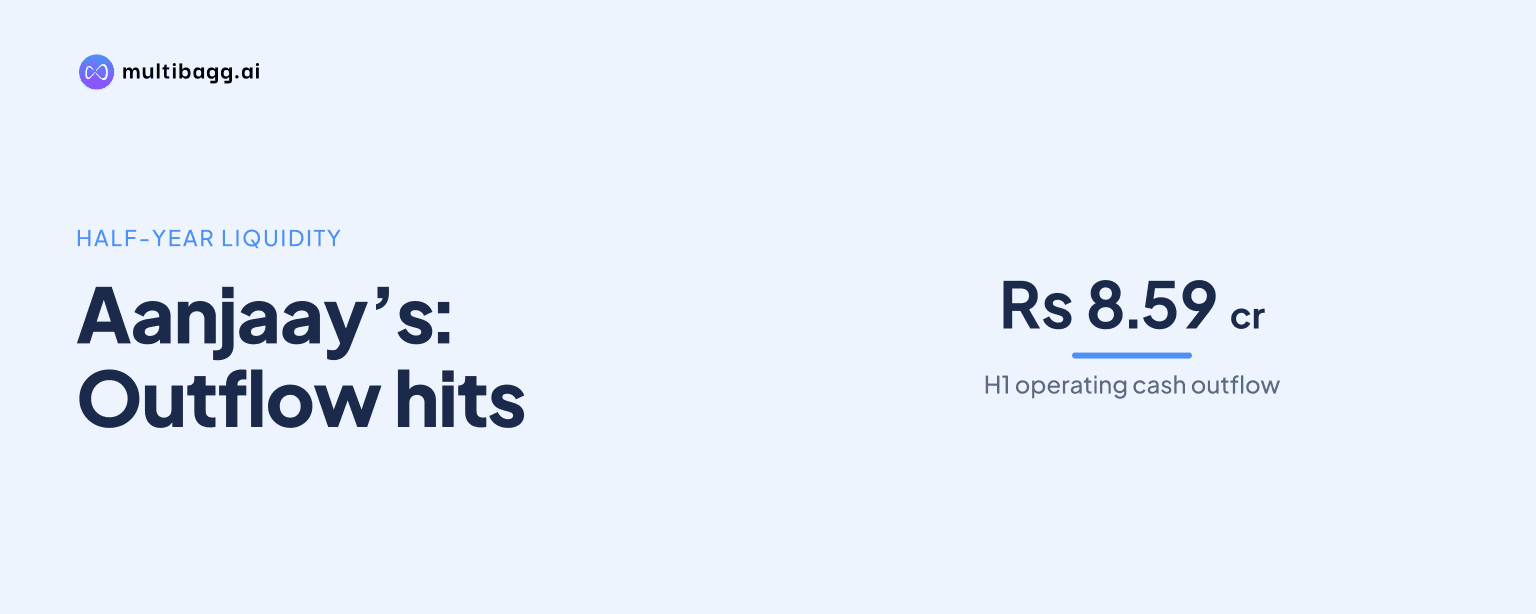
Aanjaay Industries Limited reported an Rs 8.59 crore net operating cash outflow for the half year ended September 30, 2026, despite a Rs 58.49 crore decrease in trade receivables. A Rs 54.88 crore reduction in trade payables, Rs 10.85 crore inventory increase and Rs 6.11 crore rise in other current assets outweighed the receivables movement, leaving closing cash of Rs 1.73 crore.
Know Kabra Drugs inside out
Results, valuation, peers and who's buying, in one view.
Why did Aanjaay report an Rs 8.59 crore operating cash outflow?
Aanjaay reported the Rs 8.59 crore operating cash outflow because working-capital uses exceeded the Rs 5.38 crore operating profit before working-capital changes in the half year ended September 30, 2026. The cash-flow statement starts with profit before tax of Rs 5.41 crore and records net adjustments of Rs 2.68 lakh, including Rs 2.53 lakh of depreciation and amortisation, Rs 1.67 lakh of right-of-use asset amortisation and Rs 7.80 lakh of interest income.
A Rs 54.88 crore decrease in trade payables was the largest operating cash use, followed by the Rs 10.85 crore increase in inventory and Rs 6.11 crore increase in other current assets. Aanjaay also recorded a Rs 58.85 lakh decrease in financial liabilities, a Rs 3.75 lakh increase in long-term loans and advances, and direct taxes paid net of refunds of Rs 8.55 lakh.
The bridge excludes several smaller movements shown in the cash-flow statement, including other financial assets, financial liabilities, other non-current liabilities and taxes. The statement was prepared using the indirect method under Indian Accounting Standard 7, or Ind AS 7, which reconciles profit to operating cash flow through non-cash adjustments and working-capital changes.
How did Aanjaay’s receivables and inventory change?
Aanjaay’s trade receivables decreased by Rs 58.49 crore during the half year, reaching Rs 12.28 crore at September 30, 2026 from Rs 70.78 crore at March 31, 2026. The cash-flow statement records the same movement as a Rs 58.49 crore positive change in trade receivables, which was the period’s largest source of working-capital cash.
Aanjaay’s inventory increased by Rs 10.85 crore to Rs 10.85 crore at September 30, 2026, while the March 31, 2026 balance sheet reported no inventory balance. The increase is recorded as a negative operating cash-flow movement because cash was absorbed in inventory during the period.
Other current assets rose to Rs 8.64 crore at September 30 from Rs 2.53 crore at March 31, an increase of Rs 6.11 crore. The receivables reduction exceeded the combined Rs 16.96 crore cash use from inventory and other current assets, but the benefit was largely offset by the reduction in trade payables.
What happened to Aanjaay’s trade payables and liabilities?
Aanjaay’s trade payables to creditors other than micro enterprises and small enterprises decreased by Rs 54.88 crore, from Rs 54.88 crore at March 31, 2026 to Rs 28,000 at September 30, 2026. The cash-flow statement reports a Rs 54.88 crore decrease in trade payables, matching the balance-sheet change apart from rounding.
The payables movement was Rs 3.62 crore smaller than the Rs 58.49 crore reduction in trade receivables. However, after the Rs 10.85 crore inventory build and Rs 6.11 crore increase in other current assets, those three principal working-capital movements together represented a net cash use of Rs 13.35 crore.
Aanjaay’s total current liabilities declined to Rs 2.17 crore at September 30, 2026 from Rs 56.58 crore at March 31, 2026. Current borrowings decreased to Rs 18.06 lakh from Rs 42.91 lakh, other financial liabilities decreased to Rs 15.03 lakh from Rs 73.88 lakh, while current tax liabilities increased to Rs 1.78 crore from Rs 50.75 lakh.
Got a follow-up? Ask IRIS
How did Aanjaay’s cash balance change during the half year?
Aanjaay’s cash and cash equivalents fell by Rs 8.85 crore during the half year ended September 30, 2026, closing at Rs 1.73 crore compared with Rs 10.58 crore at the start of the period. The Rs 8.59 crore operating outflow accounted for most of this decline, while financing activities used another Rs 27.19 lakh.
Investing activities produced net cash inflow of Rs 92,000 in the half year, compared with an Rs 1.36 crore investing outflow for the year ended March 31, 2026. Interest received of Rs 7.80 lakh exceeded Rs 3.13 lakh spent on fixed assets and the Rs 3.75 lakh increase in long-term loans and advances.
Financing activities included Rs 24.85 lakh of short-term borrowing repayment, Rs 2.32 lakh of lease-liability payment and Rs 2,000 of interest paid. In the year ended March 31, 2026, financing activities instead generated Rs 10.17 lakh, while net cash and cash equivalents had decreased by Rs 10.72 crore.
How does Aanjaay’s cash flow compare with profit and the prior period?
Aanjaay reported net profit after tax of Rs 4.04 crore for the six months ended September 30, 2026, compared with Rs 1.34 crore in the corresponding six months ended September 30, 2025. Revenue from operations increased to Rs 78.17 crore from Rs 26.91 crore, while the reported operating cash result remained negative because the cash-flow statement includes movements in current assets and liabilities.
The Rs 8.59 crore operating cash outflow for the six months to September 2026 was smaller than the Rs 9.46 crore outflow reported for the full year ended March 31, 2026, although the periods have different lengths. In the prior full year, trade receivables increased by Rs 70.18 crore, using cash, whereas trade payables increased by Rs 54.88 crore, providing cash; both directions reversed in the current half year.
Aanjaay’s reported profit before tax in the half-year income statement was Rs 5.41 crore after an exceptional bad-debt write-off of Rs 9.61 lakh. The company reported only one business segment, so the filing does not provide product or geographic segment data that could explain the inventory build or the receivables and payables movements.
Conclusion
Aanjaay’s half-year accounts show that a Rs 58.49 crore reduction in receivables did not translate into positive operating cash flow because trade payables declined by Rs 54.88 crore and inventory and other current assets rose by a combined Rs 16.96 crore. The result was an Rs 8.59 crore operating cash outflow and an Rs 8.85 crore reduction in cash and cash equivalents to Rs 1.73 crore.
The next financial results will show whether Aanjaay reduces its Rs 10.85 crore inventory balance and converts its Rs 8.64 crore of other current assets into cash after September 30, 2026. The filing discloses no working-capital target, cash-flow guidance or future funding plan, while reporting Rs 18.06 lakh of current borrowings at the half-year date.