










ABB India Q2 profit rises 3% as orders jump 49.6%
Key highlights
- ABB India's total orders rose 49.6% year on year to ₹4,363 crore in the June 2026 quarter.
- Consolidated revenue increased 21% year on year to ₹3,521 crore.
- Consolidated net profit rose 3% year on year to ₹362 crore.
- Operating profit margin declined 100 basis points to 12.6% as expenses rose 22.3%.
powered by IRIS
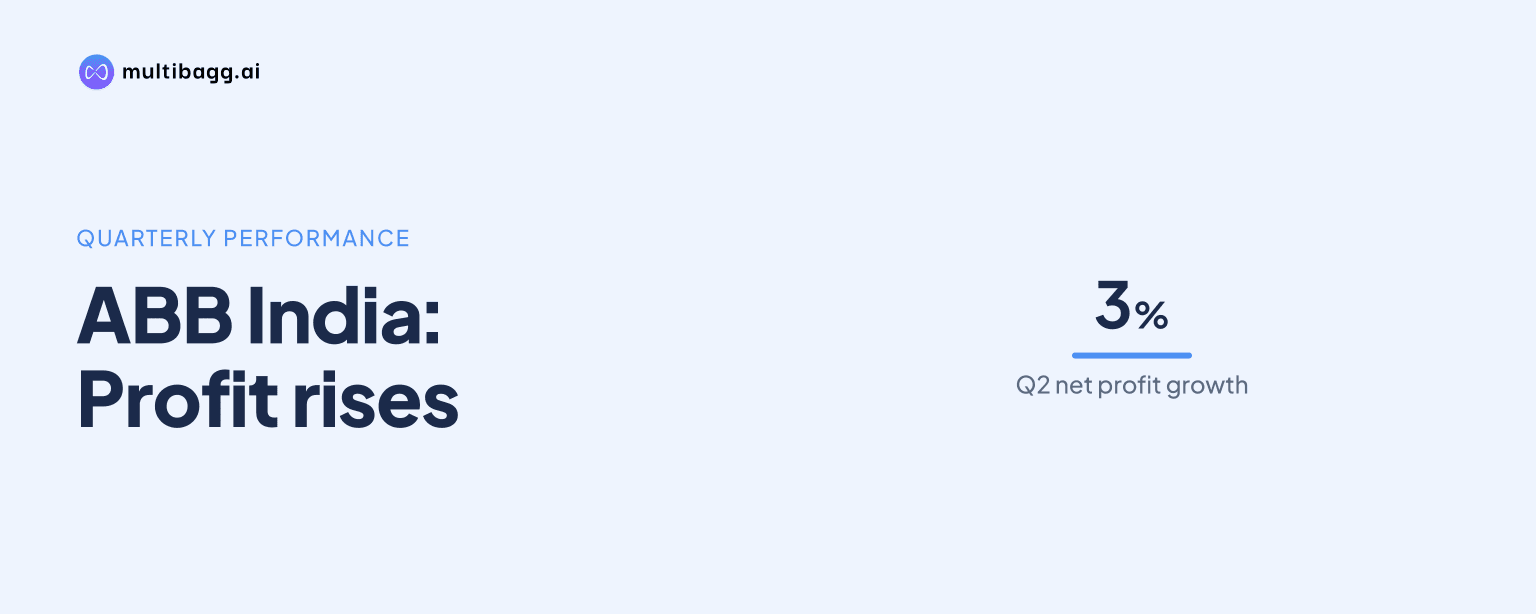
ABB India Limited reported a 3% year-on-year rise in consolidated net profit to ₹362 crore in the June 2026 quarter, while total orders increased 49.6% to ₹4,363 crore. The result showed strong demand from infrastructure, data centres and renewable-energy projects, although higher costs reduced operating profitability.
Know ABB India inside out
Results, valuation, peers and who's buying, in one view.
What did ABB India report for the June 2026 quarter?
ABB India reported consolidated revenue of ₹3,521 crore for the June 2026 quarter, up 21% from a year earlier. Consolidated net profit rose to ₹362 crore from ₹352 crore in the corresponding quarter of the previous year. The company's order inflow was ₹4,363 crore, marking a 49.6% increase year on year.
The order growth was materially faster than revenue growth, indicating that new project wins exceeded the revenue recognised during the quarter. ABB India supplies electrification, automation and motion technologies to industrial and infrastructure customers. Its customer base includes Indian Railways and Kolkata Metro, according to the reported information.
The company also disclosed profit before tax of ₹499 crore and profit after tax of ₹370 crore in its quarterly-results summary. Separately reported consolidated net profit was ₹362 crore. The figures cited for profit after tax and consolidated net profit come from different reported result summaries, while the reported trend in profitability was a 3% year-on-year increase in consolidated profit.
Which sectors drove ABB India's order growth?
Infrastructure, data centres and renewable-energy projects supported ABB India's order momentum during the quarter. These sectors require equipment and systems for power distribution, electrification, process automation and energy-efficient industrial operations, areas in which ABB India operates.
The company was also reported to have benefited from higher order wins in its electrification and automation businesses. The order intake of ₹4,363 crore was larger than quarterly revenue of ₹3,521 crore, underscoring the pace of fresh demand during the period.
Demand from transport and urban infrastructure remains relevant to the company's operations because of its relationships with customers such as Indian Railways and Kolkata Metro. However, the available results information does not provide a segment-wise breakdown of quarterly orders or revenue, so the precise contribution of each business line was not disclosed.
Why did ABB India's operating margin decline?
ABB India's operating profit margin declined to 12.6% from 13.6% a year earlier, a fall of 100 basis points. The margin movement came even as revenue increased, reflecting pressure from higher commodity costs, geopolitical uncertainty and related supply-chain challenges.
Quarterly expenses increased 22.3%, outpacing the reported 21% rise in consolidated revenue. This difference helps explain why profit growth was modest relative to the expansion in sales and orders. The company was able to maintain year-on-year profit growth, but costs reduced the conversion of revenue into operating profit.
Commodity-price movements can affect the cost of inputs used in electrical and industrial equipment. Supply-chain disruptions can also influence procurement and project execution costs. The reported result does not quantify the individual effect of each cost factor, but it identifies both commodities and geopolitical uncertainty as pressures on margins.
Got a follow-up? Ask IRIS
What do the quarterly figures show for investors?
The quarterly figures show robust order growth alongside a narrower operating margin. ABB India's ₹4,363 crore order intake was 49.6% higher year on year, while revenue reached ₹3,521 crore and consolidated net profit was ₹362 crore, up 3%.
For investors, the key contrast is between the growth in demand and the pressure on profitability. Orders grew more than twice as fast as revenue, while expense growth slightly exceeded revenue growth. No share-price movement, order backlog value or forward earnings guidance was included in the provided information.
ABB India's reporting year begins in January and ends in December. Therefore, the June reporting period falls in the second quarter of its calendar-year financial cycle. The company publishes results quarterly and is listed on both the BSE and NSE.
How does the result fit ABB India's stated growth and margin goals?
The result fits ABB India's stated focus on moving from overall revenue growth of around 8% toward double-digit growth, but it also highlights the importance of cost control. The company has indicated a sustainable profit-after-tax margin target of 12% to 15% going forward.
The June-quarter revenue growth of 21% was above that cited overall growth level, while the 49.6% increase in orders provided evidence of active demand across its addressed markets. Yet the decline in operating margin shows that revenue expansion alone does not remove input-cost and supply-chain risks.
The available information does not state whether ABB India changed its annual growth or margin expectations after the quarterly results. Investors will therefore need to assess subsequent disclosures for order execution, expense trends and whether operating margin stabilises as projects move through the revenue cycle.
Conclusion
ABB India's June 2026 quarter combined a 49.6% increase in orders with 21% revenue growth and a 3% rise in consolidated net profit. Demand from infrastructure, data centres and renewables supported new business, but a 100-basis-point fall in operating margin showed the impact of higher costs and supply-chain uncertainty.
The next reported event is ABB India's Q3 2026 results, scheduled for October 20. The main points to watch are whether the higher order intake converts into revenue, whether expenses remain elevated, and how the company progresses toward its stated double-digit growth ambition and 12% to 15% sustainable PAT-margin range.