










ABB India Q3 revenue rises 19% while profit margins decline
Key highlights
- ABB India Q3 CY2026 revenue rose 19% year on year to Rs 3,738.1 crore.
- ABB India Q3 CY2026 profit after tax increased 10% to Rs 439.8 crore, while its margin fell to 11.8% from 12.7%.
- ABB India’s material-cost ratio increased to 62.9% of revenue from 61.5% in Q3 CY2025.
- ABB India ended Q3 CY2026 with an order backlog of Rs 12,927 crore, up 36% year on year.
powered by IRIS
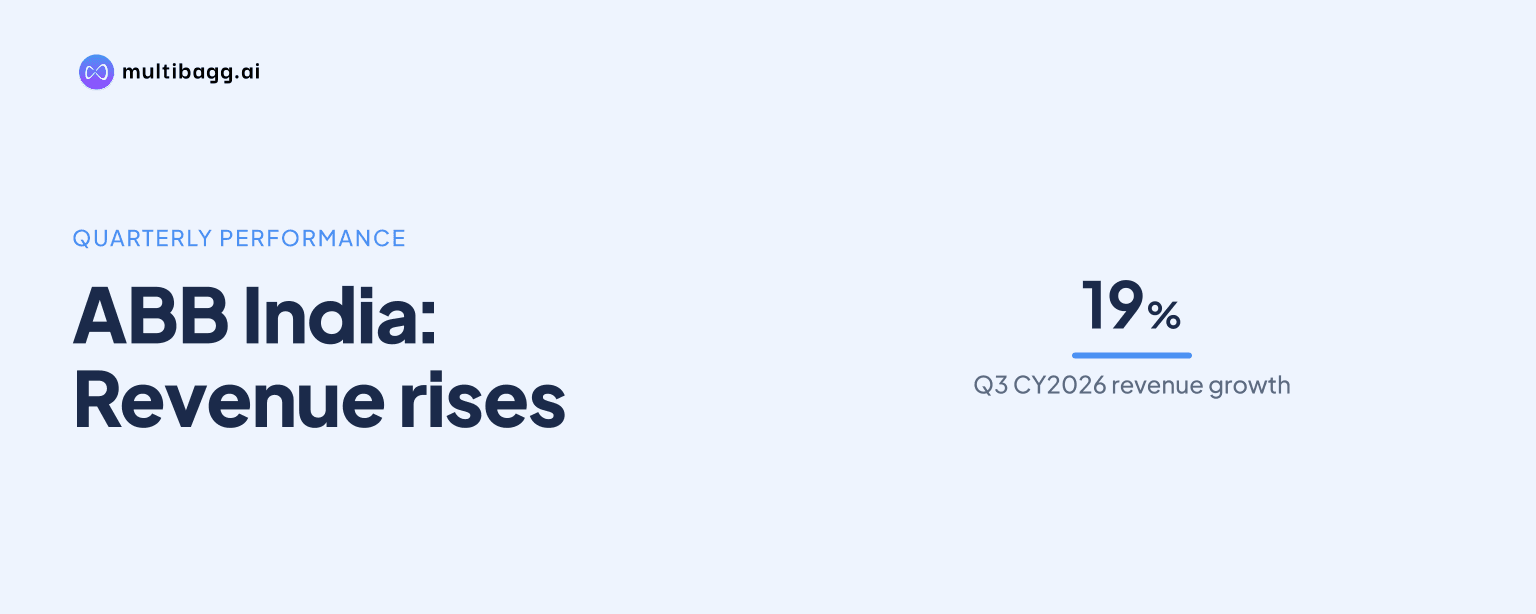
ABB India reported Q3 CY2026 revenue of Rs 3,738.1 crore, up 19% year on year, and profit after tax of Rs 439.8 crore, up 10%, but operational EBITA margin declined to 12.9% from 13.4% as material costs increased to 62.9% of revenue from 61.5%.
Know ABB India inside out
Results, valuation, peers and who's buying, in one view.
What drove ABB India’s Q3 CY2026 revenue growth?
ABB India’s Q3 CY2026 revenue growth was driven by execution, with revenue rising to Rs 3,738.1 crore from Rs 3,130.1 crore in Q3 CY2025 and Rs 3,558.9 crore in Q2 CY2026. That represents 19% year-on-year growth and 5% quarter-on-quarter growth. The company described the quarterly revenue trend as positive execution momentum, within continuing operations excluding robotics.
Electrification recorded the largest disclosed segment revenue at Rs 1,927 crore, 40% higher year on year from Rs 1,378 crore in Q3 CY2025. ABB India attributed this segment’s growth to effective price management, higher volume, backlog execution and increased export revenue. The segment’s revenue was also higher than Rs 1,804 crore in Q2 CY2026.
Motion revenue increased 14% year on year to Rs 1,336 crore from Rs 1,175 crore, supported by growth across most divisions and consistent execution. Automation moved in the other direction: revenue declined 16% to Rs 505 crore from Rs 601 crore, which ABB India attributed to the timing of delivery of systems orders. This contrast shows that growth in Electrification and Motion offset a lower Automation revenue contribution.
Why did ABB India’s material-cost ratio increase?
ABB India’s material-cost ratio increased by 1.4 percentage points year on year, reaching 62.9% of Q3 CY2026 revenue against 61.5% in Q3 CY2025. Material costs rose to Rs 2,351.5 crore from Rs 1,924.9 crore, an increase of Rs 426.6 crore alongside the Rs 608.0 crore increase in revenue. Management identified commodity inflation, rupee depreciation and revenue mix as the reasons for the higher material-cost share.
Other expenses increased more quickly than revenue, rising to Rs 650.1 crore from Rs 504.8 crore. As a share of revenue, these costs increased to 17.4% from 16.1%, and ABB India linked the increase to revenue-linked costs. Personnel expenses were Rs 224.8 crore, compared with Rs 215.2 crore a year earlier, with salary and headcount revisions cited as the cause.
The quarter included a net exchange and commodity variation gain of Rs 40.2 crore, compared with a Rs 0.5 crore gain in Q3 CY2025. This gain reduced reported expenditure, but it did not prevent the material-cost ratio from moving higher. Total expenditure was Rs 3,235.8 crore, equal to 86.6% of revenue, compared with Rs 2,686.4 crore, or 85.8%, a year earlier.
Got a follow-up? Ask IRIS
How did ABB India’s higher costs affect quarterly profit margins?
ABB India’s operational EBITA, or earnings before interest, tax and amortisation, rose 15% to Rs 484 crore in Q3 CY2026 from Rs 420 crore in Q3 CY2025, but its margin fell to 12.9% from 13.4%. Operational EBITA also rose from Rs 461 crore in Q2 CY2026, when the margin was 13.0%, indicating that quarterly profit increased while the percentage margin remained below the prior-year level.
Earnings before interest, tax, depreciation and amortisation, or EBITDA, increased 14% to Rs 552 crore from Rs 486 crore. Its margin declined to 14.8% from 15.5%. Profit before tax increased 10% to Rs 580.6 crore, but its margin declined to 15.5% from 16.9%, reflecting the higher expenditure ratio reported during the quarter.
Profit after tax rose to Rs 439.8 crore from Rs 398.0 crore, while the net profit margin declined to 11.8% from 12.7%. The tax expense was Rs 140.8 crore, and the effective tax rate was 24.3%, compared with 24.6% in Q3 CY2025. In segment disclosures, ABB India said Electrification margins were primarily affected by material cost, while Motion faced higher material cost and revenue mix; Automation cited sluggish execution and higher manufacturing and associated expenses.
What do ABB India’s orders and backlog indicate?
ABB India received orders of Rs 4,733 crore in Q3 CY2026, 56% higher than Rs 3,030 crore in Q3 CY2025 and 8% above Rs 4,363 crore in Q2 CY2026. Its period-end order backlog reached Rs 12,927 crore, up 36% year on year and 9% sequentially. For the first nine months of CY2026, orders grew 43% to Rs 13,376 crore while revenue increased 15% to Rs 10,481 crore.
Electrification accounted for Rs 2,780 crore of quarterly orders, an increase of 117% year on year, and its backlog was Rs 5,784 crore, up 73%. ABB India cited demand for smart power and distribution solutions, including the data centre, energy, chemicals, and food and beverage sectors. Motion orders rose 15% to Rs 1,477 crore, with a Rs 4,964 crore backlog that was 20% higher year on year.
Automation orders were Rs 499 crore, up 4% year on year, while its backlog was Rs 2,245 crore, up 5%. ABB India reported demand in metals and cement and increased export orders in this segment, but also reported slower revenue execution in Q3. The overall cash balance was Rs 5,299 crore at the end of Q3 CY2026, compared with Rs 4,991 crore a year earlier, and the company linked cash performance to collections.
Conclusion
ABB India combined higher Q3 CY2026 revenue, profit and orders with lower margins. Revenue increased 19% and profit after tax increased 10%, but material costs absorbed 62.9% of revenue versus 61.5% a year earlier, while revenue-linked other expenses also rose as a share of sales. Electrification was the main disclosed growth engine, whereas Automation’s delivery timing held back its revenue.
The next reporting period should clarify whether ABB India converts its Rs 12,927 crore order backlog into revenue while managing the factors it identified: commodity inflation, rupee depreciation, revenue mix, logistics costs and revenue-linked expenses. It should also show whether Automation’s systems-order deliveries improve after its Q3 CY2026 revenue declined 16% and whether Electrification sustains execution from its Rs 5,784 crore backlog.