










ACE operating cash flow turns negative on inventory build
Key highlights
- ACE reported a Rs 5.46 crore standalone operating cash outflow for the six months ended 30 September 2026, versus a Rs 6.39 crore inflow a year earlier.
- Standalone inventories rose to Rs 831.37 crore at 30 September 2026 from Rs 603.38 crore at 31 March 2026.
- ACE’s current borrowings increased to Rs 143.88 crore from Rs 11 lakh at 31 March 2026.
- Standalone profit before tax included a Rs 50 crore exceptional gain from the Heavy Cranes business transfer.
powered by IRIS
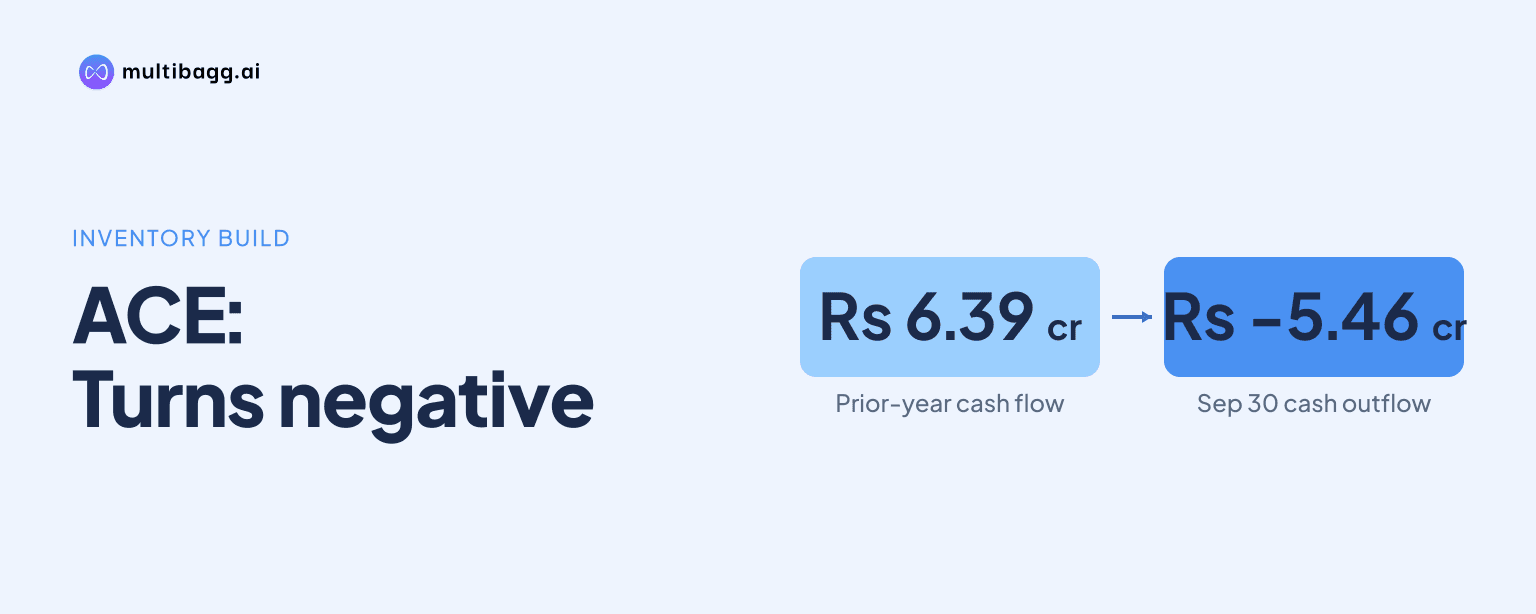
Action Construction Equipment Limited reported a standalone operating cash outflow of Rs 5.46 crore for the six months ended 30 September 2026, against an inflow of Rs 6.39 crore a year earlier, as inventory absorbed Rs 232.72 crore and tax payments exceeded cash generated from operations despite a rise in reported profit before tax.
Know Action Construction Equipment inside out
Results, valuation, peers and who's buying, in one view.
Why did ACE report negative operating cash flow?
ACE reported negative standalone operating cash flow because Rs 75.15 crore of net income-tax payments exceeded the Rs 69.69 crore of cash generated from operations during the six months ended 30 September 2026. In the comparable six months ended 30 September 2025, cash generated from operations was Rs 77.00 crore and net tax paid was Rs 70.61 crore, leaving an operating cash inflow of Rs 6.39 crore.
Reported profit did not translate directly into operating cash during the period. Standalone profit before tax rose to Rs 372.18 crore from Rs 264.13 crore, but the 2026 result included a Rs 50 crore exceptional gain on the transfer of the Heavy Cranes business undertaking to ACE KATO Private Limited. The cash-flow statement deducts that gain in reconciling profit before tax, resulting in operating profit before working-capital changes of Rs 262.78 crore, compared with Rs 206.90 crore a year earlier.
How much cash did ACE’s inventory build consume?
ACE’s standalone inventory increase consumed Rs 232.72 crore of cash in the six months ended 30 September 2026, compared with Rs 89.79 crore in the prior-year period. This was the largest working-capital outflow recorded in the cash-flow statement and was greater than the Rs 39.00 crore cash inflow generated by lower trade receivables.
The standalone inventory balance rose to Rs 831.37 crore at 30 September 2026 from Rs 603.38 crore at 31 March 2026, an increase of Rs 227.99 crore. The difference from the Rs 232.72 crore cash-flow line arises within the cash-flow reconciliation; the filing does not separately explain that difference. ACE’s disclosed inventory turnover ratio was 1.56 times for the six-month period, down from 1.66 times in the corresponding 2025 period.
The income statement also recorded a larger movement in finished goods and work-in-progress. Standalone changes in inventories of finished goods and work-in-progress were negative Rs 120.24 crore in the first half of 2026, compared with negative Rs 41.30 crore a year earlier. Within segments, Cranes, Material Handling and Construction Equipment reported negative Rs 160.04 crore in such changes, while Agriculture Equipment reported positive Rs 39.80 crore.
Got a follow-up? Ask IRIS
What other working-capital movements reduced ACE’s cash?
ACE’s trade payables decreased by Rs 95.36 crore in the six months ended 30 September 2026, following a Rs 30.27 crore decrease in the prior-year period, creating an additional cash outflow. At 30 September 2026, dues to creditors other than micro and small enterprises were Rs 709.12 crore, compared with Rs 734.20 crore at 31 March 2026, while dues to micro and small enterprises fell to Rs 116.35 crore from Rs 181.47 crore.
Other current liabilities partly offset those outflows, increasing by Rs 152.32 crore in the standalone cash-flow statement, against an increase of Rs 8.01 crore a year earlier. The balance-sheet amount for other current liabilities rose to Rs 407.51 crore at 30 September 2026 from Rs 255.19 crore at 31 March 2026. Other assets used Rs 59.50 crore of cash, compared with Rs 3.72 crore in the previous first half.
Trade receivables moved in the opposite direction. Standalone receivables declined to Rs 242.57 crore at 30 September 2026 from Rs 287.34 crore at 31 March 2026, and the cash-flow statement recorded a Rs 39.00 crore decrease in receivables. The debtor turnover ratio increased to 6.28 times from 5.06 times in the comparable six-month period, while inventory turnover declined, showing that receivables and inventory moved differently during the first half.
The consolidated cash-flow statement showed the same overall pattern, with an operating cash outflow of Rs 9.19 crore for the six months ended 30 September 2026, compared with an inflow of Rs 4.74 crore a year earlier. Consolidated inventories consumed Rs 231.52 crore and consolidated trade payables decreased by Rs 95.16 crore, while lower receivables released Rs 31.85 crore of cash.
How did ACE finance its cash requirements?
ACE generated Rs 139.46 crore of net financing cash in the first half of 2026, compared with Rs 85.95 crore in the previous first half. Borrowing proceeds were Rs 471.76 crore and repayments were Rs 327.98 crore, producing a gross net borrowing inflow of Rs 143.78 crore before lease principal payments and finance-cost payments.
Standalone current borrowings rose to Rs 143.88 crore at 30 September 2026 from Rs 11 lakh at 31 March 2026. ACE disclosed that it issued Rs 70 crore of commercial paper with a three-month tenure during the six months ended 30 September 2026, of which Rs 35 crore matured during that period. It also disclosed Rs 35 crore of commercial-paper issuance during the September quarter.
Investing activities used Rs 146.82 crore, compared with Rs 102.54 crore a year earlier. ACE spent Rs 81.21 crore on property, plant and equipment, intangible assets, capital work-in-progress, right-of-use assets, investment property and capital advances, while purchases of investments totalled Rs 676.30 crore and sale proceeds from investments were Rs 528.91 crore.
Cash and cash equivalents fell to Rs 49.82 crore at 30 September 2026 from Rs 62.64 crore at the beginning of the financial year. Standalone current assets increased to Rs 1,908.34 crore from Rs 1,622.33 crore, while current liabilities rose to Rs 1,454.69 crore from Rs 1,213.26 crore. The current ratio was 1.31 times at 30 September 2026, compared with 1.34 times at 31 March 2026, and the debt-equity ratio was 0.06 times versus 0.00 times.
Conclusion
ACE’s first-half 2026 accounts show that higher reported profit and cash generation diverged as working capital and tax payments absorbed operating cash. The Rs 232.72 crore inventory outflow, Rs 95.36 crore decrease in trade payables and Rs 75.15 crore of tax payments outweighed Rs 262.78 crore of operating profit before working-capital changes, while the Rs 50 crore Heavy Cranes transfer gain increased reported pre-tax profit.
The next disclosure will help clarify whether the Rs 831.37 crore inventory balance converts into revenue and cash, and how current borrowings develop after the Rs 70 crore of three-month commercial paper issued in the first half. ACE has also disclosed that ACE KATO depends on ACE and Kato Works Co., Ltd. for continued operations and for its ability to generate cash flows to settle obligations, making the joint operation’s progress a disclosed matter to watch.