








AceVector Limited Files FY26 Annual Report With 19th AGM Notice
MAX Plan at ₹4,999/yr

Find your next multibaggerBe a Pro Investor
Research stocks and track your picks on the go. Download the app.
Key highlights
- AceVector Limited filed its FY26 Annual Report and Notice of its 19th Annual General Meeting on November 27, 2026.
- AceVector reported FY26 consolidated total revenue of ₹537.67 crore, up 32.18% from ₹406.77 crore in FY25.
- AceVector's FY26 consolidated loss after tax narrowed to ₹45.51 crore from ₹126.31 crore in FY25.
- The filing highlight stated that Unicommerce FY26 revenue grew 51.6% to ₹204.34 crore.
powered by IRIS
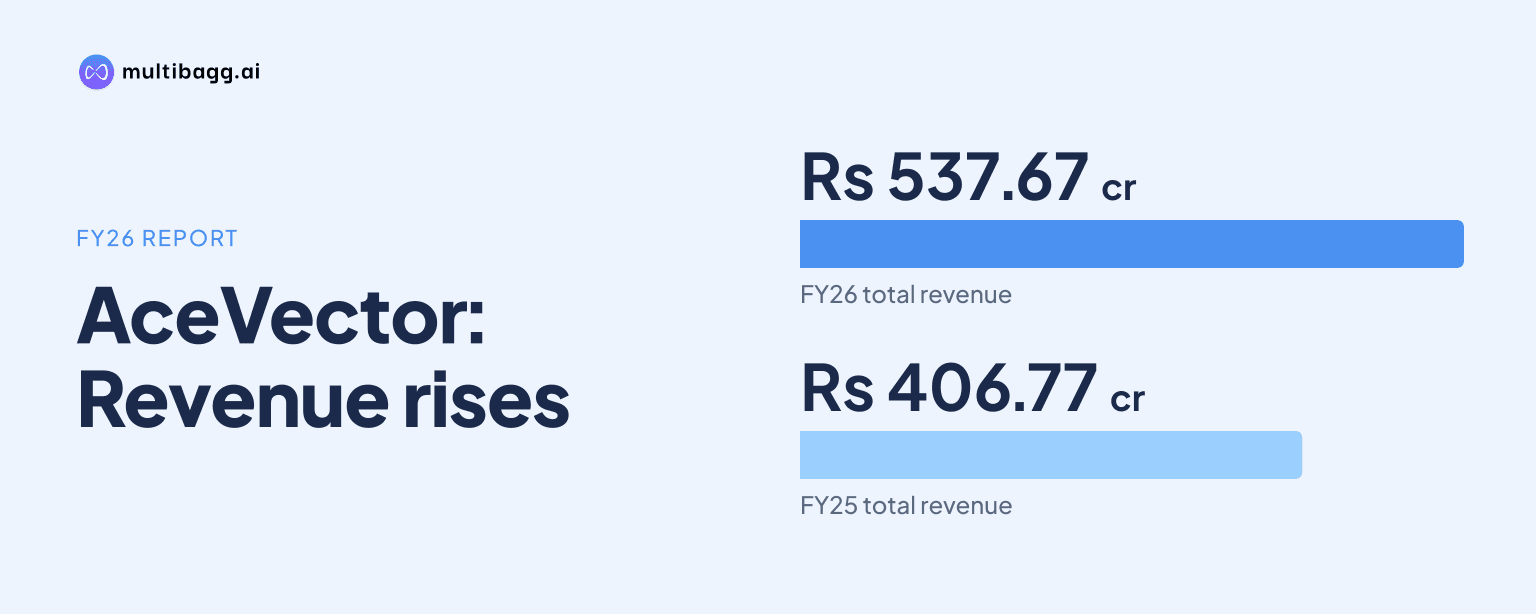
AceVector Limited filed its FY26 Annual Report on November 27, 2026, together with the Notice of its 19th Annual General Meeting, reporting consolidated total revenue of ₹537.67 crore, up 32.18% from ₹406.77 crore in FY25.
Know AceVector inside out
Results, valuation, peers and who's buying, in one view.
What did AceVector file on November 27, 2026?
AceVector filed its annual report for the financial year ended March 2026 and included the notice convening its 19th Annual General Meeting. The filing makes the company’s annual financial information and AGM-related documentation available to shareholders and the wider market.
The supplied filing information does not state the date, venue or resolutions for the AGM. It does, however, establish that the AGM notice forms part of the FY26 annual-report filing. Investors can use the report to review the consolidated income statement and compare the latest annual performance with earlier years.
The filing is significant because it places AceVector’s FY26 financial outcome in a formal annual-report disclosure. The company remained loss-making during the year, although both its loss before tax and loss after tax narrowed materially from FY25 levels.
What were AceVector's key FY26 financial figures?
AceVector reported consolidated revenue from operations of ₹510.38 crore in FY26, compared with ₹395.02 crore in FY25. Other income rose to ₹27.28 crore from ₹11.75 crore, taking total revenue to ₹537.67 crore from ₹406.77 crore.
Total expenses were ₹575.22 crore, compared with ₹453.75 crore in the preceding year. As a result, the company recorded a loss before tax of ₹37.56 crore, sharply lower than the ₹120.59 crore loss before tax reported in FY25.
Profit after tax was a loss of ₹45.51 crore in FY26, against a loss of ₹126.31 crore in FY25. Basic and diluted earnings per share were both negative ₹1.32, improving from negative ₹3.04 a year earlier. The supplied summary separately describes a net loss of ₹45.87 crore, while the consolidated income-statement table shows a loss after tax of ₹45.51 crore.
How does FY26 compare with AceVector's earlier years?
AceVector’s FY26 total revenue was higher than the ₹384.74 crore reported in FY24 and ₹388.13 crore in FY23. Revenue from operations was ₹379.76 crore in FY24 and ₹371.96 crore in FY23, showing that the FY26 increase followed more modest movement in the preceding two years.
The loss before tax also improved against the earlier period, though the company did not return to profitability. It had reported losses before tax of ₹45.76 crore in FY24 and ₹265.15 crore in FY23. FY26 expenses remained above total revenue, which explains the continuing annual loss.
This comparison matters because revenue growth alone does not determine earnings performance. The annual statement shows that the gap between total expenses and total revenue reduced substantially in FY26 from FY25, but expenses still exceeded income for the year.
Got a follow-up? Ask IRIS
What other performance detail does the filing highlight?
The filing highlight states that Unicommerce FY26 revenue grew 51.6% to ₹2,043.4 million, equivalent to ₹204.34 crore. This is a separate performance figure highlighted alongside the AceVector annual-report filing.
No additional operating metric, customer measure or segment-level financial reconciliation for this figure is provided in the supplied filing material. Therefore, the reported growth rate and revenue amount should be read as the disclosed highlight, without attributing it to a particular AceVector segment or calculating additional relationships not stated in the information provided.
The distinction between the consolidated AceVector income statement and the separately highlighted Unicommerce figure is important for investors reviewing the disclosure. AceVector’s annual total revenue was ₹537.67 crore, while the highlighted Unicommerce revenue is stated as ₹204.34 crore after converting the disclosed million-denominated figure into crore.
How does the annual-report filing affect investors?
The filing gives shareholders a formal reference point for AceVector’s FY26 performance, including its revenue growth, expenses, tax charge and per-share loss. The reduction in loss before tax to ₹37.56 crore and loss after tax to ₹45.51 crore indicates an improvement from FY25, while the negative EPS confirms that the company remained loss-making.
No share-price movement, market reaction, dividend declaration, capital-raising decision or management outlook is included in the supplied information. As a result, no direct market impact can be established from this filing alone. The immediate relevance for investors is the availability of audited annual financial information and the AGM notice.
For company operations, the FY26 numbers show higher revenue from operations and higher total expenses. The report does not provide enough detail in the supplied extract to establish the specific drivers of expense growth or to assess changes in individual business lines beyond the separately stated Unicommerce revenue highlight.
Conclusion
AceVector’s November 27 filing formally places its FY26 annual financial results and the notice of its 19th AGM before shareholders. Consolidated total revenue increased 32.18% to ₹537.67 crore, while the loss after tax narrowed to ₹45.51 crore from ₹126.31 crore in FY25, though the company remained in the red.
Investors should watch for the detailed agenda and timing of the 19th AGM, if disclosed in the notice, and future company updates that may explain the drivers of revenue growth, expenses and the path of profitability. The supplied material does not disclose a forward target or guidance.

