










Snapdeal fashion exceeds 68% as H1 NMV grows 31% year-on-year
Key highlights
- Fashion accounted for more than 68% of Snapdeal's business in H1 FY27.
- Fashion NMV grew 31% year-on-year, compared with 10% growth in overall NMV.
- Active fashion listings increased 91% year-on-year to nearly 95 lakh.
- Annual transacting customers exceeded 1.3 crore after 12% year-on-year growth in H1 FY27.
powered by IRIS
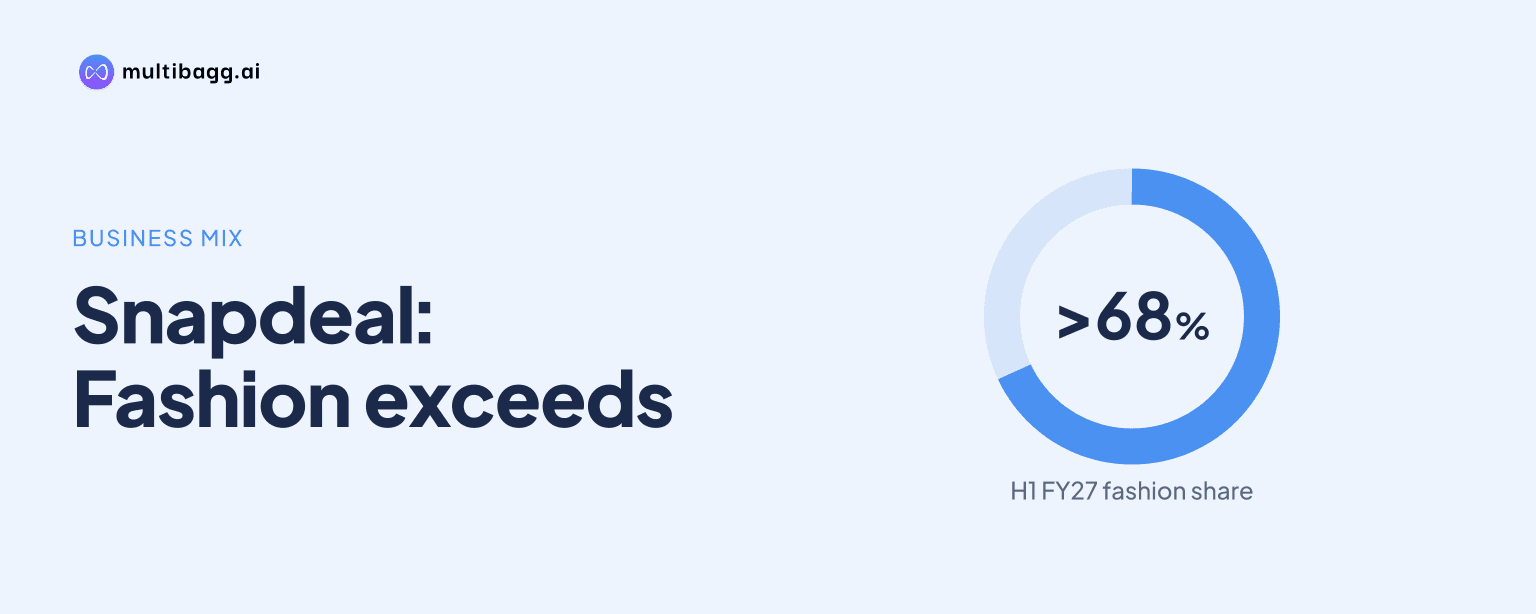
In H1 FY27, Snapdeal said fashion exceeded 68% of its business as fashion net merchandise value, or NMV, grew 31% year-on-year. Active fashion listings rose 91% to nearly 95 lakh, while overall NMV increased 10%, indicating that fashion expanded faster than the marketplace as a whole.
Know AceVector inside out
Results, valuation, peers and who's buying, in one view.
How large is fashion in Snapdeal's business?
Fashion accounts for more than 68% of Snapdeal's business, making it the marketplace's largest disclosed category focus in H1 FY27. Management said Snapdeal targets value-conscious fashion shoppers in the Rs 300-to-Rs 800 price range, positioned between entry-level clothing below Rs 300 and branded fashion above Rs 800.
Snapdeal described its customers as young and aspirational, with Generation Z representing nearly two-thirds of new customers in H1 FY27. The company also said 80% of its sales came from outside metropolitan areas, linking its value-fashion strategy to demand in non-metro markets.
Management presented FashionX as the first of Snapdeal's three strategic pillars, alongside CustomerX and CreatorX. FashionX covers selection, curation and quality controls; CustomerX addresses discovery and post-order support; and CreatorX uses regional fashion content to generate demand.
How quickly did Snapdeal's fashion assortment and NMV grow?
Snapdeal's fashion NMV rose 31% year-on-year in H1 FY27, compared with 10% growth in overall NMV during the same period. Its active fashion listings increased 91% year-on-year to nearly 95 lakh, showing that the category shift included both a larger assortment and faster value growth.
The 21-percentage-point difference between fashion NMV growth and overall NMV growth shows that fashion outpaced the rest of Snapdeal's marketplace. App-delivered units grew 23% year-on-year, also ahead of the 16% increase in overall delivered units, although Snapdeal did not disclose absolute fashion NMV or total NMV for H1 FY27.
Management attributed the lower overall H1 growth rate partly to festive timing, with festivities falling mainly in Q3 this year rather than Q2 last year. It cited 60% year-on-year unit growth in the first 15 days of October as an indicator of demand in the later festive period.
How is Snapdeal using AI to expand fashion listings?
Snapdeal said its AI seller tools reduced catalog onboarding time by 90% and helped double its active seller base over the past year. Its SnapList AI agent supports catalog onboarding, image and catalog enrichment, and listing-quality checks and corrections, providing a mechanism for expanding its nearly 95 lakh fashion listings.
The marketplace also uses algorithms to screen sellers at onboarding and assess customer feedback, ratings, reviews and returns after listings go live. Management said sellers whose assortment falls below Snapdeal's minimum quality threshold can be disabled, while product ratings have remained at 4 out of 5 stars over the past three years.
This control process is relevant to Snapdeal's Rs 300-to-Rs 800 target segment, where management aims to offer better quality than entry-level clothing without branded-fashion pricing. Snapdeal did not disclose a return rate, the number of sellers disabled, or a specific quality threshold, so the reported measures are the automated process and three-year product-rating record.
Snapdeal described its operating model as asset-light, zero-inventory and fully reliant on third-party logistics. It charges sellers 0% commission and reported a contribution margin of 10% of NMV; with an average selling price of nearly Rs 400, management said unit contribution was about Rs 40 per order.
Got a follow-up? Ask IRIS
Are repeat customers supporting Snapdeal's fashion strategy?
Snapdeal said repeat customers support its fashion strategy, with annual transacting customers rising 12% year-on-year to more than 1.3 crore in H1 FY27. Purchase frequency rose 11% to 4.1 orders per customer, and management said nearly 80% of platform volumes came from repeat purchases.
Management said purchase frequency increased across existing customer cohorts, while newer cohorts placed more orders in their first year. The top 10% of customers made 17 purchases a year in FY26, up from 13 purchases in FY24, a rise of four orders over two financial years.
CustomerX is intended to support this repeat behaviour through personalised discovery and search. Snapdeal said StyleMatch AI influenced more than 81% of platform orders, while its Snap&Shop image-search tool generated more than 4 crore monthly product-discovery views across colours, patterns and styles.
Snapdeal also applies AI after a customer places an order. Its Retina AI agent blocked 32 lakh high-risk orders before shipping over the last 12 months, while SIA AI resolved nearly 89% of support queries; management did not quantify the delivery-success improvement from its Pinpoint AI address-enrichment tool.
How does creator content fit Snapdeal's value-fashion plan?
Snapdeal is using its SlayClan creator network to produce regional fashion content and has partnered with YouTube Shopping to expand this effort. Management said the content generated more than 15 crore video views across YouTube and Instagram and that its social handles had an active community of more than 1.1 crore followers.
CreatorX is intended to inspire product discovery, build trust and lead to purchases, particularly given that 80% of Snapdeal sales originate outside metros. The company did not disclose creator spending, creator numbers, conversion rates or revenue tied directly to SlayClan content.
Management described a cycle in which fashion curation and AI-powered shopping increase repeat purchases and expand the contribution-margin pool. It said Snapdeal reinvests part of that pool in its brand and creator network to acquire app customers, who management expects to become repeat customers over time.
Conclusion
Snapdeal's H1 FY27 disclosures indicate a greater concentration on value fashion, with the category above 68% of business, 31% fashion NMV growth and nearly 95 lakh active listings. Fashion grew faster than the marketplace's overall 10% NMV growth, while a 12% increase in annual transacting customers and 4.1 orders per customer supported management's repeat-purchase strategy.
The next disclosed marker is festive demand in Q3, after the first 15 days of October produced 60% year-on-year unit growth. Future updates can show whether Snapdeal's plan to turn acquired app users into repeat customers continues to raise purchase frequency from the H1 FY27 level of 4.1 orders per customer.