










Capital Infra Trust expects FY28 DPU growth of 5%-10%
Key highlights
- Capital Infra Trust expects FY28 DPU growth of 5%-10%, subject to fuller guidance on a later earnings call.
- Capital Infra Trust said it has about Rs 2,500 crore of debt-only acquisition capacity at a 57.5% net borrowing ratio.
- Capital Infra Trust reported September 2026 NAV of Rs 73.1 per unit, versus Rs 67.5 per unit in September 2025.
- Capital Infra Trust has 12 sponsor ROFO projects with about Rs 15,500 crore of base project cost, including two that may be ready in May 2027.
powered by IRIS
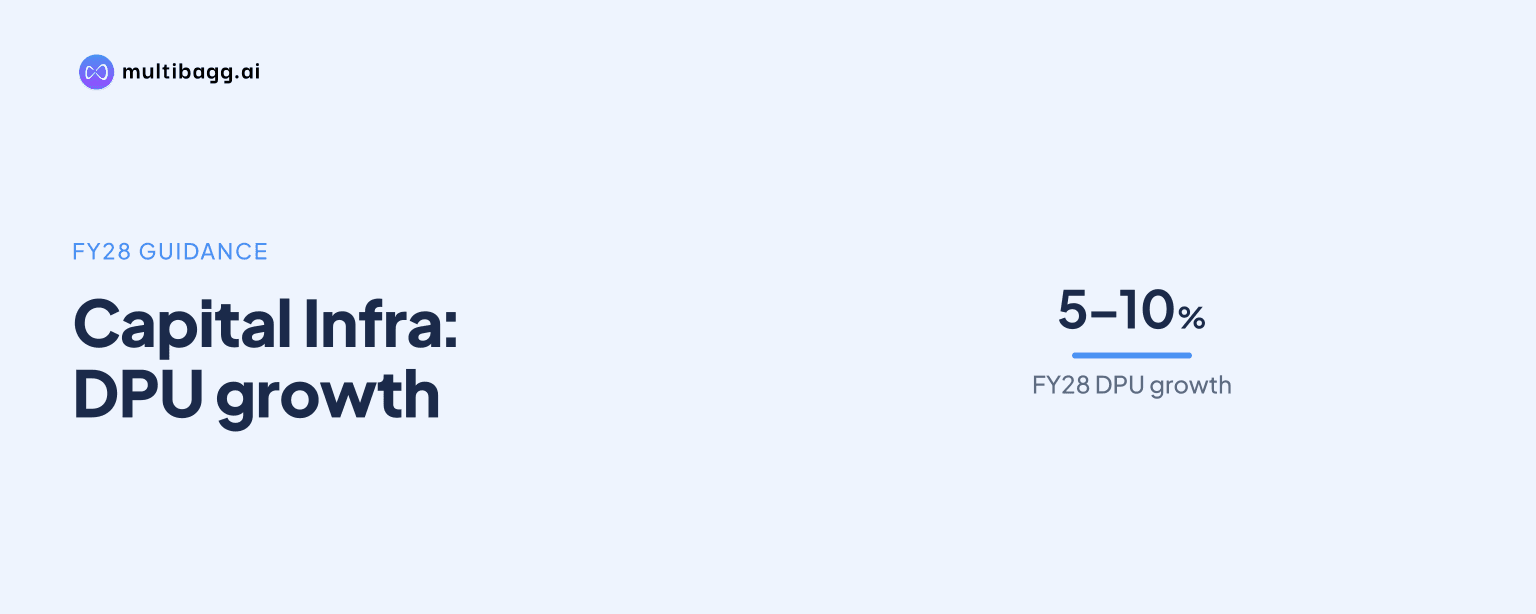
Capital Infra Trust expects distribution per unit, or DPU, to rise by 5%-10% in FY28, based on its current financial estimates, management said on the earnings call. The Trust has not issued formal FY28 guidance and said it expects to provide a clearer assessment on the next call or its Q4 earnings call.
Know Capital Infra Trust inside out
Results, valuation, peers and who's buying, in one view.
What FY28 DPU growth does Capital Infra Trust expect?
Capital Infra Trust expects FY28 DPU growth of 5%-10%, although management said it has yet to release formal guidance for that year. The range was provided in response to a question about recently acquired assets contributing for a full year, and management said its current financial estimates support that level of growth.
Management said it would be better placed to comment on FY28 in the next earnings call or the Q4 earnings call. The 5%-10% range is therefore a preliminary outlook rather than a detailed forecast, and the supplied discussion did not state the Trust's FY27 DPU guidance or a FY28 DPU amount per unit.
The FY28 outlook extends management's discussion beyond FY27 and follows a period of portfolio expansion. Capital Infra Trust said its next-quarter results should provide a clearer picture of its full 18-asset portfolio, including the cost and cash-flow effect of the newer projects.
How much capacity does Capital Infra Trust have for acquisitions?
Capital Infra Trust said it has about Rs 2,500 crore of capacity to acquire assets through debt alone after the stated acquisition. Management said the post-acquisition net debt-to-enterprise-value ratio would be around 45%, and it used a 57.5% net borrowing ratio to calculate the additional acquisition capacity.
Management separately said leverage was around 40.3% at the time of the call, compared with a permitted level of up to 70%. Its strategy is to keep leverage around 60%, according to management, and the two prior capital raises, comprising a preferential issue and a qualified institutional placement, were intended to broaden the equity base for debt-funded expansion.
The available debt-only capacity was described as a range of Rs 2,000 crore to Rs 2,500 crore for sponsor right-of-first-offer, or ROFO, and third-party assets. Capital Infra Trust said it had not entered into a binding agreement for any third-party asset, so this capacity represents financial headroom rather than committed deployment.
Capital Infra Trust also identified 12 sponsor ROFO projects with a stated base project cost of about Rs 15,500 crore that are expected to mature over the next three to four years. Management said two assets could be ready for acquisition in May 2027, which it described as Q1 of the next financial year, after they receive provisional or commercial operation status.
Got a follow-up? Ask IRIS
What acquisition terms could affect Capital Infra Trust's growth?
Capital Infra Trust said it would acquire sponsor ROFO assets only after an independent third-party valuation and would seek a 3%-5% discount to that valuation. Management said it achieved a 5% discount in the latest transaction, while it also cited a prior acquisition of three assets in December at a discount of more than 9% to enterprise value.
Third-party assets could add to growth, but their timing remains uncertain. Management said it had evaluated such opportunities for six months and was examining a portfolio of two or three assets, yet it had not reached the term-sheet closure stage with sellers.
Management said its underwriting is focused on operations and maintenance, or O&M, and major-maintenance expenditure because these estimates can differ materially between a buyer and seller. This approach means the stated Rs 2,500 crore funding capacity does not establish the amount, price or timing of acquisitions that Capital Infra Trust will complete after FY27.
The current portfolio's operating costs are largely fixed for each financial year and rise 5% annually, according to management. Reported expenses appeared marginally higher because of scope changes and pending engineering, procurement and construction payments related to newly acquired projects, rather than variation in routine O&M expense between Q1 and Q2.
How have rates, tax and valuation inputs affected Capital Infra Trust?
Capital Infra Trust reported net asset value, or NAV, of Rs 73.1 per unit in September 2026, excluding the six acquired assets, compared with Rs 67.5 per unit in September 2025. Management described the change as 8% annualised growth and attributed part of the accretion to the three discounted assets acquired in December.
The weighted average cost of capital, or WACC, used in the September valuation was 7.22%, up from 7%. Management said a 25-basis-point increase in the bank rate had been reflected in both projected cash flows and WACC, with the overall effect nullified. One basis point equals one-hundredth of a percentage point.
A tax change reduced NAV by about Rs 1.05 per unit. Management said the tax rate for Infrastructure Investment Trust special purpose vehicles increased to 28.6% from 25.2%, while higher inflation also affected O&M income received from the National Highways Authority of India and contributed to modification gains or losses.
Capital Infra Trust said its annualised borrowing cost was 7.3% for the September quarter and that it saw no current need to refinance existing borrowings. Management said it was reviewing the debt book and planning new borrowings to maintain suitable rates, while expecting a further 50-75 basis points of rate increases over the next nine to 12 months, subject to Indian and global macroeconomic conditions.
Conclusion
Capital Infra Trust has set out a preliminary FY28 DPU growth expectation of 5%-10%, supported by management's current financial estimates and an enlarged portfolio. Its ability to add assets is underpinned by stated debt-only acquisition capacity of about Rs 2,500 crore, but neither third-party acquisitions nor their financial terms have been finalised.
The next points to watch are management's next or Q4 earnings call for fuller FY28 guidance, the expected availability of two sponsor ROFO assets in May 2027, and next-quarter disclosures on the 18-asset portfolio. Unitholders can also monitor whether discussions on the two or three third-party assets progress to term sheets or binding agreements.