










Capital Infra Trust partly offsets 58% floating-rate debt
Key highlights
- Capital Infra Trust reported Rs 1,680.48 crore of floating-rate debt, equal to 58.4% of its stated debt composition at 30 September 2026.
- CIT reported a 7.30% blended effective borrowing cost, versus 7.01% on floating debt and 7.71% on fixed debt.
- CIT listed Rs 165.70 crore of repayment within one year and Rs 987.50 crore beyond five years.
- CIT reported gross debt of Rs 2,895.05 crore, net debt of Rs 2,429.58 crore and a DSCR of 2.27 times.
powered by IRIS
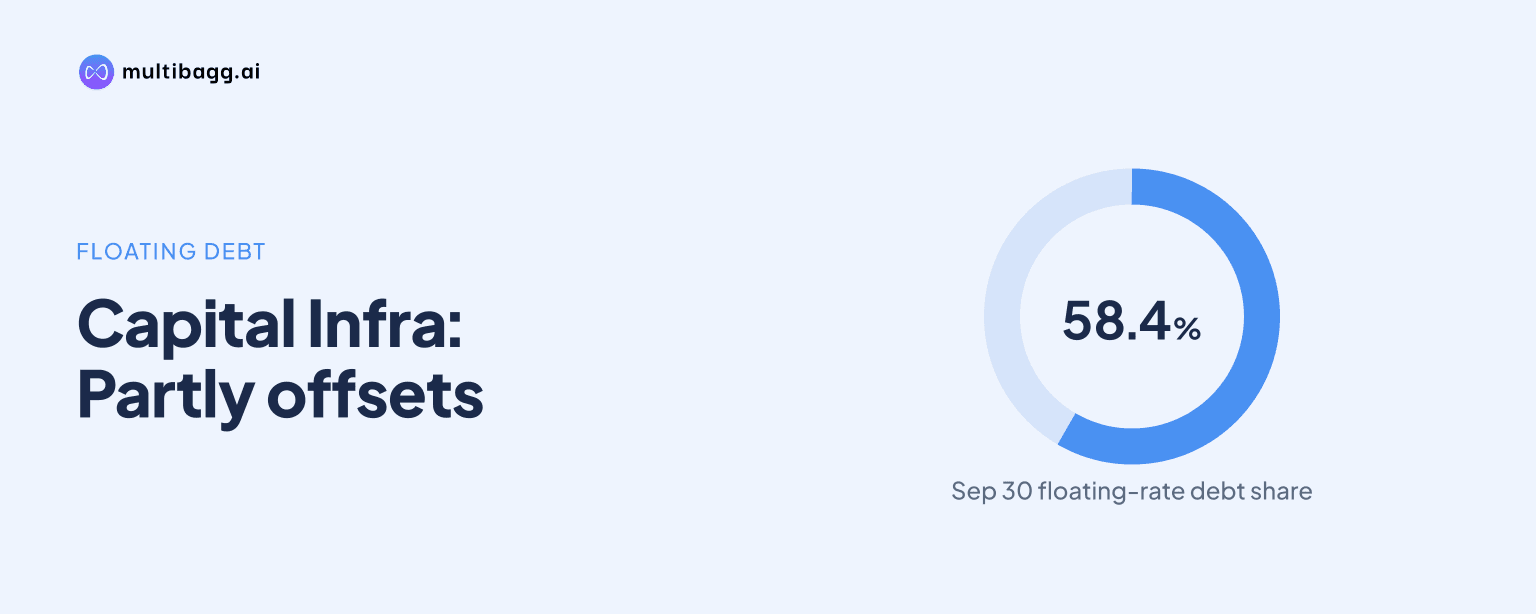
Capital Infra Trust reported that 58.4% of its debt was floating rate at 30 September 2026, while interest-linked Hybrid Annuity Model, or HAM, receipts can partly offset higher interest expense when benchmark rates rise. Its effective borrowing cost was 7.30% per annum on Rs 2,878.08 crore of debt in the stated composition.
Know Capital Infra Trust inside out
Results, valuation, peers and who's buying, in one view.
How is CIT's debt split between fixed and floating rates?
CIT had Rs 1,680.48 crore of floating-rate borrowings, or 58.4% of the Rs 2,878.08 crore debt composition reported at 30 September 2026. Those floating borrowings carried an effective rate of 7.01% per annum, below the 7.71% per annum on Rs 1,197.60 crore of fixed-rate borrowings. The blended effective borrowing cost across the stated composition was 7.30% per annum.
The presentation separately reports Rs 2,895.05 crore of gross debt and Rs 2,429.58 crore of net debt in its consolidated debt metrics at 30 September 2026. It labels the rate composition as a standalone debt mix, while the gross and net debt figures are consolidated metrics, so the two reported debt totals are not identical measures. Net debt to enterprise value, or EV, was 40.3%, and debt service coverage ratio, or DSCR, was 2.27 times.
What happens to CIT if benchmark interest rates rise?
CIT says a rise in market reference rates increases interest expense on its 58.4% floating-rate debt, while the cost of its 41.6% fixed-rate debt remains protected from that immediate rate movement. The offset is built into the HAM structure: the presentation says interest-linked annuity receipts reset with benchmark rates, creating higher receipts when the benchmark rate rises.
CIT characterises the resulting position as a partial hedge or potential upside, rather than a full offset of interest-rate exposure. The presentation does not quantify the size or timing of the receipt uplift, so it does not establish that higher HAM receipts will exactly match the increase in floating-rate interest expense. Management’s stated position is that the receipt uplift partially offsets that cost.
The presentation also describes an interest-rate up-cycle in which the Reserve Bank of India, or RBI, raised the repo rate by 25 basis points to 5.50% and adopted “calibrated tightening.” Management assessed this environment as positive for CIT because annuity interest income is linked to interest rates. That assessment depends on the contractual cash-flow mechanism and the fixed-rate portion of debt, rather than on a claim that borrowing costs will not rise.
Got a follow-up? Ask IRIS
When is CIT scheduled to repay its borrowings?
CIT lists Rs 165.70 crore of scheduled repayments within one year, Rs 289.20 crore in one to three years, Rs 277.20 crore in three to five years, and Rs 987.50 crore after five years. The largest disclosed repayment bucket is therefore the more-than-five-years category. The four buckets total Rs 1,719.60 crore based on the amounts in the repayment schedule.
During Q2FY27, CIT repaid Rs 49.77 crore. The presentation also identifies two non-convertible debentures, or NCDs, subject to put or call options: Rs 243.80 crore in Q4FY27 and Rs 914.70 crore in Q4FY28. Those options can affect the timing of repayment, making the two dates relevant alongside the standard maturity buckets.
CIT lists India Infrastructure Finance Company Limited, ICICI Bank, HDFC Bank and Union Bank of India among its lenders. Its reported credit rating was AAA Stable at 30 September 2026. The presentation does not provide the maturity, coupon or lender allocation for each borrowing, leaving the repayment buckets and NCD option dates as the disclosed indicators of the repayment profile.
Which other macro factors does CIT say affect cash flow?
CIT says inflation can increase operations and maintenance, or O&M, inflows from the National Highways Authority of India, or NHAI, while its operating expenses remain at fixed prices. It cited headline wholesale price index, or WPI, inflation of about 10% in Q2FY27 and assessed that condition positively for cash flows. This differs from the rate-linked annuity interest mechanism because it concerns inflation-linked O&M inflows and fixed O&M obligations.
For geopolitical instability, CIT assessed the effect as neutral despite Middle East tensions, crude-oil volatility and an impact on the gross domestic product outlook. Its stated rationale is that long-term contracted cash flows come through a sovereign entity and are delinked from market events. This is management’s risk assessment, and the presentation does not quantify the financial effect of oil volatility or geopolitical events on revenue, costs or debt service.
CIT also viewed slower NHAI road awards as positive for growth visibility because it has rights of first offer, or ROFO, on sponsor assets while evaluating third-party assets. The presentation describes a Rs 15,557 crore sponsor ROFO pipeline spanning 385 kilometres and a FY27 target of about Rs 10,000 crore in assets under management, or AUM. The document does not state how much new debt, if any, would fund future acquisitions.
Conclusion
CIT’s disclosed debt profile combines Rs 1,680.48 crore of floating-rate borrowings with Rs 1,197.60 crore of fixed-rate borrowings, producing a 7.30% effective borrowing cost at 30 September 2026. Management’s central point is that benchmark-linked HAM receipts can partially counter higher interest expense on the floating portion, while inflation-linked O&M inflows and fixed O&M costs provide another stated cash-flow support.
The next items to watch are the Rs 165.70 crore due within one year, the Rs 243.80 crore NCD put or call option in Q4FY27, and the Rs 914.70 crore option in Q4FY28. Management’s FY27 AUM target of about Rs 10,000 crore and its evaluation of ROFO and third-party assets will indicate whether portfolio growth changes the disclosed debt mix, repayment needs or annuity receipts.